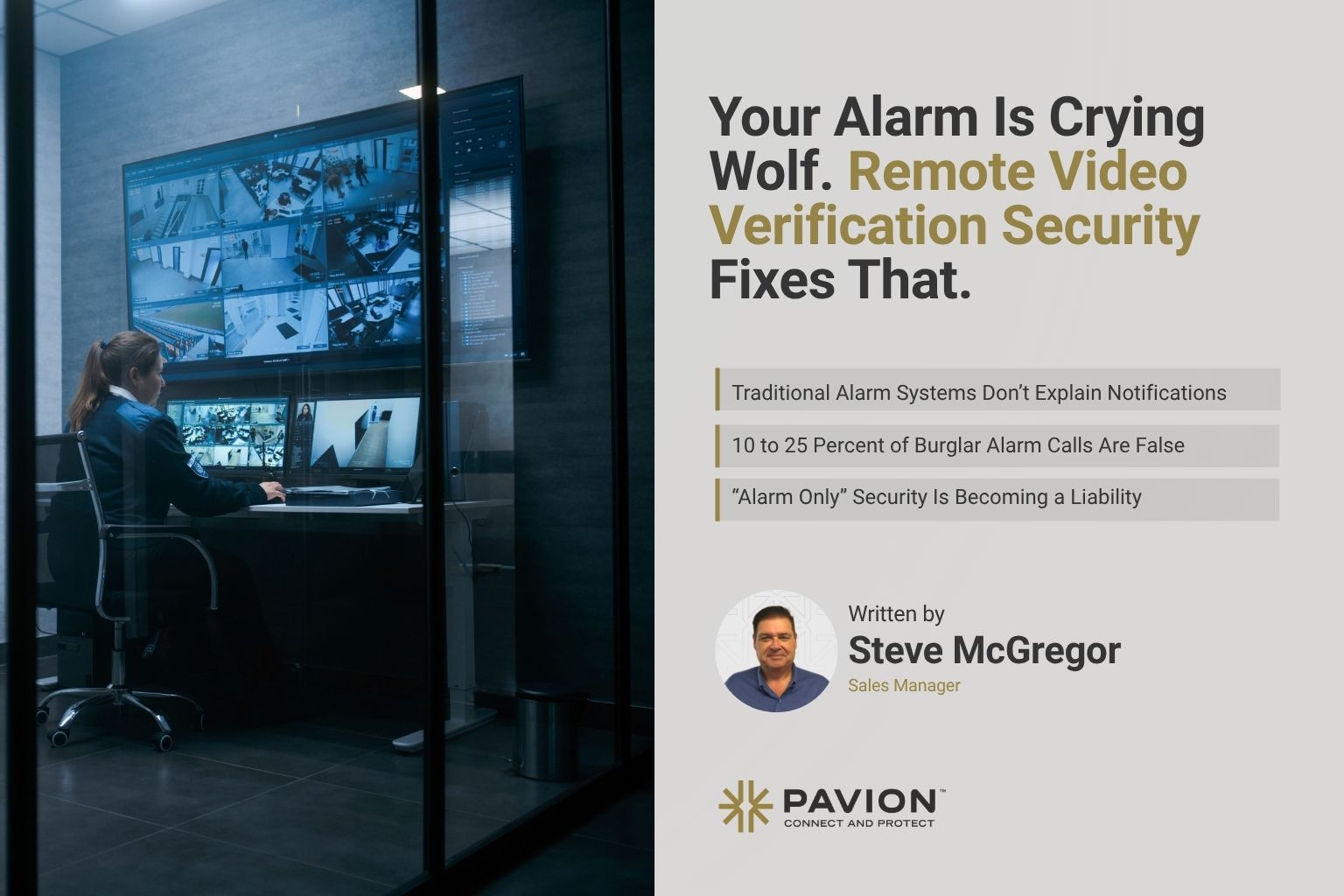
Your Alarm Is Crying Wolf. Remote Video Verification Security Fixes That.

It’s 2:14 a.m. Your intrusion alarm goes off. The monitoring center calls the police. An officer eventually shows up, walks the perimeter, and finds nothing. Maybe it was a loose door. Maybe a sensor caught a shadow, or a balloon left over from the office party.
It happens again next week. And the week after.
Here’s the uncomfortable truth: if your alarm system can’t tell the difference between a burglar and a draft, the people you count on to respond are learning to stop taking it seriously. That’s exactly the problem remote video verification security is built to solve.
The False Alarm Problem No One Wants to Talk About
Traditional alarm systems are very good at one thing: making noise. They’re much worse at explaining why.
According to the U.S. Department of Justice’s COPS Office, alarm calls make up 10 to 25 percent of all police calls for service in many cities, and the overwhelming majority of them turn out to be false. Every one of those calls ties up an officer who could be responding to a real emergency.
Police departments have responded the way you’d expect. Unverified burglar alarms usually land low on the dispatch priority list. Many jurisdictions now fine businesses for repeated false alarms, and some cities have adopted verified response policies, which means no police dispatch without proof that a crime is actually happening. Salt Lake City led that shift back in 2000, and others have followed.
So ask yourself: if your alarm goes off tonight, what evidence does anyone have that it’s real?
Why “Alarm Only” Security Is Becoming a Liability
For decades, the model was simple: sensor trips, signal goes to a central station, someone calls the police or a keyholder. That model has three big cracks in it:
- Slower response. A vague alarm competes poorly against calls that clearly describe a crime in progress.
- Rising costs. False alarm fines, wasted keyholder trips, and after-hours callouts add up fast.
- Safety risks for your team. Without video, someone often gets sent to “go check it out,” walking into an unknown situation alone at night.
And when a real break-in does happen, an alarm-only system gives you a timestamp and not much else.
What Is Remote Video Verification Security?
Remote video verification security pairs your alarm system with live and recorded video so trained operators can see what triggered an alarm before anyone is dispatched.
Pavion’s video verification solution connects video surveillance with your alarm system, so footage is available right alongside the alarm signal. That gives the people responding real-time visual confirmation of whether the threat is real. As Pavion’s electronic security team describes it, motion-activated cameras alert a monitoring station that then decides whether police are needed.
The result: verified threats get escalated with evidence. False alarms get identified and documented instead of turning into a dispatch.
How It Works
Pavion’s proactive security video monitoring follows a clear sequence:
- Intelligent software detects a potential threat.
- A trained specialist assesses and verifies it.
- If it’s real, the specialist steps in and intervenes in real time.
- The appropriate keyholders and responders are notified.
- A detailed incident report is delivered within 24 hours.
That’s the difference between “our alarm went off” and “there are two people at the loading dock door right now.”
The Business Case for Remote Video Verification
Fewer false alarms
Instant visual confirmation means only verified threats prompt a response. That cuts nuisance dispatches, fines, and wasted keyholder trips.
Faster, smarter response
With video in hand, responders know who is there, what they’re doing, and where they are. Decisions get made in seconds, not after a drive across town.
Real evidence, not just a timestamp
Cloud-based storage keeps recorded footage secure, tamper-resistant, and easy to retrieve for investigations, insurance claims, and legal follow-up.
AI that filters the noise
AI-powered analytics detect abnormal behavior and unusual activity early, so operators focus on events that actually matter.
Lower cost than on-site guards
Pavion’s 24/7 video monitoring delivers up to 75% cost savings compared to physical security guards, with false alarm reduction and intelligent analytics for intrusion and loitering events built in.
Protection for your people
Nobody on your team has to walk into the dark to check a tripped sensor. For staff working late or moving through high-risk areas, Virtual Guard & Escort Services add live monitoring and real-time assistance.
Is Recording Enough? (Spoiler: No.)
This is where we’ll push back on a common assumption: having cameras is not the same as having video security.
Most cameras record and wait. They’re great for figuring out what happened after the damage is done. They do nothing to stop it while it’s happening. If nobody is watching and nothing is verified, your camera system is really just an expensive way to document a loss.
Remote video verification turns cameras from a rearview mirror into a windshield.
Where Remote Video Verification Makes the Biggest Impact
- Retail locations dealing with after-hours theft and vandalism
- Distribution and storage sites with large yards, docks, and perimeters
- Data centers where unauthorized access carries major risk
- Healthcare facilities protecting people, pharmaceuticals, and equipment
- Property management portfolios with multiple unstaffed sites
- Construction and remote sites with expensive equipment and no one on-site overnight
Five Questions to Ask About Your Current Alarm System
- How many false alarms did we have last year, and what did they cost us?
- If our alarm goes off tonight, can anyone see what triggered it?
- Do our local police require verification before they dispatch?
- Who on our team gets sent to check an alarm, and is that safe?
- If something happens, will we have usable video evidence in the first minute?
If those answers made you uneasy, it’s time to rethink how your alarms get verified.
The Bottom Line
An alarm that can’t prove what’s happening is just noise, and noise gets ignored. Remote video verification security replaces guesswork with evidence, so real threats get a faster response and false alarms stop draining your budget and your credibility.
Pair it with central station monitoring, ON-X Proactive System Monitoring, and integrated access control, and you have a security program that sees, verifies, and acts around the clock.
Pavion helps organizations stay connected and protected, with security that responds to what’s actually happening.
Ready to stop crying wolf?
Contact Pavion to schedule a personalized consultation today.
Frequently Asked Questions
What is remote video verification security?
Remote video verification security combines your alarm system with live and recorded video so trained operators can visually confirm whether an alarm is a real threat before dispatching police or keyholders. Learn more about Pavion’s video verification services.
How does video verification reduce false alarms?
When an alarm triggers, operators review the camera footage tied to that location. If there’s no real threat, the event is documented instead of dispatched, which cuts down on nuisance calls, fines, and unnecessary trips.
Do police respond faster to video-verified alarms?
Verified alarms give dispatchers clear evidence of a crime in progress, which typically earns a higher priority than an unverified alarm. Response policies vary by jurisdiction, so check your local requirements.
Can video verification work with my existing alarm and camera system?
In many cases, yes. Pavion’s video verification is designed to integrate with existing alarm and access control systems, making the most of the infrastructure you already have.
What’s the difference between video verification and proactive video monitoring?
Video verification is triggered by an alarm event. Proactive video monitoring uses intelligent analytics and trained specialists to watch for suspicious activity and intervene in real time, even before a traditional alarm goes off.
Is remote video monitoring cheaper than on-site security guards?
For many organizations, yes. Pavion’s video monitoring services offer up to 75% cost savings over physical security guards while providing 24/7 coverage.
Can I view my video and alerts remotely?
Yes. Pavion’s cloud-based solution offers access to live and recorded video from mobile or desktop, along with instant notifications and video clips sent to your device.
What industries benefit most from remote video verification?
Retail, distribution and storage, data centers, healthcare, property management, and any site that sits unstaffed after hours. Contact Pavion to find out what fits your facility.