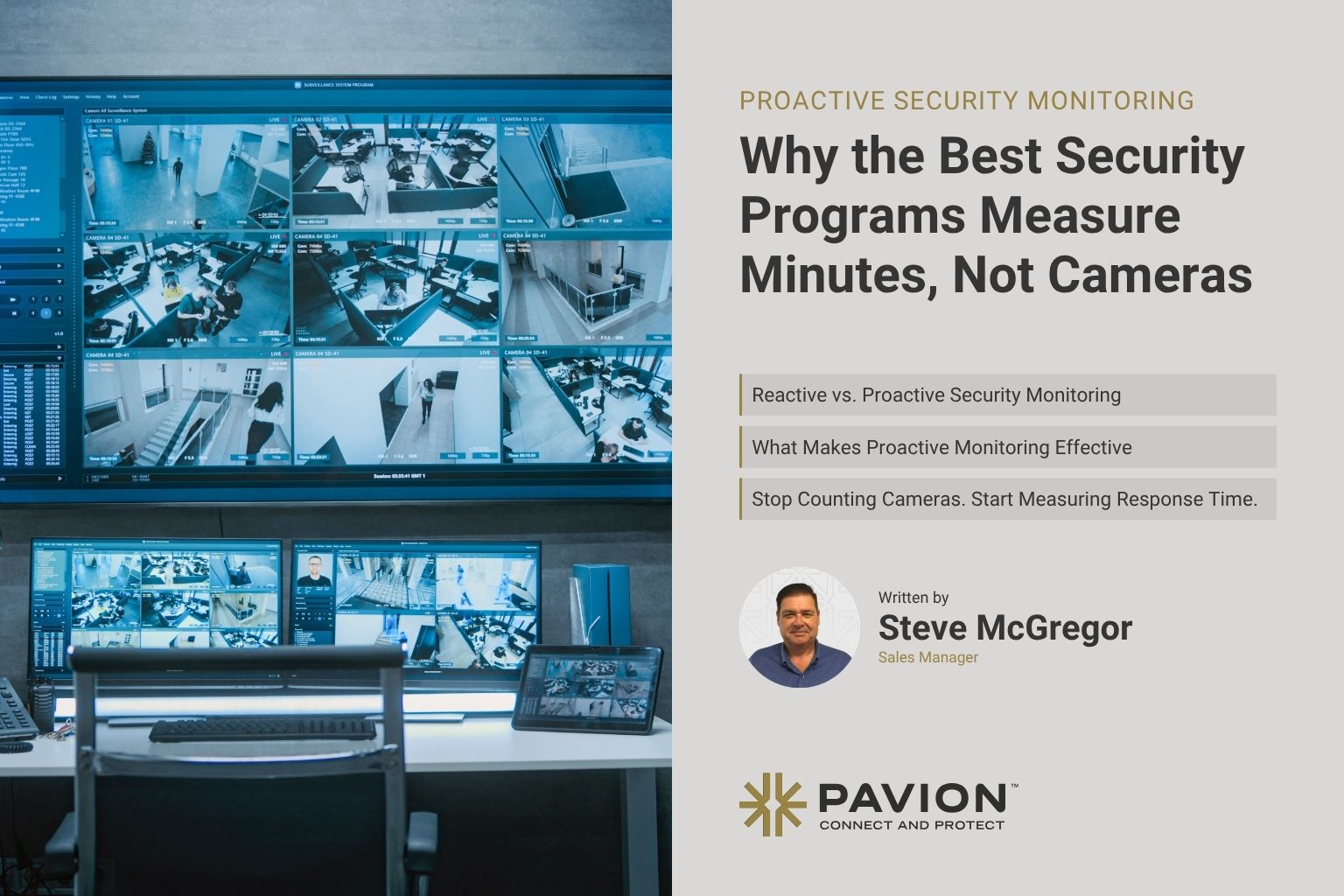
Proactive Security Monitoring Systems: Why the Best Security Programs Measure Minutes, Not Cameras

More cameras don’t automatically mean better security.
It’s a reality many organizations overlook when evaluating their security investments. For years, businesses have measured the strength of their security programs by the technology they own: more cameras, more access points, better resolution and more sophisticated alarm systems.
But there’s a critical difference between having the technology to detect a threat and having a strategy to respond to it. A camera can capture an incident in perfect detail. An alarm can notify the right people. But if nobody verifies the threat or takes action in time, what has that technology actually prevented?
The real measure of an effective security program isn’t how much it can see. It’s how quickly it can respond.
That’s why proactive security monitoring systems are changing how organizations approach protection, shifting the focus from collecting footage and generating alerts to identifying threats, verifying activity and taking action before incidents escalate.
Your Security System Might Be Working. But Is It Protecting You?
A business can have hundreds of cameras, sophisticated access control systems and a fully functioning alarm system and still be vulnerable. Why? Because detecting an incident and responding to it are two very different things.
Consider what happens during a typical security event:
- An incident begins. Someone enters a restricted area, forces open a door or approaches a property after hours.
- Technology detects activity. A camera records movement or a sensor triggers an alarm.
- Someone evaluates the threat. A monitoring specialist or security team determines whether action is necessary.
- A response begins. An intervention, notification or escalation occurs.
The real risk often exists between steps two and four. A camera may capture suspicious behavior immediately, but what happens if nobody is watching? An alarm might sound, but what if the person responsible for responding doesn’t know whether it’s a genuine threat?
These aren’t necessarily failures of individual devices. They’re gaps in the overall security strategy. That’s why forward-thinking organizations are shifting their attention from the number of devices installed to the speed and effectiveness of their response.
The Hidden Cost of Reactive Security
Traditional security has largely been built around documenting incidents. A break-in occurs. Footage is reviewed. An investigation follows. While that information is valuable, it comes after the organization has already been exposed to potential loss.
The consequences can extend well beyond stolen equipment or damaged property. A security incident can disrupt operations, create employee safety concerns, expose sensitive areas and require hours of investigation and recovery.
False alarms create their own challenges. Repeated unnecessary alerts contribute to alarm fatigue, wasted resources and preventable dispatches. According to research from the U.S. Department of Justice’s Office of Community Oriented Policing Services (COPS Office), false alarms have historically represented a significant portion of police calls for service in many communities.
An effective security program should do more than tell you something happened. It should help determine what’s happening, whether it matters and what needs to happen next. That’s the fundamental value of proactive security monitoring.
Reactive vs. Proactive Security Monitoring: What’s the Difference?
Reactive security focuses on documenting and responding to events after they’re detected. Proactive security monitoring emphasizes early identification, timely verification and coordinated intervention.
Security Capability
Reactive Security
Proactive Security Monitoring
Threat detection
Records activity or generates alarms
Identifies potential threats for real-time review
Video surveillance
Primarily supports incident investigation
Supports live assessment and intervention
Alarm verification
May rely on manual follow-up
Uses available video and event context
Incident response
Often begins after a reported event
Can begin while an incident is unfolding
System maintenance
Often depends on periodic checks
Can identify equipment issues automatically
Performance measurement
Equipment and recordings
Response times, uptime and outcomes
The goal isn’t to eliminate traditional security technologies. It’s to make them work together more effectively, turning cameras, alarms and access control into a connected strategy designed to turn information into action.
What Makes Proactive Security Monitoring Systems Effective?
Technology alone doesn’t make a security program proactive. The strongest programs combine intelligent detection, human expertise and continuous system oversight.
1. Intelligent Video Analytics That Recognize Potential Threats
Security teams don’t need more alerts. They need better information. Traditional motion detection can generate notifications for everything from passing headlights to weather conditions. When unnecessary alerts become routine, meaningful events become harder to identify.
AI-powered video analytics help by evaluating activity against defined rules and behaviors. For example, analytics may identify:
- A person entering a restricted area after business hours
- A vehicle remaining near a loading dock longer than expected
- Movement across a secured perimeter
- Someone lingering near a sensitive entrance
Rather than relying on someone watching a screen, intelligent analytics surface potentially important events for review, so security teams can focus their attention where it’s needed most. Learn more about how AI-powered video analytics go beyond traditional motion detection.
2. Trained Specialists Who Turn Alerts Into Action
Detecting suspicious activity is only the beginning. A security system becomes significantly more valuable when a qualified person can quickly evaluate an event and initiate an appropriate response.
With Pavion’s proactive security video monitoring, intelligent software identifies a potential threat and trained monitoring specialists assess and verify the activity. When intervention is appropriate, specialists act according to established procedures, including live audio intervention where supported, notifying keyholders or escalating to authorities. Incident reports are provided within 24 hours, and alarm events are supported by Pavion’s UL Listed central station monitoring.
Consider someone approaching a fenced storage yard after closing. In a traditional setup, the activity might be recorded and reviewed the following morning. With proactive monitoring, an alert prompts a specialist to assess the situation while it’s happening and initiate the appropriate response. That difference creates an opportunity to interrupt suspicious activity before it escalates.
3. Continuous Monitoring of the Security System Itself
Here’s a question many organizations overlook: What happens when the technology you’re relying on to protect your business stops working?
A camera goes offline. A recording device fails. An access control component stops communicating. Without visibility into system health, those problems may go unnoticed until an incident occurs.
Pavion ON-X Proactive System Monitoring helps organizations monitor the health and performance of connected security infrastructure through cloud-based monitoring, anomaly detection and actionable system insights. By identifying technology problems earlier, organizations can reduce the risk of prolonged gaps in protection.
Together, these three capabilities answer three essential questions: What’s happening? Does it require action? Is our security technology ready when we need it?
Ready to see what proactive monitoring looks like in practice?
Explore Pavion ON-X Proactive System Monitoring to catch security system issues before they create gaps in protection.
Why Connected Electronic Security Delivers Better Results
Consider a common challenge. An access-controlled door is forced open at a commercial facility after business hours. The intrusion system generates an alert. The access control platform records a door event. A nearby camera captures the activity.
If those systems operate independently, someone may need to gather information from multiple platforms before understanding what occurred. When electronic security systems are properly integrated, the monitoring team receives the alarm alongside relevant video and access information. That context helps specialists decide whether the event requires intervention, escalation or further investigation.
The difference isn’t the amount of technology installed. It’s how effectively the technology communicates. Integrating access control monitoring, remote video monitoring and intrusion detection improves situational awareness and creates greater consistency across multiple facilities. Explore how Pavion’s commercial security solutions bring these technologies together.
Stop Counting Cameras. Start Measuring Response Time.
Security leaders are often asked to justify investments with equipment inventories and installation costs. Those metrics matter, but they don’t tell the full story. A better approach is to measure how well the security program performs when something goes wrong.
Time to Detection
How long does it take for suspicious activity to generate an alert? The earlier a possible threat is identified, the more opportunity there is to respond.
Time to Verification
Once an alert is generated, how quickly can someone determine whether it’s a genuine concern? Faster verification reduces unnecessary escalation while legitimate events get attention.
Time to Intervention
How much time passes between a verified event and the first meaningful response? This measures what the security program actually does with the information it receives.
System Uptime and Availability
What percentage of critical cameras, controllers and other security devices are functioning as intended? A system that isn’t operational can’t provide the protection an organization expects.
False Alarm Rate
How many alerts are non-actionable, and how often do they lead to unnecessary dispatches? Tracking this helps organizations improve detection rules and response procedures.
The most valuable security dashboard may not be the one displaying the most cameras. It may be the one showing how quickly threats are identified, verified and addressed.
Could Your Security Program Respond Fast Enough?
If you’re unsure how quickly your organization could detect, verify and respond to an incident, that’s an important gap to investigate. Talk with a Pavion security specialist to review your current approach and identify opportunities to improve response.
The Business Value of Proactive Security Monitoring Goes Beyond Loss Prevention
More Efficient Security Spending
Maintaining physical security coverage across multiple buildings or properties can become expensive. Remote video monitoring can provide a cost-effective alternative or complement to certain on-site guarding functions. Pavion’s 24/7 remote video monitoring offers potential cost savings of up to 75% compared with physical security guards, depending on the application.
Improved Employee Safety
After-hours incidents can put employees in uncomfortable or unsafe situations. Rather than asking someone to investigate a suspicious alarm alone, organizations can use remote monitoring to assess the situation first. Pavion’s Virtual Guard and Escort Services add oversight for employees entering, leaving or moving through certain areas.
Greater Operational Visibility
Video analytics support more than investigations. The same infrastructure may provide insight into occupancy, movement patterns and facility activity. See how in AI Video Surveillance: How Analytics Turn Security into Business Intelligence.
More Predictable Maintenance and Support
With proactive system monitoring and managed security services, organizations gain visibility into device performance, catch issues earlier and plan service more effectively. A security monitoring as a service model can also make technology, monitoring and support costs more predictable, depending on the agreement.
Together, these benefits show why proactive monitoring is more than a security expense. It’s an investment in operational resilience, visibility and business continuity.
Which Organizations Have the Most to Gain?
- Retail: Identify suspicious activity, monitor vulnerable entrances and support after-hours loss prevention.
- Distribution and Warehousing: Monitor large perimeters, loading docks and outdoor storage.
- Healthcare: Strengthen oversight of sensitive access points and protect patients, employees and visitors.
- Data Centers: Improve visibility into restricted areas while monitoring the reliability of security infrastructure.
- Commercial Property Management: Support multiple properties, shared entrances, parking areas and sites with limited staffing.
- Education and Government: Improve visibility across facilities and establish consistent, documented response procedures.
While the applications differ, the objective is the same: identify potential problems earlier and respond more effectively.
Is Your Security Program Actually Proactive? Ask These Five Questions.
1. If suspicious activity occurred at one of our facilities tonight, who would know about it? Would an alert be reviewed immediately, or would someone discover the footage the next morning?
2. How quickly can our team verify whether an alarm is a real threat? Does the process provide enough information to make an informed decision?
3. What happens after an event is verified? Who is responsible for intervening, notifying stakeholders or escalating?
4. How would we know if a critical camera or security device stopped working? Is system health monitored continuously, or are failures found during inspections or incident reviews?
5. Are we measuring security outcomes or simply counting equipment? Can leadership see how quickly incidents are detected, verified and addressed?
Your Next Security Investment Should Improve Outcomes, Not Just Add Equipment
The number of devices an organization owns doesn’t necessarily indicate how well it’s protected. The more important questions are whether those devices provide useful information, whether someone can act on it and whether the systems stay reliable when they’re needed most.
Proactive security monitoring systems shift the focus from documenting incidents to earlier detection, faster verification and meaningful intervention. The next evolution of security won’t be defined by image resolution or device count. It will be defined by how effectively organizations turn security intelligence into action.
How Long Would It Take Your Security Program to Respond?
You may already have the cameras, access control and intrusion detection in place. The question is whether they’re working together to deliver the protection your organization needs. Whether you’re responsible for one facility or a nationwide portfolio, Pavion can help you connect and protect what matters most.
Don’t wait for an incident to reveal a gap in your security program. Request a security assessment from Pavion today.
Frequently Asked Questions
What are proactive security monitoring systems?
Proactive security monitoring systems use AI video analytics, intrusion detection, remote monitoring and human verification to identify potential threats and support timely responses. They may also include system health monitoring to catch equipment issues before they affect security operations.
How is proactive security monitoring different from traditional video surveillance?
Traditional video surveillance is mainly used to record and investigate incidents. Proactive security video monitoring uses intelligent detection and trained specialists to evaluate suspicious activity while it occurs and intervene when appropriate.
Can proactive security monitoring reduce false alarms?
Yes. Video verification and intelligent analytics help specialists confirm whether alerts are genuine before escalating them, reducing unnecessary responses and dispatches.
Can proactive monitoring work with existing security cameras and access control?
In many cases, yes. Compatibility depends on existing cameras, video management software, network infrastructure and monitoring requirements. A professional assessment can determine which capabilities can be added without replacing the entire system.
What is the difference between proactive video monitoring and system health monitoring?
Proactive video monitoring focuses on identifying and responding to activity at a property. System health monitoring, like Pavion ON-X, focuses on the condition and performance of security infrastructure, including device connectivity and other technical issues.
Is remote video monitoring more cost-effective than security guards?
It can be, depending on the facility and its requirements. Pavion’s video monitoring offers potential savings of up to 75% compared with physical guards. Remote monitoring may replace certain guarding duties or complement existing personnel.
How can I tell whether my business needs proactive security monitoring?
Review how your organization detects suspicious activity, verifies alarms, responds to incidents and monitors equipment health. If there are delays or gaps between those stages, contact Pavion to discuss your current systems.