AI-Powered Video Analytics: Beyond Motion Detection

For decades, video surveillance systems have served a relatively straightforward purpose: capture footage, detect movement, and provide a record of what happened. Security teams relied on cameras to monitor facilities and review recordings after an incident occurred.
That approach is changing.
Today, organizations are looking for more than video footage. They want systems that can identify potential threats, recognize patterns, improve workplace safety, and provide information that helps them make better operational decisions.
AI-powered video analytics is helping transform traditional surveillance from a reactive security tool into a proactive source of business intelligence.
Modern video analytics can do far more than recognize movement within a camera’s field of view. Depending on the technology and configuration, these systems can identify unusual activity, monitor occupancy trends, detect potential safety violations, and uncover inefficiencies that might otherwise go unnoticed.
The opportunity is significant, but so is the need to understand what these technologies can realistically accomplish.
Why Traditional Motion Detection Is No Longer Enough
Traditional motion detection was an important advancement in video surveillance, but it has limitations.
Conventional motion-based systems typically respond to changes within an image. A moving vehicle, shifting shadows, weather conditions, or an animal passing through a monitored area can all generate an alert.
The challenge is that detecting movement does not necessarily explain its significance.
A delivery truck entering a loading dock during normal business hours may be expected. The same activity occurring in a restricted area after hours may warrant immediate attention.
Traditional motion detection does not inherently understand that distinction.
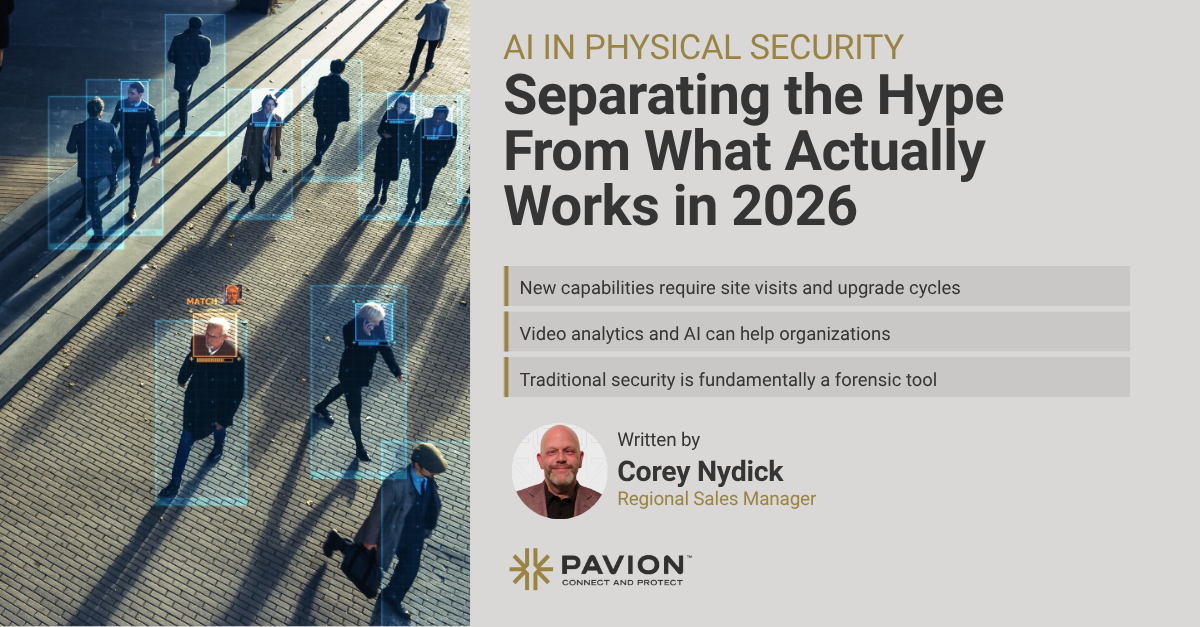
AI-powered video analytics takes a more sophisticated approach by using computer vision and machine learning to identify objects, classify activities, and evaluate events against predefined rules.
Instead of simply asking whether something moved, an intelligently configured system can help answer more meaningful questions:
- Is someone remaining in a restricted area longer than expected?
- Has a person or vehicle crossed a designated perimeter?
- Are occupancy levels approaching an established threshold?
- Is required personal protective equipment visibly missing?
- Are repeated traffic patterns contributing to operational bottlenecks?
This shift from basic detection to contextual analysis is helping organizations extract greater value from their existing security infrastructure.
Five Ways AI-Powered Video Analytics Is Changing Security and Operations
1. Loitering Detection: Identifying Potential Risks Earlier
Not every security concern begins with a forced entry or an obvious intrusion.
In many environments, unusual behavior can develop gradually. Someone may remain near a restricted entrance, repeatedly approach a secured area, or spend an extended period in a location where prolonged activity is uncommon.
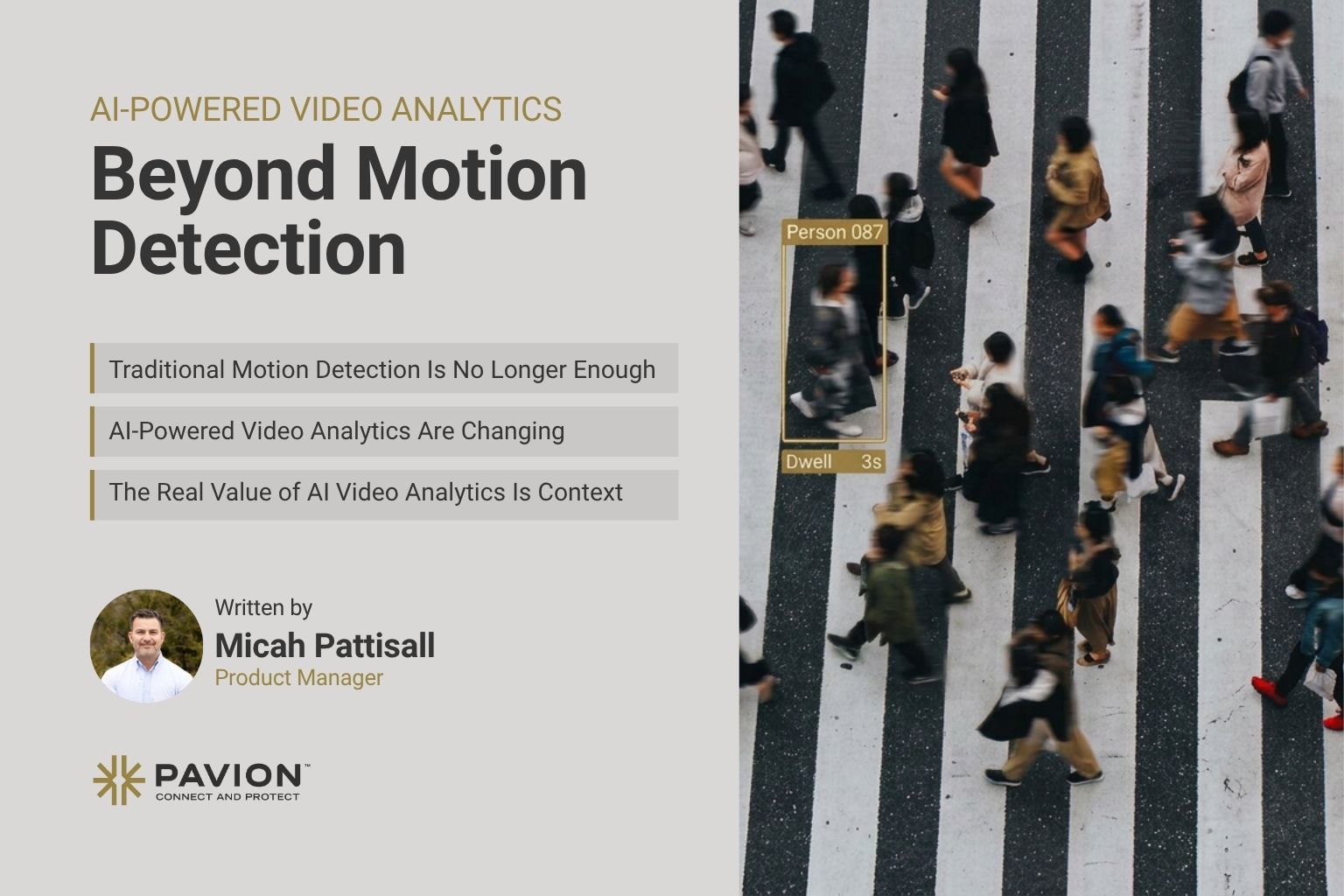
AI-powered video analytics can help identify these situations through configurable dwell-time monitoring and predefined activity zones.
For example, a commercial property may establish an alert when an individual remains near a closed loading entrance beyond a specified period.
Rather than relying on security personnel to continuously observe every camera feed, the system can flag the activity for further review.
This capability can be particularly useful in parking facilities, logistics centers, commercial buildings, and other environments with large or distributed security footprints.
However, loitering detection should not automatically equate prolonged presence with suspicious intent. Effective deployments establish reasonable thresholds, account for normal site activity, and maintain human oversight when evaluating alerts.
The value is not simply detecting that someone is present. It is helping security personnel recognize when a particular activity deserves attention.
2. Occupancy Analytics: Turning Foot Traffic Into Actionable Insights
Video analytics is increasingly valuable outside traditional security applications.
Occupancy monitoring and people-counting capabilities can help organizations understand how employees, customers, and visitors move through physical spaces.
With appropriately positioned cameras and analytics software, businesses can assess foot traffic, monitor capacity thresholds, and identify patterns in space utilization.
Consider a large corporate campus.
Occupancy analytics may reveal that certain entrances experience significantly greater traffic during shift changes, while other access points remain underutilized.
That information can help facility managers evaluate staffing needs, adjust visitor management processes, and improve building operations.
In retail environments, similar analytics can provide insight into customer traffic patterns and queue congestion. In healthcare facilities, occupancy information can support planning for waiting areas and other shared spaces.
Over time, these insights may help organizations make more informed decisions about resource allocation, building layouts, and operational efficiency.
The distinction is important: video analytics is no longer exclusively about identifying threats. It can also help organizations better understand how their physical environments are being used.
3. PPE Compliance Monitoring: Supporting a Safer Workplace
Workplace safety is another area where AI-powered video analytics offers practical applications.
In manufacturing plants, warehouses, construction environments, and other industrial facilities, employees may be required to wear personal protective equipment (PPE), including hard hats, safety vests, and other protective gear.
Depending on the system, video analytics can identify visible PPE and flag situations where required equipment appears to be missing within a monitored area.
For example, an industrial facility could configure analytics to identify individuals entering a designated work zone without a visible hard hat.
The system could then generate an alert for a safety supervisor to review.
This provides another layer of visibility, particularly in facilities where supervisors cannot physically observe every location at all times.
However, automated PPE detection has important limitations. A camera may identify whether certain equipment appears to be present, but it cannot necessarily determine whether that equipment is properly fitted, suitable for a particular hazard, or being used correctly.
AI analytics should therefore support, rather than replace, established safety procedures, training, inspections, and human judgment.
When implemented appropriately, these capabilities can help safety teams identify recurring concerns and determine where additional education or preventive action may be needed.
4. Perimeter Intrusion Detection: Improving Situational Awareness
Protecting a facility’s perimeter has always been a critical component of physical security.
Traditional approaches often rely on fences, intrusion sensors, access control systems, and security patrols.
AI-powered video analytics adds another layer by monitoring defined boundaries and identifying people or vehicles that cross virtual lines or enter restricted zones.
Consider a distribution center with a large outdoor storage yard.
A conventional system may generate alerts based on movement across several cameras, leaving operators to determine which events are relevant.
An AI-enabled system can be configured to distinguish between certain object types and monitor specific areas based on operational requirements.
For example, vehicle activity near an authorized entrance during regular operating hours may be treated differently from a person entering a restricted yard overnight.
When connected with video management, access control, or other security platforms, these alerts can provide additional information that helps personnel assess an event and respond appropriately.
The effectiveness of perimeter analytics depends on several factors, including camera positioning, lighting, environmental conditions, object classification accuracy, and system configuration.
Even advanced analytics requires ongoing evaluation and adjustment to maintain dependable performance.
5. Operational Analytics: Finding Inefficiencies That Cameras Already See
One of the most promising applications of AI-powered video analytics has relatively little to do with traditional security.
Organizations already capture substantial amounts of video across warehouses, manufacturing facilities, commercial buildings, transportation hubs, and other operational environments.
Much of that footage is never reviewed unless an incident occurs.
Video analytics creates an opportunity to use appropriately collected visual information to identify recurring operational patterns.
In a distribution facility, for example, analytics may help reveal congestion around loading docks, excessive vehicle dwell times, or recurring bottlenecks in material movement.
In a commercial office building, traffic analysis may support decisions about entrance configurations, lobby staffing, or visitor flow.
In retail environments, queue monitoring can help managers understand when additional service capacity may be needed.
These capabilities do not automatically solve operational problems. Their value comes from translating observations into measurable insights that managers can evaluate and act upon.
When security and operations teams collaborate, video analytics can become a shared resource for improving both protection and business performance.
The Real Value of AI Video Analytics Is Context, Not More Alerts
One of the misconceptions surrounding artificial intelligence in physical security is that more automated detection necessarily produces better outcomes.
In reality, an increased volume of alerts can become another operational burden if those alerts are not meaningful.
Security operators already manage information from cameras, access control systems, intrusion alarms, and other connected technologies.
Introducing AI analytics without a clear strategy can create additional complexity rather than reduce it.
A more effective approach begins with defining the problem that analytics is intended to solve.
For example, an organization concerned about unauthorized after-hours activity should prioritize accurate detection within designated zones rather than deploying every available analytic feature.
Similarly, a facility focused on occupancy management should determine which metrics will actually support staffing, capacity planning, or customer experience decisions.
Organizations should also establish how alerts will be reviewed, who is responsible for responding, and how performance will be measured.
The goal should not be to automate every observation.
The goal should be to provide the right information to the right people at the right time.
Why Integration Matters More Than Individual AI Features
AI-powered video analytics is often marketed through individual capabilities: people counting, object recognition, intrusion detection, or behavioral monitoring.
But the value of these features can be limited when they operate independently of the broader security environment.
An analytics alert that remains isolated within a camera interface may require an operator to manually locate additional footage, review access records, and contact personnel before determining what happened.
An integrated security environment can help connect those steps.
For example, when video analytics detects activity near a secured entrance, an integrated solution may allow authorized personnel to review corresponding video, evaluate access control events, and follow an established response workflow from a more centralized environment.
This can improve situational awareness and reduce the need to navigate disconnected systems.
However, integration should be evaluated carefully. Not every camera, analytics platform, or video management system supports the same features or interoperability standards.
Organizations should consider compatibility, cybersecurity, data management, and long-term scalability before selecting technology.
The strongest strategy is not necessarily the one with the most AI capabilities. It is the one that aligns those capabilities with the organization’s existing infrastructure, security objectives, and operational processes.
What Organizations Should Consider Before Investing in AI-Powered Video Analytics
While AI analytics offers meaningful opportunities, successful implementation requires planning.
Organizations should evaluate several important considerations before deployment.
Define measurable objectives. Determine whether the primary goal is faster incident detection, fewer nuisance alarms, improved occupancy visibility, workplace safety support, or operational efficiency.
Assess existing infrastructure. Camera resolution, positioning, lighting, network capacity, and video management compatibility can influence system performance.
Test analytics in real-world conditions. Algorithms should be evaluated under the actual environmental and operational conditions in which they will be used.
Establish privacy and governance requirements. Organizations should consider applicable laws, data retention policies, access permissions, cybersecurity controls, and appropriate use of video-derived information.
Maintain human oversight. AI-generated classifications and alerts should support informed decision-making rather than automatically determine intent, responsibility, or compliance.
Measure results over time. Alert accuracy, false-positive rates, response workflows, operator feedback, and business outcomes should be reviewed regularly.
These considerations are especially important because AI performance can change as site conditions, workflows, and environments evolve.
Successful deployment is an ongoing process, not simply a software installation.
The Future of Video Analytics: From Surveillance to Business Intelligence
The evolution of video analytics reflects a broader shift occurring across physical security.
Organizations increasingly expect security technology to contribute to business resilience, workplace safety, customer experience, and operational performance.
AI-powered video analytics is one example of how that convergence is taking shape.
As computer vision capabilities continue to mature, organizations may gain more opportunities to connect visual insights with access control, building management, incident response, and other enterprise systems.
The long-term value will depend less on the number of features available and more on how effectively organizations turn those capabilities into practical outcomes.
Security leaders should be asking a different set of questions.
Not simply, “What can our cameras detect?”
But rather, “What information do we need to protect our people, operate more efficiently, and make better decisions?”
That is where the next stage of intelligent video analytics begins.
Building a Smarter Approach to Video Security
AI-powered video analytics represents a significant evolution in how organizations use physical security technology.
From loitering and perimeter intrusion detection to occupancy monitoring, workplace safety support, and operational insights, modern analytics can transform cameras from passive recording devices into more valuable sources of information.
However, technology alone does not create a successful security strategy.
Organizations need to identify relevant use cases, evaluate the capabilities and limitations of available solutions, integrate technologies effectively, and establish clear processes for acting on the information they generate.
At Pavion, we understand that intelligent security requires more than deploying advanced technology. It requires connecting the right solutions with the people, processes, and infrastructure that support the organization’s broader objectives.
Ready to explore how intelligent video analytics can strengthen your security strategy and support operational performance? Connect with Pavion to discuss solutions aligned with your organization’s needs.
Frequently Asked Questions About AI-Powered Video Analytics
What is AI-powered video analytics?
AI-powered video analytics uses artificial intelligence, computer vision, and machine learning to analyze video footage and identify predefined objects, activities, patterns, or events. Unlike basic motion detection, advanced analytics can distinguish certain object types and evaluate activity against rules such as restricted-area entry, occupancy thresholds, or dwell times.
How is AI video analytics different from traditional motion detection?
Traditional motion detection generally identifies changes or movement within a camera’s field of view. AI video analytics can provide additional context by recognizing people, vehicles, objects, and certain behaviors. This allows security teams to configure more specific alerts and potentially reduce irrelevant notifications.
Can AI video analytics detect loitering?
Yes. Supported video analytics systems can identify when a person or object remains within a designated area for longer than a configured period. Loitering detection can help security teams monitor entrances, parking facilities, restricted zones, and other sensitive locations. Alerts still require appropriate context and human review.
How does AI video analytics improve perimeter security?
AI-powered perimeter analytics can identify people or vehicles entering restricted areas or crossing virtual boundaries. When integrated with broader security systems, these detections can help operators investigate potential intrusions, review relevant footage, and coordinate an appropriate response.
Can AI-powered cameras monitor PPE compliance?
Certain AI video analytics solutions can detect visible protective equipment, including hard hats and high-visibility vests, and flag potentially missing items. However, these systems cannot independently confirm full PPE compliance or replace workplace safety inspections, training, and qualified supervision.
How can video analytics improve business operations?
Video analytics can help organizations analyze foot traffic, occupancy levels, queue lengths, vehicle dwell times, and movement patterns. These insights may support staffing decisions, space utilization, facility management, and process improvements, depending on the environment and analytics capabilities.
Can AI video analytics work with existing security cameras?
In some cases, yes. Certain analytics platforms can process video from compatible existing IP cameras or video management systems. However, capabilities depend on camera quality, hardware resources, network infrastructure, integration support, and the specific analytics software being deployed. A technical assessment can help determine whether upgrades are necessary.
Is AI-powered video analytics accurate?
Accuracy varies depending on the analytic function, technology, camera placement, lighting, environmental conditions, and configuration. Organizations should evaluate performance in their actual deployment environment, monitor false positives and missed detections, and regularly review system effectiveness.
Does AI video analytics replace security personnel?
No. AI-powered analytics is best used to support security teams by highlighting relevant events and providing additional information for review. Human personnel remain essential for interpreting context, making decisions, responding to incidents, and maintaining accountability.
What industries benefit from AI-powered video analytics?
AI video analytics can support organizations across manufacturing, logistics, healthcare, retail, commercial real estate, education, transportation, and other industries. The most valuable applications depend on each organization’s security risks, operational environment, and business objectives.