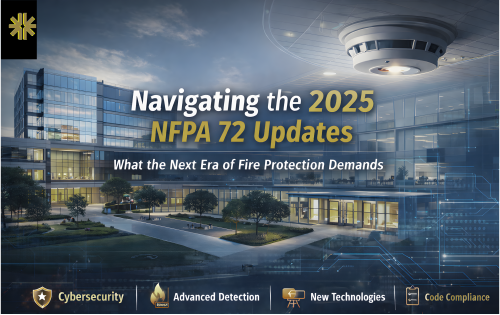
Navigating the 2025 NFPA 72 Updates: What the Next Era of Fire Protection Demands

Every three years, updates to NFPA 72 – the National Fire Alarm and Signaling Code – redefine the standards that shape the fire protection landscape. The 2025 edition marks one of the most significant evolutions in recent memory, blending traditional fire science with emerging technologies. Below, we cover what NFPA 72 requires today, what’s changing in the 2025 edition, and what it means for compliance going forward.
What Is NFPA 72?
NFPA 72 is the National Fire Alarm and Signaling Code, published by the National Fire Protection Association (NFPA). It sets the requirements for how fire alarm, mass notification, and other emergency communication systems are designed, installed, tested, and maintained in buildings across the United States.
Rather than a single fixed rulebook, NFPA 72 is a living code – reviewed and updated on a three-year cycle to reflect new detection technologies, real-world incident data, and lessons learned in the field. Most jurisdictions adopt a specific edition of NFPA 72 through their state or local fire code, so the edition that applies to a given building depends on when local authorities last updated their adopted code.
For building owners, facility managers, and compliance officers, NFPA 72 answers three practical questions: what detection and notification equipment a space requires, how often that equipment must be inspected and tested, and what documentation proves the system meets code.
What NFPA 72 Requires: Testing, Inspection, and Documentation
Beyond installation, NFPA 72 sets ongoing requirements for keeping a fire alarm system in compliance – commonly referred to as Inspection, Testing, and Maintenance (ITM).
Smoke detectors and other initiating devices are subject to periodic functional testing and sensitivity checks, with required intervals that vary by device type and system configuration. Notification appliances, control panels, and monitoring connections to a central station are tested on their own schedules as well.
Because these intervals differ by component and can shift between code editions, the most reliable approach for most organizations is a documented ITM schedule maintained by a qualified fire alarm services provider, rather than a single blanket testing calendar for the whole system.
The NFPA 72 Record of Completion
When a new or modified fire alarm system passes acceptance testing, NFPA 72 requires a Record of Completion – a standardized form that documents the system’s design, the equipment installed, and the tests performed, and confirms the installation matches the approved plans and applicable code requirements.
The Record of Completion is typically prepared jointly by the system designer and installer, then reviewed by the authority having jurisdiction (AHJ) as part of final acceptance. For facility managers, keeping this record current and accessible is one of the most direct ways to demonstrate compliance during an inspection or insurance review.
If your organization cannot locate a Record of Completion for an existing system, that is usually a sign the system’s documentation history has gaps worth closing before the next inspection cycle.
Accessing the NFPA 72 Code
NFPA makes the full text of NFPA 72 available to read for free through its official website, though a purchased copy is required to download or print the code. Because code language and section numbering shift between editions, always confirm which edition – for example, 2022 or 2025 – applies to your jurisdiction before citing a specific requirement. Read NFPA 72 online at nfpa.org.
What’s New in the 2025 Edition
- Cybersecurity requirements for connected systems
- New device classes, including acoustic leak and thermal image fire detectors
- Enhanced smoke detection standards for high-ceiling environments
- New notification modes for spaces with sound-sensitive populations
These updates reflect the growing complexity of modern facilities and the demand for adaptive, intelligent detection methods.
Raising the Bar for Compliance
Stricter enforcement of fire codes — driven by AHJs, insurers, and federal funding for public safety — is reshaping how both owners and integrators approach compliance. Where once meeting code was sufficient, today’s projects are expected to demonstrate future-readiness, cyber resilience, and operational transparency through digital reporting and analytics.
This shift is not a burden — it’s an opportunity. By embracing modern standards early, organizations can reduce long-term liability, improve inspection outcomes, and strengthen their overall risk posture.
Toward a Smarter, Safer Future
The pace of change in fire protection is accelerating. First draft meetings for the 2028 NFPA 72 revision are already underway, with more focus on intelligent systems, automation, and cross-domain integration.
For an industry historically defined by stability, the next few years represent an inflection point — one where innovation and compliance intersect to create a new era of intelligent life safety.
FAQs: Understanding NFPA 72 and the 2025 Updates
What is NFPA 72 and why does it change every three years?
NFPA 72 is the National Fire Alarm and Signaling Code, which establishes requirements for the design, installation, testing, and performance of fire alarm and emergency communication systems. It is updated on a three-year cycle to reflect new research, technologies, and real-world safety lessons.
What are some of the most important changes in the 2025 edition?
Key updates include new cybersecurity requirements for connected and networked life-safety systems, new detector classifications such as acoustic leak and thermal image detectors, enhanced smoke detection guidance for high-ceiling environments, and new notification approaches for sound-sensitive spaces and occupants.
Why are cybersecurity requirements being added to NFPA 72?
As fire alarm and signaling systems become more connected to enterprise networks and cloud environments, cyber risk becomes a life-safety risk. The 2025 updates emphasize security, access control, and system hardening to prevent unauthorized access or disruption.
How do the 2025 changes affect building owners and facility managers?
Owners are increasingly expected to demonstrate not just code compliance, but preparedness for emerging risks — including digital reporting, data visibility, documented maintenance, and cyber-resilient system infrastructure. Early adoption can improve inspection outcomes and reduce liability exposure.
What do these updates mean for integrators and contractors?
Integrators must account for new device classes, documentation standards, and cybersecurity considerations in system design, commissioning, and lifecycle support. The shift encourages more collaborative planning with AHJs, insurers, and IT stakeholders.
Will existing systems need to be upgraded immediately?
Not necessarily. Most upgrades occur when renovating, expanding, or installing new systems — however, AHJs, insurers, or risk assessments may recommend earlier improvements where safety gaps, performance issues, or connectivity risks are identified.
How do these changes support high-ceiling and special-environment applications?
The 2025 edition strengthens guidance around alternative detection technologies and design strategies for atriums, warehouses, industrial spaces, and other tall or complex environments where traditional smoke detection may be less effective.
What trends are expected in future NFPA 72 editions?
Early discussions for the 2028 cycle point toward greater emphasis on intelligent detection, automation, analytics, and integration with building, security, and communication platforms — continuing the movement toward smarter, interconnected life-safety ecosystems.
Where can organizations get help interpreting or preparing for the new requirements?
Working with an experienced fire and life-safety partner can help evaluate system readiness, plan upgrades, and align technology decisions with both current code and anticipated future changes.
What does NFPA 72 stand for?
NFPA 72 stands for the National Fire Alarm and Signaling Code. It’s published by the National Fire Protection Association (NFPA) and referenced by most U.S. jurisdictions as the standard for fire alarm and emergency communication system design, installation, and maintenance.
What is a NFPA 72 Record of Completion, and who fills it out?
The Record of Completion is a standardized form confirming that a newly installed or modified fire alarm system matches its approved design and meets applicable code requirements. It’s typically completed jointly by the system designer and installer, then reviewed by the authority having jurisdiction (AHJ) as part of final acceptance.
Where can I read or access the NFPA 72 code?
NFPA provides free, read-only access to the full text of NFPA 72 on its official website. A purchased copy is required to download or print the code for reference.
How often does a fire alarm system need to be tested under NFPA 72?
Testing intervals vary by device type, system configuration, and the edition of NFPA 72 your jurisdiction has adopted – a qualified fire alarm services provider can confirm the exact schedule that applies to your system.