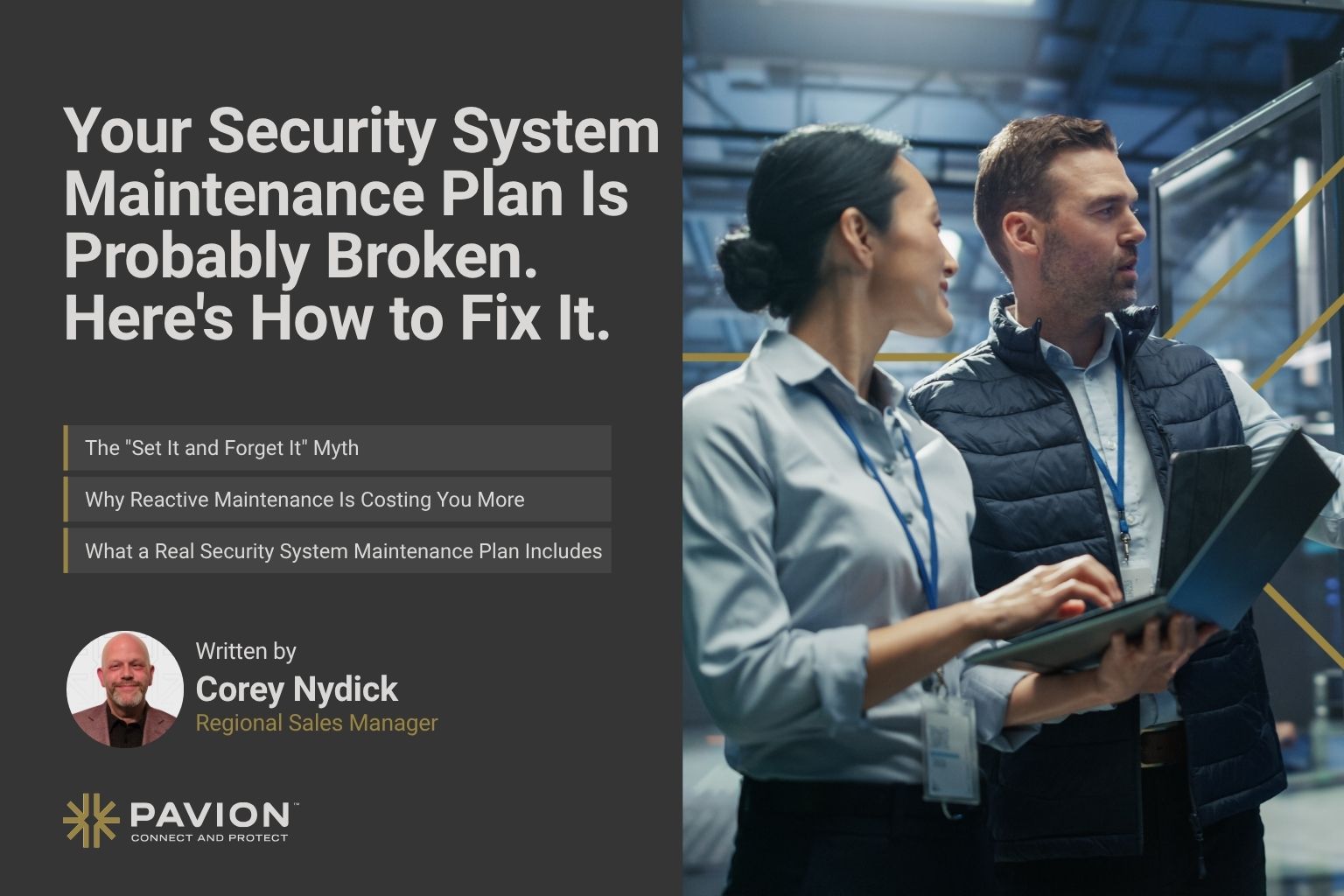
Your Security System Maintenance Plan Is Probably Broken. Here’s How to Fix It.

Here’s something most security providers won’t say out loud: the day your access control system goes live is the best it will ever perform without maintenance. After that, it starts to slip.
A reader stops scanning reliably. A camera loses focus. A door controller misses a firmware update. A former employee’s badge still works months after their last day. None of these set off an alarm, and nobody sends you an email about them. Your system just keeps showing green while your actual protection gets weaker.
If your business doesn’t have a real security system maintenance plan, or if yours is a once-a-year walkthrough with a clipboard, it’s worth asking an uncomfortable question: are you protected, or does it just look that way?
The “Set It and Forget It” Myth
Many organizations treat commercial security systems like a one-time capital project. They budget for it, install it, sign off on it, and move on.
But access control, video surveillance, and intrusion detection aren’t furniture. They’re networked technology that depends on software, firmware, credentials, power, and connectivity, and all of those change over time. Treating security as “done” after installation is like buying a car and never changing the oil. It runs fine right up until it doesn’t, and the failure tends to come at the worst possible moment.
Why Reactive Maintenance Is Costing You More Than You Think
The traditional model is simple: something breaks, you call for service. It feels cheaper because you only pay when there’s a problem.
The trouble is that in security, you usually find the problem after the incident. That’s when you pull footage and learn the camera has been offline for weeks. Or you investigate a theft and discover the door was propped open with no alert. Or an auditor asks for access logs and they’re incomplete.
Reactive maintenance doesn’t actually cost less. It moves the cost to a point where it’s larger and harder to recover from, and includes:
- Emergency service calls at premium rates
- Lost or missing evidence when it matters most
- Compliance gaps that surface during audits
- Liability exposure if you can’t show your system was working
- Operational disruption when doors, readers, or gates fail during business hours
What a Real Security System Maintenance Plan Includes
A strong plan isn’t a checklist you pull out once a year. It’s an ongoing partnership built around uptime, visibility, and risk reduction. Here’s what to look for.
1. Proactive monitoring, not just repairs
Your system should be watched continuously so issues are caught before they turn into incidents. Pavion’s ON-X Proactive System Monitoring uses cloud-based automation for anomaly detection and performance monitoring, backed by dedicated technicians 24/7.
2. Firmware, software, and patch management
Outdated firmware is one of the most overlooked risks in physical security. Access control and video systems live on your network, and unpatched devices can open the door to cyber threats. Pavion’s access control and security managed services include risk, patch, and vulnerability management.
3. Credential and user audits
Who has access right now? Not who should have access, but who actually does. Regular credential reviews close the gap between your HR records and your door permissions.
4. Preventive inspections and testing
Readers, locks, door hardware, controllers, cameras, and power supplies all wear out. Scheduled testing finds degradation before it turns into downtime.
5. Live eyes on your property
Cameras that record but don’t alert are only useful after the fact. With proactive security video monitoring, intelligent software detects threats, specialists verify them and step in in real time, and incident reports are delivered within 24 hours. Pair that with central station monitoring for round-the-clock protection against unauthorized entry.
6. Audit trails and compliance support
In regulated industries like healthcare, financial services, government, and data centers, being able to prove your system works is as important as having it work. A detailed record of access events makes audits easier and strengthens your position if something goes wrong.
7. Predictable costs
You shouldn’t have to dread a surprise invoice every time something fails. That’s where the as-a-service model comes in.
Security Monitoring-as-a-Service: A Smarter Way to Maintain Security
This is where we’ll push back a little on the old way of doing things: buying a security system outright and then maintaining it piecemeal may no longer be the best financial decision for many organizations.
With Pavion’s subscription-based security services, hardware, software, and maintenance are bundled into one predictable monthly fee. Terms run from 36 to 60 months, and add-ons and end-of-term choices keep your system current instead of locked into aging technology.
Instead of asking “What’s it going to cost to fix this?” the question becomes “How do we make sure this never breaks unnoticed?” That changes the relationship. Your provider is accountable for uptime, not just repairs.
Pavion’s approach includes:
- Technology updates to stay ahead of new threats
- Seamless integration with your existing infrastructure
- 24/7 support and expert training so your team can use the system to its full potential
- 24/7 video monitoring with real-time intervention and false alarm reduction
- Subscription maintenance and support that protects your investment and maximizes uptime
Five Questions to Ask About Your Current Plan
If you’re not sure whether your security system maintenance plan is doing its job, start here:
- When was the firmware on my access control panels last updated?
- How would I find out if a camera went offline tonight?
- Do any former employees or contractors still have active credentials?
- Could I produce a complete access log for an auditor tomorrow?
- Do I know what security maintenance will cost me next year?
If any of these made you pause, you’re not alone, and you’re not out of options.
The Bottom Line
Security systems rarely fail loudly. They wear down quietly, a missed update, an expired credential, or a dead camera at a time, until the day you actually need them.
A modern security system maintenance plan keeps your protection real instead of just apparent. It combines proactive monitoring, regular updates, credential management, and predictable costs, backed by a partner who’s accountable for keeping your system running.
Pavion helps organizations stay connected and protected every day, not just on installation day.
Ready to find out where your security really stands?
Contact Pavion to schedule a personalized consultation today.
Frequently Asked Questions
What is a security system maintenance plan?
A security system maintenance plan is an ongoing service agreement that keeps your access control, video surveillance, and intrusion detection systems working as designed. It typically includes proactive monitoring, preventive inspections, firmware and software updates, credential audits, and priority repair support.
How often should a commercial security system be maintained?
Continuous monitoring is ideal, because many failures happen silently between scheduled visits. On top of that, most businesses benefit from regular preventive inspections, with frequency based on system size, risk level, and industry compliance requirements. A provider like Pavion can recommend the right schedule for your facility.
What’s the difference between reactive and proactive security maintenance?
Reactive maintenance means fixing equipment after it fails, often after an incident has already exposed the problem. Proactive maintenance uses monitoring and scheduled testing to catch issues before they cause downtime. ON-X Proactive System Monitoring is designed to flag anomalies early so they can be addressed quickly.
Why do access control systems need firmware updates?
Access control panels, readers, and software are network-connected devices. Firmware and software updates fix bugs, improve performance, and close security vulnerabilities that could be exploited. Skipping updates leaves both your physical and digital security exposed.
What is Security Monitoring-as-a-Service?
Security Monitoring-as-a-Service is a subscription model that bundles hardware, software, monitoring, and maintenance into one predictable monthly fee. Pavion’s subscription services offer terms from 36 to 60 months with flexible add-ons and end-of-term options.
Is a subscription security model more cost-effective than buying a system outright?
For many organizations, yes. A subscription lowers upfront costs, removes surprise repair bills, and keeps technology current over the life of the agreement. The best fit depends on your budget, facility needs, and long-term plans.
Can a maintenance plan work with my existing security system?
In many cases, yes. Pavion evaluates existing infrastructure and focuses on integrating with the systems you already have. Contact Pavion for an assessment of your current setup.
Does a maintenance plan include video monitoring?
It can. Pavion’s proactive video monitoring adds intelligent threat detection, real-time intervention by trained specialists, and incident reports within 24 hours.