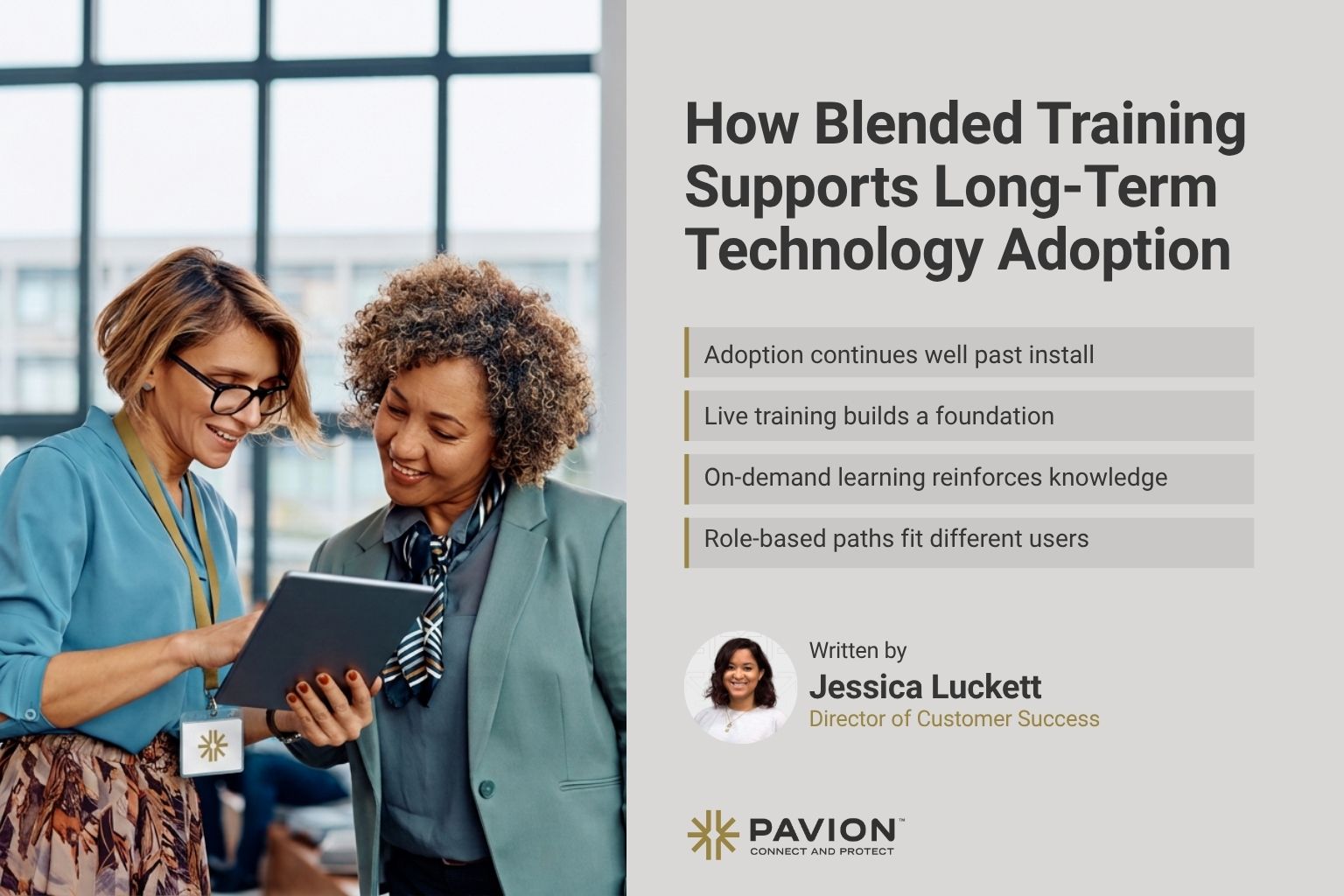
How Blended Training Supports Long-Term Technology Adoption

Organizations are investing in advanced fire, security, and integrated technologies to improve safety, communication, and operational efficiency. However, implementing a system is only the beginning. Long-term success also depends on providing employees with the education and resources they need to use the technology effectively in their day-to-day roles.
Instructor-led training, onsite education, live walkthroughs, and go-live support provide an essential foundation. Interactive learning can build on this foundation by giving users flexible, on-demand resources that support ongoing education as roles, teams, and systems evolve.
At Pavion, we believe the most effective training strategies combine live education with continuous learning opportunities that support customers throughout the lifecycle of their technology.
Technology Training Is an Ongoing Need
Employee training needs continue well after installation is complete. Organizations must account for ongoing changes, including:
- Staff turnover and the onboarding of new employees
- Multiple shifts with different training schedules
- Teams working across several departments or locations
- System updates, new features, and changing workflows
- Annual competencies and operational procedures
These challenges make it difficult for a single training session to address every user’s needs indefinitely.
Providing continued access to training resources can help organizations maintain consistent processes, support new employees, and keep teams informed as technology and workflows change.
Building on Instructor-Led Education
Live, instructor-led training remains a critical part of a successful technology deployment. It gives users the opportunity to interact directly with knowledgeable trainers, ask questions, review real-world workflows, and receive guidance tailored to their environment.
Interactive learning is not intended to replace instructor-led education. Instead, it complements existing training strategies by providing flexible, on-demand resources employees can access when needed.
A blended training approach can combine:
- Instructor-led classroom or virtual education
- Onsite training and live system walkthroughs
- Go-live support
- Video-based learning resources
- Interactive learning modules
- Role-specific training paths
- Knowledge checks and guided exercises
- Refresher and competency-based training
Interactive training modules are offered through an annual subscription and give customers greater control over ongoing training management. Organizations can track employee completion and compliance directly, helping them maintain visibility into who has completed required training.
Knowledge checks are also built into the learning experience, giving organizations a way to assess understanding rather than relying solely on passive video viewing.
Supporting Onboarding, Retention, and Continuous Learning
One of the most valuable applications of interactive training is its ability to extend education beyond the initial project team.
When employees leave or change roles, organizations must train new users without always having access to the original instructor or project resources. On-demand learning materials can help create a more consistent onboarding experience and reduce reliance on informal, peer-to-peer knowledge transfer.
Interactive resources can also support:
- New employee onboarding
- Refresher training for existing users
- Annual education and competency requirements
- Training following software or system updates
- Education following workflow or policy changes
- Employees working different shifts
- Consistent training across multiple locations
By making relevant education available when employees need it, organizations can provide ongoing access to important information without waiting for the next formal training session.
Addressing Different Roles and User Needs
Fire, security, communications, and integrated technology systems often support several departments and user groups. Each group may interact with the system differently and require a different level of knowledge.
For example:
- Security personnel may need detailed operational and incident-response training.
- Administrators may focus on reporting, permissions, and system oversight.
- Frontline employees may need guidance on specific daily workflows.
- IT teams may require system management and integration visibility.
- Leadership may need access to performance data and operational insights.
Role-based learning paths can help ensure users receive information that is relevant to their responsibilities while maintaining consistent standards across the organization.
This focused approach can make training more manageable for employees by concentrating on the functions and information most relevant to their roles.
A Long-Term Strategy for Technology Value
Training should not be viewed as a single project milestone. As employees, workflows, and technologies change, organizations need a way to provide education that can evolve with them.
Instructor-led education establishes the foundation, while interactive and on-demand learning provide additional flexibility for onboarding, refresher training, system updates, and recurring education requirements.
By combining live education with flexible, self-paced learning opportunities, organizations can create a more sustainable training strategy that supports employees throughout the technology lifecycle.
The Bottom Line
Technology delivers the greatest value when employees have the knowledge and resources needed to use it effectively.
A blended training strategy combines the strengths of instructor-led education with the accessibility of interactive, on-demand learning. With annual subscription-based interactive modules, customers can manage training completion, track compliance, and use built-in knowledge checks to help confirm employee understanding.
Together, these training options give organizations a more flexible way to support onboarding, recurring education, system changes, and long-term technology use.