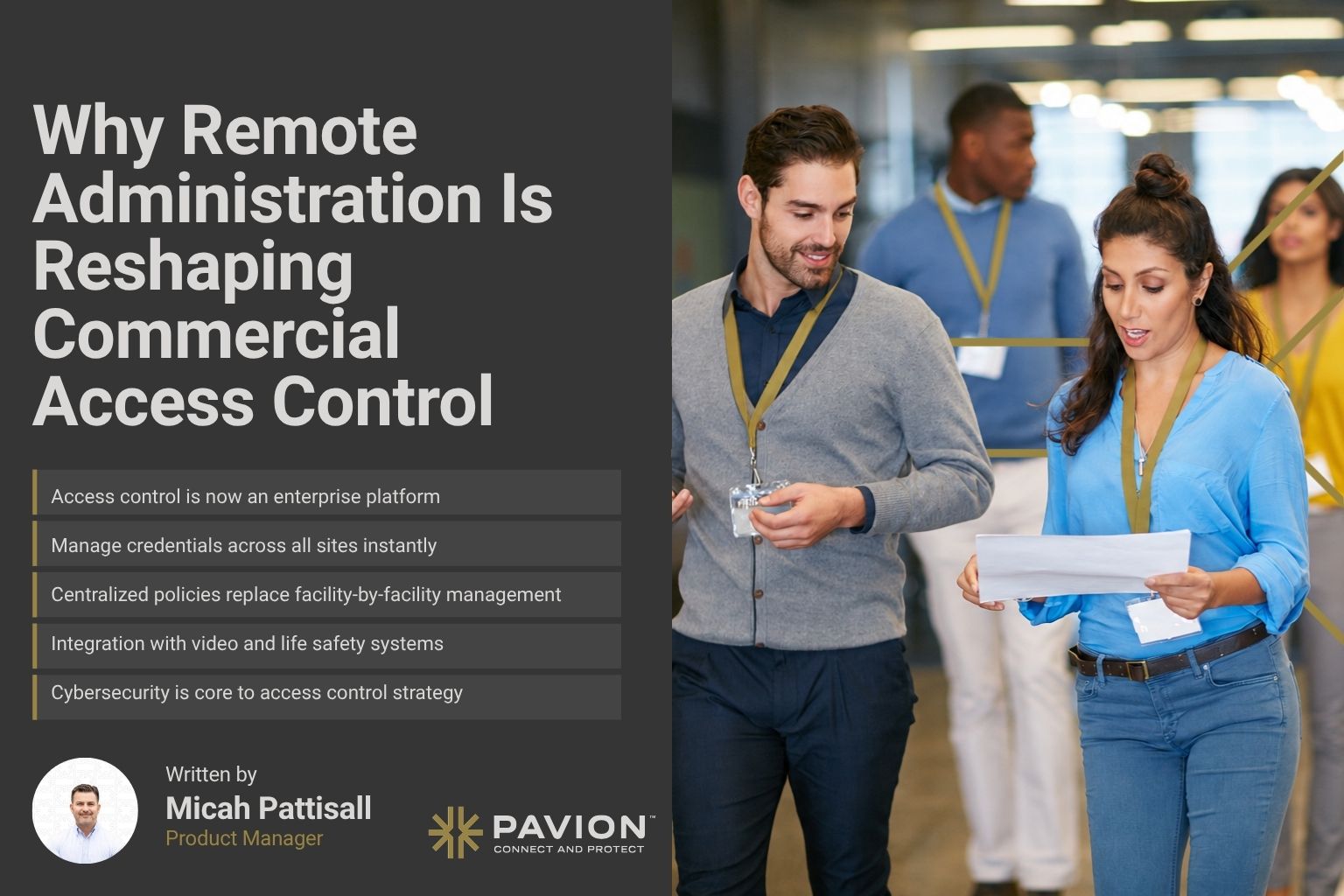
Why Remote Administration Is Reshaping Commercial Access Control
Commercial access control systems are no longer used solely to secure doors. They are becoming centralized security platforms that help organizations improve operational efficiency, strengthen cybersecurity, maintain consistent policies, and manage risk across distributed environments.
Remote access control administration allows authorized security teams to manage users, credentials, permissions, doors, and system activity across multiple locations from a unified platform. For organizations with corporate offices, healthcare facilities, manufacturing sites, retail locations, campuses, or other geographically dispersed properties, this centralized approach can provide greater visibility, consistency, and control.
As security environments grow more complex, remote administration is becoming an essential component of a scalable commercial access control strategy.
Why Organizations Need Centralized Access Control
Organizations today operate across more locations and workforce models than ever before. Security leaders may be responsible for protecting people, property, and assets across facilities that span cities, states, or countries.
At the same time, security teams are being asked to:
- Support hybrid and distributed workforces
- Manage employee, contractor, and visitor access
- Maintain consistent security policies
- Respond to incidents quickly
- Support regulatory and reporting requirements
- Accomplish more with limited personnel and resources
Traditional access control models, in which each facility is managed independently, can become difficult to maintain as an organization expands. Disconnected systems may create inconsistent permissions, slower response times, limited visibility, and additional administrative work.
Modern commercial access control systems with secure remote administration offer a more scalable and coordinated alternative.
Security Management Is Becoming More Centralized
Historically, access control was often managed at the individual building level. Local personnel handled badge creation, credential changes, access permissions, and system updates for their specific location.
While this approach may work for smaller organizations, it can create challenges as the number of facilities, employees, contractors, and credentials grows.
Employees may transfer between offices. Contractors may need temporary access to several sites. Organizations may acquire new facilities or expand into new markets. Each change requires coordination, and without centralized visibility, security gaps or policy inconsistencies can emerge.
Remote access control administration helps address these challenges by enabling security teams to oversee access across the organization from a centralized platform.
Authorized administrators can manage:
- User identities and credentials
- Access permissions and schedules
- Doors and restricted areas
- Alarm and entry activity
- Temporary and contractor access
- System health and administrative changes
Instead of maintaining separate processes for every location, organizations can establish a more consistent enterprise-wide security program.
What Are the Benefits of Remote Access Control Administration?
The benefits of remote administration extend beyond convenience. A centralized platform can improve operational efficiency, reduce risk, accelerate incident response, and support business continuity.
Faster Credential Management
Administrators can issue, update, suspend, or revoke credentials without being physically present at the affected facility.
Consider an employee who leaves the organization unexpectedly. In a decentralized environment, security personnel may need to contact several locations to remove the employee’s access.
With centralized access control, authorized administrators can revoke that individual’s credentials across all connected facilities from one platform. This can reduce the amount of time the credential remains active and help limit unnecessary risk exposure.
Consistent Security Policies
Remote administration allows organizations to establish standardized access policies across multiple locations.
Security teams can apply consistent rules based on:
- Job responsibilities
- Facility type
- Access level
- Time of day
- Employment status
- Contractor or visitor requirements
Standardization helps reduce the likelihood of outdated, excessive, or inconsistent access permissions.
Real-Time Security Visibility
Centralized platforms can provide security teams with a broader view of activity across the enterprise.
Depending on the system and configuration, administrators may be able to monitor:
- Door status
- Access attempts
- Forced-open or held-open doors
- Restricted-area activity
- Credential usage
- Alarm conditions
- Administrative changes
This visibility can help teams identify unusual activity and respond to potential security incidents more quickly.
Reduced Dependence on Local Resources
Remote management reduces the need for every facility to maintain its own dedicated access control administrator.
Local teams can continue supporting day-to-day operations while centralized security personnel handle system-wide permissions, policy changes, reporting, and incident coordination.
Stronger Business Continuity
Remote access can help security operations continue during emergencies, facility closures, severe weather, staffing disruptions, or other events that prevent administrators from reaching a location.
Authorized personnel can evaluate activity, adjust permissions, secure doors, and support incident response from another approved location.
The Business Value of Centralized Commercial Access Control
Improved protection is often the primary reason organizations invest in access control, but centralized administration can also create significant operational value.
A remotely managed commercial access control system can help organizations:
- Reduce administrative work for local teams
- Improve response times during security events
- Standardize policies across facilities
- Simplify employee onboarding and offboarding
- Improve visibility into access activity
- Support hybrid and distributed workforces
- Strengthen business continuity planning
- Improve audit preparation and reporting
- Scale security operations as the business grows
By reducing repetitive administrative tasks, security teams can dedicate more attention to higher-value activities such as risk assessment, compliance management, system planning, and security strategy.
Integrated Security Systems Improve Situational Awareness
Another major development in physical security is the transition from standalone systems to connected security ecosystems.
Organizations increasingly expect access control to integrate with technologies such as:
- Video surveillance
- Intrusion detection
- Visitor management
- Intercom and communication systems
- Identity management platforms
- Monitoring solutions
- Fire and life safety systems
When these systems are integrated effectively, security teams gain more context around events.
For example, an unauthorized access attempt could trigger a corresponding video feed, alert designated personnel, record the incident, and initiate an established response workflow. This can reduce the time required to verify events and improve the accuracy of incident investigations.
Integration also helps reduce the operational friction caused by managing multiple isolated platforms. A well-designed integrated security strategy can create a more coordinated, scalable, and responsive security environment.
Cybersecurity Must Be Part of Access Control Planning
As commercial access control systems become more connected, cybersecurity must be considered alongside physical security.
Access control platforms may contain sensitive information about employees, credentials, facility layouts, access schedules, system activity, and security policies. Protecting this information is essential.
Organizations evaluating remote access control solutions should consider capabilities such as:
- End-to-end encryption
- Multi-factor authentication for administrators
- Role-based administrative permissions
- Secure credential and identity management
- Timely software updates and security patches
- Detailed audit logs and reporting
- Network segmentation
- Secure remote connectivity
- Alignment with recognized frameworks such as NIST and ISO 27001
Organizations should also establish clear policies defining who can administer the system, which actions they may perform, and how administrative activity will be monitored.
The convergence of physical and digital security means protecting a facility also requires protecting the technology, networks, identities, and data used to manage it.
How Remote Access Control Supports Growing Organizations
Centralized administration is particularly valuable for organizations experiencing growth, consolidation, or operational change.
A scalable access control platform can make it easier to support:
- New locations
- Mergers and acquisitions
- Employee transfers
- Temporary facilities
- Changing workplace policies
- Contractor and vendor access
- Expanding regulatory requirements
- Centralized security operations centers
Rather than creating a separate security process each time the organization adds a facility, security leaders can incorporate new locations into an established access control framework.
This approach can improve consistency while reducing the administrative complexity associated with growth.
The Future of Commercial Access Control Is Centralized and Intelligent
The future of commercial access control is being shaped by several interconnected trends, including:
- Cloud-connected platforms
- Mobile credentials
- Centralized security operations
- Artificial intelligence
- Predictive analytics
- Identity-based security policies
- Automated incident workflows
- Greater integration between physical and digital systems
Remote administration provides the foundation for many of these capabilities. It allows organizations to manage security at scale without proportionally increasing administrative complexity.
As access control technology evolves, organizations with centralized and adaptable systems may be better positioned to respond to:
- Organizational growth and acquisitions
- Emerging cybersecurity threats
- New regulatory requirements
- Workforce and workplace changes
- Increasing demand for real-time information
- More complex security environments
Remote administration is no longer simply an optional feature. For many organizations, it is becoming a defining requirement for modern enterprise access control.
Build a More Centralized and Scalable Security Strategy
As organizations expand and security demands become more complex, centralized control over identities, credentials, permissions, and system activity is essential.
A properly designed remote access control system can help improve security, streamline administration, support faster responses, and provide greater visibility across the enterprise. When integrated with video surveillance, intrusion detection, monitoring, and life safety technologies, access control can become a core component of a more connected security ecosystem.
However, successful implementation requires more than selecting a platform. Organizations must also evaluate system architecture, cybersecurity, integrations, administrative policies, user workflows, and long-term support requirements.
Pavion helps organizations evaluate, design, integrate, and support commercial access control solutions for complex and distributed environments.
Contact Pavion today to discuss how centralized access control and remote administration can support your organization’s security, operational, and growth objectives.
Frequently Asked Questions About Remote Access Control
What is remote access control administration?
Remote access control administration is the ability for authorized personnel to manage credentials, permissions, doors, schedules, alarms, and system activity from a secure location without being physically present at the facility.
Can access control be managed across multiple locations?
Yes. Modern enterprise access control platforms can allow security teams to manage multiple facilities through a centralized interface. Available capabilities depend on the platform, system architecture, network configuration, and security policies.
What are the benefits of centralized access control?
Centralized access control can improve policy consistency, credential management, incident response, reporting, administrative efficiency, business continuity, and visibility across multiple facilities.
Is remote access control secure?
Remote access control can be implemented securely when supported by appropriate safeguards such as encryption, multi-factor authentication, role-based permissions, secure network architecture, software patching, and detailed audit logging.
Can access control integrate with video surveillance?
Yes. Many commercial access control systems can integrate with video surveillance, intrusion detection, visitor management, identity platforms, and other security technologies. Integration can help teams verify access events and coordinate incident response more effectively.
Is cloud-based access control the same as remote administration?
Not necessarily. Cloud-based access control commonly supports remote administration, but some on-premises or hybrid systems may also offer secure remote-management capabilities. The best architecture depends on the organization’s security, operational, compliance, and infrastructure requirements.