AI Security Cameras Are Redefining Modern Security Standards

The role of AI security cameras is expanding rapidly as organizations move beyond traditional surveillance toward intelligent, proactive protection. In Dallas, for example, police use a network of AI-powered license-plate reading cameras to help identify vehicles tied to crimes, recover stolen vehicles, and locate missing people, highlighting how AI security is becoming a foundational component of modern safety strategies.
This shift reflects a broader trend across industries: security systems are no longer expected to simply record events. They are expected to analyze activity in real time, surface meaningful insights, and support faster, more informed response.
Why AI Security Is Gaining Momentum
Traditional security cameras rely on continuous human monitoring and post-incident review. AI security cameras, by contrast, use machine learning and video analytics to automatically detect patterns, anomalies, and potential threats as they occur.
Instead of searching through hours of footage, security teams receive real-time alerts tied to specific behaviors such as unauthorized access, loitering, unusual motion, or safety risks. This evolution transforms surveillance from passive observation into active risk mitigation.
As environments become larger and more complex, AI security provides the scalability and intelligence needed to protect people, property, and operations without increasing manual workload.
“One of the benefits of AI cameras is that they’re like having an assistant for your security program,” said Corey. “With advanced built-in AI capabilities and systems that can learn over time, these cameras act like an additional employee. They continuously monitor what you’ve programmed them to watch for — without the distractions that naturally come with human monitoring.”
What Can AI Security Cameras Detect?
AI security cameras use trained video analytics to recognize specific people, objects, and behaviors, including:
- Person and vehicle classification, so shadows, animals, and weather don’t trigger alerts
- Line crossing and intrusion into restricted areas
- Loitering near entrances, loading docks, or ATMs
- License plate recognition at gates and parking entries
- Occupancy and people counting
- Objects left behind or removed
- Appearance search to find a person across cameras by clothing or features
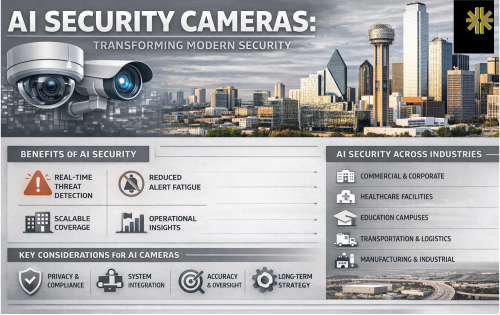
Benefits of AI Cameras for Security Operations
Real-Time Threat Detection
AI cameras identify potential security issues as they happen, enabling faster intervention and reducing escalation.
Reduced Alert Fatigue
Advanced AI filtering prioritizes relevant events, minimizing false alarms and unnecessary notifications.
Scalable AI Security Coverage
AI-powered systems allow organizations to expand coverage across multiple sites without proportional increases in staffing.
Operational Intelligence
Beyond security, AI cameras can deliver insights into traffic flow, space usage, and operational inefficiencies.
Wondering where AI cameras would make the biggest difference in your facilities?
Contact Pavion today to schedule a security consultation.
AI Security Cameras for Business: Use Cases by Industry
The adoption of AI security cameras is accelerating across multiple sectors, including:
- Commercial buildings and corporate campuses
- Healthcare facilities and hospitals
- K–12 schools and higher education
- Transportation, logistics, and smart infrastructure
- Manufacturing and industrial operations
In each environment, AI-powered security cameras support safer operations by providing visibility that traditional systems cannot deliver alone.
Key Considerations When Implementing AI Security Cameras
While AI security offers significant advantages, successful deployment requires strategic planning.
Privacy and Compliance
Organizations must ensure AI camera usage aligns with privacy regulations, data governance policies, and transparency standards.
Integration With Existing Security Systems
AI cameras are most effective when integrated with access control, alarms, proactive monitoring, and mass notification systems.
Accuracy and Oversight
AI models should be carefully configured and monitored to maintain accuracy and reduce false positives over time.
Long-Term AI Security Strategy
Businesses should select AI security solutions that are scalable, updatable, and capable of evolving with future requirements.
Business Buying Checklist
Before selecting AI security cameras for your business, ask:
- Will they work with our existing cameras and video management system?
- Is the hardware NDAA-compliant? (Required for many government and federally funded buyers.)
- How much bandwidth and storage will the analytics need?
- How are firmware and cybersecurity updates delivered?
- Are analytics licensed per camera, per feature, or per site?
- Who will monitor and respond to alerts: our team or a proactive monitoring service?
Pair AI video with 24/7 proactive monitoring.
Explore Pavion’s Proactive Monitoring Services.
The Future of AI-Powered Security
The expansion of AI security cameras in Dallas reflects a clear industry direction: AI-powered security is becoming the new standard. As threats grow more dynamic and response expectations increase, organizations are turning to AI cameras to enhance awareness, improve response times, and strengthen overall resilience.
For businesses, the goal is not simply adding AI — but implementing AI security cameras as part of an integrated, intelligent security ecosystem.
Put AI Security Cameras to Work Across Your Sites
Pavion helps organizations select, deploy, and integrate AI security cameras with access control, alarms, and monitoring into one security ecosystem.
Contact Us Today to plan an AI video deployment that scales with your business.
FAQs: AI Security Cameras
What are AI security cameras?
AI security cameras use machine learning and video analytics to detect, analyze, and alert on events automatically.
How are AI cameras different from traditional security cameras?
Traditional cameras record footage. AI cameras analyze activity in real time and surface actionable alerts.
Are AI security cameras replacing security personnel?
No. AI security enhances human teams by improving efficiency and decision-making, not replacing people.
What industries benefit most from AI security?
Commercial real estate, healthcare, education, transportation, manufacturing, and smart city environments all benefit from AI-powered security cameras.
What should businesses consider before deploying AI cameras?
Privacy compliance, system integration, AI accuracy, and long-term scalability are critical factors.
Are AI security cameras worth it for business?
For multi-site or high-traffic facilities, usually yes. AI filtering reduces the footage teams must review and surfaces real-time alerts, so coverage can grow without adding monitoring staff. Value depends on camera placement, integration with access control and alarms, and ongoing tuning to limit false alerts.
Can I add AI to my existing security cameras?
Often, yes. Server- or VMS-based analytics can add AI detection to many existing IP cameras, depending on image resolution, camera placement, and software compatibility. An assessment of your current system shows which cameras can be upgraded and which should be replaced.