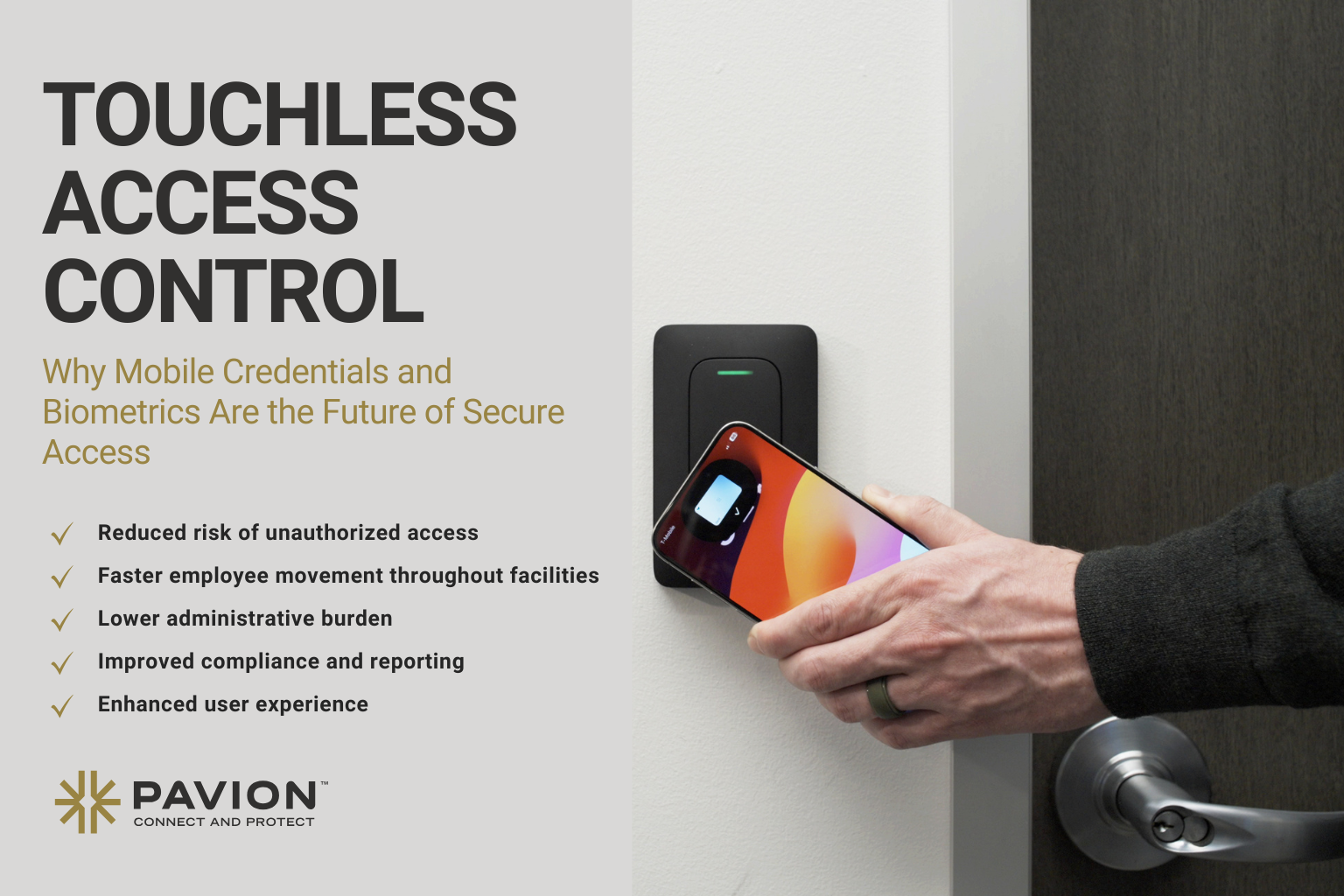
Touchless Access Control: Why Mobile Credentials and Biometrics Are the Future of Secure Access

The Shift Toward Touchless Access Control
Security is evolving—and so are the expectations around convenience, safety, and efficiency.
Traditional access control systems that rely on keycards and fobs are quickly being replaced by touchless access control systems, including mobile credentials, wave-to-open sensors, and biometric authentication.
Why? Because today’s organizations need solutions that are not only secure, but also adaptable, hygienic, and harder to exploit.
The Problem with Cards and Fobs
Physical credentials have a fundamental flaw:
They can be shared, lost, or stolen.
Employees may:
- Lend a badge to a coworker
- Misplace a keycard
- Forget to report a lost fob
And when that happens, access control breaks down.
Why Mobile Credentials Are More Secure
Mobile credentials solve one of the biggest gaps in traditional access control—identity verification.
Unlike keycards:
- People rarely share their phones
- Devices are protected with biometrics or passcodes
- Access can be revoked instantly
- Activity can be tracked in real time
This creates a much stronger connection between credential and user identity.
For multi-site organizations or hybrid work environments, mobile credentials also allow administrators to:
- Grant or revoke access remotely
- Adjust schedules instantly
- Monitor access activity across locations
Biometrics: Security Without Friction
Biometric access control takes security one step further by tying access directly to a person—not something they carry.
Common biometric methods include:
- Facial recognition
- Retina or iris scanning
- Fingerprint authentication
Real-World Use Cases
Healthcare
- Doctors and nurses can access restricted areas while scrubbed in
- No need to touch readers or carry credentials
- Supports infection control protocols
Fire & Emergency Services
- First responders may not have a badge on them
- Fingerprints may fail due to dirt or damage
- Facial or retina recognition enables fast, secure entry
Corporate & High-Security Facilities
- Eliminates shared credentials
- Enhances audit trails
- Strengthens compliance
Business Benefits of Touchless Access Control
Touchless systems provide measurable value beyond security:
- Reduced risk of unauthorized access
- Faster employee movement throughout facilities
- Lower administrative burden
- Improved compliance and reporting
- Enhanced user experience
What to Look for in a Touchless Access Control System
When evaluating solutions, organizations should consider:
- Mobile credential compatibility
- Biometric accuracy and privacy protections
- Integration with existing systems
- Scalability for future growth
- Remote management capabilities
Working with an experienced partner ensures the system is designed around your operational needs—not just installed.
Frequently Asked Questions
Are mobile credentials more secure than keycards?
Yes. Mobile credentials are tied to personal devices, which are rarely shared and often protected by biometrics or passcodes, making them significantly more secure than traditional cards.
Is biometric data safe to use?
Modern biometric systems use encryption and secure storage methods. When implemented correctly, they are both safe and highly effective.
Can touchless access control work in existing buildings?
Yes. Many systems can be integrated into existing infrastructure, allowing organizations to upgrade without a full system replacement.
What industries benefit most from touchless access control?
Healthcare, education, corporate offices, and emergency services see significant benefits due to efficiency, hygiene, and security improvements.
Final Thought
Touchless access control is more than a convenience—it’s a shift toward identity-based security.
Organizations that adopt mobile and biometric solutions are not just upgrading their systems—they’re strengthening their entire security posture.