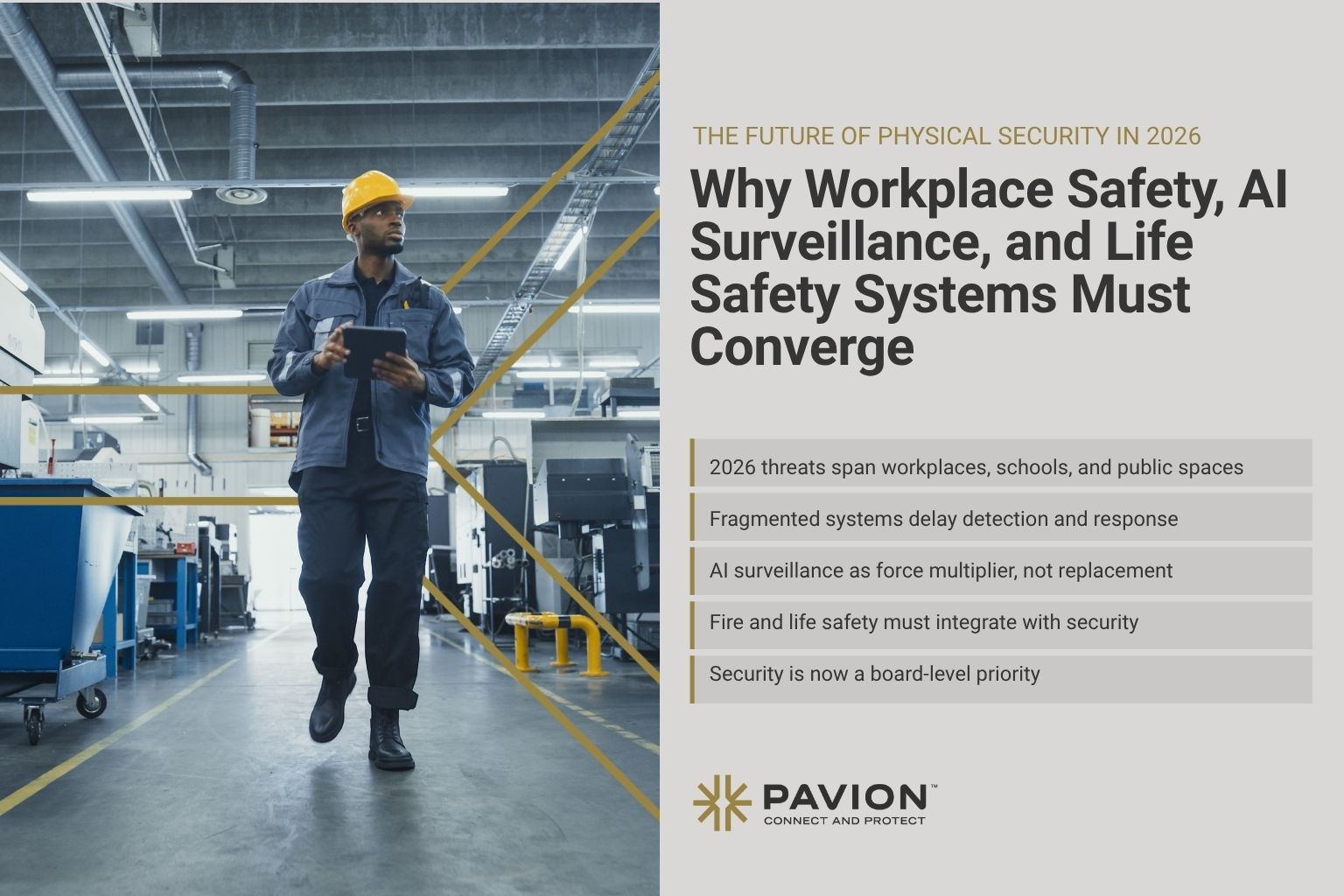
Physical Security Trends 2026: Why AI, Workplace Safety, and Life Safety Systems Must Converge
The future of physical security in 2026 is being shaped by a fundamental shift in how organizations protect their people, facilities, and operations. Understanding these physical security trends 2026 is crucial for effective planning.
In examining the physical security trends 2026, it becomes evident that organizations must adapt to an evolving landscape of threats and solutions.
Security cameras, access control systems, fire alarms, emergency communications, and workplace violence prevention programs can no longer operate as separate functions. As risks become more complex, organizations need integrated security systems that provide real-time awareness, faster communication, and a coordinated response across the entire enterprise.
Artificial intelligence is accelerating this transition. AI-powered video analytics can help security teams identify unusual activity, investigate incidents, and manage large environments more efficiently. However, technology alone cannot create a complete safety strategy.
Organizations must connect AI surveillance, access control, fire and life safety systems, emergency communications, cybersecurity, and human decision-making into one coordinated security ecosystem.
What Is Driving Physical Security Trends in 2026?
Organizations are managing a wider range of physical and operational risks than ever before. Security teams must prepare for incidents that may affect multiple systems, departments, and locations simultaneously.
These risks can include:
- Workplace violence and active assailant incidents
- Unauthorized access and credential misuse
- Theft, vandalism, and property damage
- Fire, smoke, and environmental emergencies
- Cyberattacks targeting connected security devices
- Operational disruptions and system outages
- Emergencies affecting employees, visitors, and the public
These challenges are especially significant in workplaces, schools, healthcare facilities, retail locations, transportation environments, entertainment venues, government buildings, and critical infrastructure.
Traditional security systems may still detect individual events. The greater challenge is determining whether those systems can share information and support a coordinated response while an incident is unfolding.
Workplace Violence Prevention Is an Enterprise Priority
Workplace violence prevention has become a critical component of physical security planning.
Organizations in healthcare, education, retail, logistics, manufacturing, hospitality, and corporate environments must consider how they will identify warning signs, report concerns, control access, communicate during an emergency, and support first responders.
An effective workplace violence prevention strategy may include:
- Facility and site risk assessments
- Visitor management procedures
- Access control and identity management
- Video surveillance and security monitoring
- Duress buttons and emergency notification systems
- Employee reporting procedures
- Threat assessment teams
- Emergency response training
- Coordination among security, human resources, legal, facilities, and executive leadership
No single camera, sensor, or software platform can prevent every incident. Technology must support a broader program that includes clear policies, employee training, threat assessment, and defined response procedures.
Fragmented systems can create serious operational gaps. An access control event may appear in one platform, video footage in another, and emergency notifications in a third. When teams must manually connect that information, valuable time may be lost.
Integrated physical security systems help authorized personnel see related events, verify threats, and respond from a more complete operational picture.
As we consider the future, it’s imperative to keep an eye on evolving physical security trends 2026 that will redefine safety standards.
How AI Is Changing Video Surveillance in 2026
AI video surveillance is one of the most significant physical security trends of 2026.
Traditional surveillance systems primarily recorded footage for later review. Modern AI-enabled video systems can analyze live or recorded video and help operators identify activity that may require attention.
Depending on the system, environment, configuration, and applicable policies, AI video analytics may help detect:
- Unusual movement or behavior
- People entering restricted areas
- Objects left behind
- Perimeter breaches
- Vehicles or license plates
- Occupancy and crowd conditions
- Loitering or extended dwell time
- Movement across multiple cameras
- Conditions that may require further investigation
These capabilities can reduce the time required to search video, support faster incident verification, and help security teams manage large volumes of information.
However, AI should not be treated as an independent decision-maker.
The Limitations of AI Surveillance
AI security technology can improve situational awareness, but its effectiveness depends on how it is designed, configured, maintained, and governed.
Potential limitations include:
- False alarms and misclassification
- Poor image quality or inadequate camera placement
- Environmental conditions that affect visibility
- Bias or performance differences across use cases
- Privacy and data governance concerns
- Cybersecurity risks involving connected devices
- Limited context without human review
- Integration problems with existing security systems
For these reasons, AI video analytics should function as a decision-support tool rather than a replacement for trained security professionals.
The strongest deployments combine AI-generated alerts with human verification, clear escalation procedures, cybersecurity protections, and documented policies governing how security data is collected and used.
Why Fire and Life Safety Systems Must Be Part of the Security Strategy
Fire and life safety systems are essential to protecting occupants, yet they are often managed separately from physical security technology.
Fire alarm systems, emergency communications, mass notification, access control, video surveillance, and building systems may all play a role during the same emergency.
Consider a situation involving smoke, fire, an active threat, or another rapidly developing event. Security personnel may need to:
- Identify where the incident is occurring
- Determine which occupants may be affected
- Notify employees, visitors, and emergency personnel
- Control or release specific doors
- Review live video from the affected area
- Support evacuation or shelter-in-place procedures
- Provide responders with accurate facility information
- Preserve event records for investigation and compliance
When these systems operate independently, teams may receive incomplete or conflicting information. Integrated life safety and security systems can improve coordination by bringing critical alerts and operational data into a more unified response process.
Integration must still respect applicable fire codes, system listings, cybersecurity requirements, emergency procedures, and the intended operation of each life safety system.
The goal is not to override fire protection functions. It is to improve visibility and coordination among the systems and teams responsible for protecting people.
What Is an Integrated Physical Security System?
An integrated physical security system connects multiple security and life safety technologies so information can be monitored, analyzed, and acted upon more effectively.
An integrated security ecosystem may include:
- Video surveillance systems
- AI video analytics
- Access control systems
- Intrusion detection
- Visitor management
- Fire alarm and life safety systems
- Emergency communications
- Mass notification
- Intercom and duress systems
- Remote system monitoring
- Building management platforms
- Cybersecurity controls
- Centralized security dashboards
The exact design will depend on the organization’s facilities, risks, regulatory requirements, existing infrastructure, and operational priorities.
Integration does not always mean replacing every existing system. In many cases, organizations can modernize in phases by connecting compatible technologies, improving monitoring, strengthening network infrastructure, and establishing a long-term security roadmap.
Benefits of Security System Integration
A properly designed integrated security system can help organizations improve both safety and operational performance.
Faster incident detection
Connected systems can bring related alarms, video, access events, and other data together, helping teams identify potential incidents sooner.
Improved situational awareness
Operators can evaluate an event using information from multiple sources rather than relying on a single alarm or camera view.
More coordinated emergency response
Security, facilities, life safety personnel, leadership, and first responders can work from more consistent information.
Reduced operational blind spots
Centralized monitoring can make it easier to identify system failures, recurring alarms, unsecured doors, and other conditions requiring attention.
More efficient investigations
Integrated event records and searchable video can reduce the time required to reconstruct what happened before, during, and after an incident.
Greater system scalability
Organizations can develop repeatable security standards across multiple facilities while addressing the specific risks of each location.
Stronger business continuity
Faster detection and better coordination may help reduce disruption, protect essential operations, and support recovery following an emergency.
Cybersecurity Is Now Part of Physical Security
Modern physical security systems rely heavily on networks, software, cloud platforms, mobile applications, connected sensors, and internet-enabled devices.
This creates an important reality: physical security and cybersecurity can no longer be managed separately.
A compromised camera, access control panel, server, or administrator account can create both digital and physical risk. Organizations should therefore apply cybersecurity principles throughout the security system lifecycle.
Important practices include:
- Secure system architecture
- Network segmentation
- Multifactor authentication
- Role-based access permissions
- Software and firmware management
- Encryption where appropriate
- System health monitoring
- Vendor risk management
- Documented incident response procedures
- Regular review of inactive users and credentials
Physical security, information technology, and cybersecurity teams should collaborate from the beginning of a project rather than after systems have already been selected and deployed.
Physical Security Is Becoming a Board-Level Business Issue
Physical security is no longer solely a facilities or security department responsibility.
Executives and board members are increasingly evaluating security in the context of enterprise risk, employee safety, compliance, business continuity, reputation, and operational resilience.
Leadership teams should be asking:
- Have we completed a current physical security risk assessment?
- Are our highest-risk facilities adequately protected?
- Do our security systems communicate with one another?
- Can our teams detect and verify incidents in real time?
- Are workplace violence prevention procedures documented and practiced?
- Are fire and life safety systems included in emergency planning?
- Is our connected security infrastructure protected from cyber threats?
- Can we monitor critical systems across multiple locations?
- Do employees know how to report concerns and request help?
- Is there a clear plan for modernizing outdated systems?
The answers can reveal whether an organization has a collection of security products or a coordinated protection strategy.
How to Build an Integrated Security Strategy
Organizations do not need to modernize every system at once. A structured approach can help prioritize investments and reduce unnecessary complexity.
1. Complete a comprehensive risk assessment
Evaluate the organization’s people, properties, operations, threats, vulnerabilities, and existing safeguards.
2. Inventory current systems
Document cameras, access control platforms, fire alarms, intercoms, emergency communications, network infrastructure, software versions, service agreements, and system ownership.
3. Identify integration gaps
Determine where systems operate independently, where information must be transferred manually, and where response teams lack visibility.
4. Define operational outcomes
Focus on what the organization needs to accomplish, such as faster threat verification, improved emergency communication, remote monitoring, or standardized security across multiple facilities.
5. Include IT and cybersecurity stakeholders
Confirm that the proposed architecture meets network, identity, data protection, software maintenance, and cybersecurity requirements.
6. Develop a phased modernization roadmap
Prioritize the facilities, risks, and system improvements that can create the greatest operational value.
7. Test the complete response process
Technology should be tested alongside emergency procedures, employee communications, escalation protocols, and responder coordination.
8. Monitor and maintain the environment
Integrated systems require ongoing inspection, software management, testing, training, and performance review.
The Future of Physical Security Is Convergence
The future of physical security will not be defined by how many individual products an organization installs.
It will be defined by how effectively its people, procedures, security technology, fire and life safety systems, and operational data work together.
AI can help identify potential threats. Video surveillance can provide visual context. Access control can help manage movement through a facility. Emergency communications can deliver critical instructions. Fire and life safety systems can detect hazardous conditions and support occupant protection.
The greatest value emerges when those capabilities contribute to one coordinated strategy.
Organizations that adopt an integrated approach can improve situational awareness, accelerate response, reduce operational blind spots, and build a more resilient safety environment.
At Pavion, we help organizations connect and protect their people, facilities, and operations through integrated fire, security, life safety, and communications solutions.
Contact Pavion to discuss a physical security assessment, system integration project, or long-term security modernization strategy.
One of the key physical security trends 2026 is the integration of advanced technology to enhance safety protocols.