Bank Branch Security Systems: 10 Layers of Physical Security for Financial Institutions

What Are the Most Important Layers of Bank Branch Security?
Bank branch security systems should be designed in layers, combining access control, video surveillance, intrusion detection, duress alarms, secure cash-area protection, ATM security, visitor awareness, monitoring, and documented response procedures.
No single device protects a financial institution on its own. Effective security comes from connecting people, technology, policies, and response workflows.
For banks, credit unions, and other financial institutions, layered physical security can help reduce risk, support compliance, protect employees and customers, and improve visibility across branches. The goal is to deter threats, detect suspicious activity early, delay unauthorized access, document incidents clearly, and support a faster response when something happens.
Contact us for a free security assessment.
Why Layered Security Matters for Financial Institutions
Banks and financial institutions operate in a unique physical security environment. They are public-facing businesses, trusted community institutions, regulated organizations, cash-handling environments, employee workplaces, customer service centers, and digital banking access points all at once.
That combination creates a wide range of security concerns.
A branch must welcome legitimate customers while controlling access to restricted areas. Employees need to move efficiently while cash rooms, vault areas, teller lines, IT closets, back offices, and after-hours zones remain protected.
ATMs and vestibules may operate outside normal branch hours. Surveillance footage must be usable for investigations. Panic and duress alarms need to support fast escalation. Security decisions must also align with internal policies, regulatory expectations, and law enforcement coordination.
The FBI reports that bank robberies and other crimes against financial institutions continue to create risks for banks, credit unions, employees, and customers.
Layered security matters because financial institutions are not protecting only money. They are protecting people, trust, operations, records, facilities, and brand confidence.
Bank Branch Security Layers at a Glance
A strong physical security program connects multiple layers, from exterior awareness to monitoring, response, and compliance.
| Security Layer | Key Areas and Technologies |
|---|---|
| Perimeter & Exterior Awareness | Parking lot cameras, exterior lighting, drive-through lanes, ATM areas, exterior doors, and after-hours vestibules |
| Public Branch Entry | Main entrance visibility, visitor flow, lobby cameras, customer-facing signage, and employee line-of-sight |
| Controlled Interior Access | Access-controlled employee doors, back offices, IT/network closets, cash-handling rooms, and staff-only corridors |
| Transaction & Cash Protection Zones | Teller lines, cash drawers, vaults, safes, cash recyclers, night depositories, and dual-control areas |
| Detection & Alerting | Intrusion sensors, door contacts, glass-break detection, panic buttons, duress alarms, ATM alerts, and alarm monitoring |
| Video Verification & Investigation | Surveillance coverage, camera placement, video retention, evidence export, and remote review |
| Response & Compliance Workflow | Monitoring procedures, emergency contacts, law enforcement coordination, audit trails, inspection records, and branch security policies |
Security is strongest when every layer works together.
Bank Branch Security Is Not One System — It Is a Connected Program
Many organizations think about bank security in terms of individual devices: cameras, card readers, panic buttons, door contacts, or alarm panels.
That is only part of the picture.
Effective bank branch security systems are built as a connected program. The technology must support how the branch actually operates, including customer traffic, employee workflows, cash handling, opening and closing procedures, ATM access, deliveries, cleaning crews, vendor access, and emergency response.
The best approach does not rely on one security control. It layers multiple controls so that if one layer misses something, another can help detect, delay, verify, document, or escalate the event.
Layered Security Model for Banks and Credit Unions
| Security Layer | Purpose | Examples of Technology | Why It Matters for Banks |
|---|---|---|---|
| Deterrence | Discourage unwanted behavior before it happens | Visible cameras, lighting, signage, secure entry design | Helps reduce opportunistic crime and reinforces a controlled environment |
| Detection | Identify suspicious activity or unauthorized access | Video analytics, intrusion sensors, door contacts, glass-break detection | Helps security teams know when something is happening |
| Delay | Slow unauthorized movement or access | Locked doors, access control, secured cash rooms, safes, vestibule controls | Buys time for employees, monitoring teams, or law enforcement response |
| Verification | Confirm what is happening | Video surveillance, alarm-video integration, remote monitoring | Reduces uncertainty and supports faster decision-making |
| Response | Escalate events to the right people quickly | Duress alarms, monitoring, emergency contacts, law enforcement workflows | Helps protect employees and customers during incidents |
| Documentation | Preserve evidence and support audits | Video retention, access logs, incident reports, system records | Supports investigations, compliance reviews, and internal accountability |
| Improvement | Strengthen security over time | System assessments, service records, branch audits, technology roadmaps | Helps financial institutions adapt to changing risks and aging systems |
1. Exterior and Perimeter Awareness
The first layer of bank branch security starts before someone enters the building.
Exterior security helps financial institutions monitor activity around parking areas, entrances, drive-through lanes, night depositories, ATM vestibules, employee entrances, and loading or service areas.
These zones are important because threats, suspicious behavior, and employee safety concerns can begin outside the branch.
Key considerations include:
- Are exterior cameras positioned to capture usable images?
- Are entrances and exits clearly visible?
- Is lighting adequate near ATMs, parking areas, and vestibules?
- Are after-hours access points protected?
- Are drive-through lanes and night depositories covered?
- Can employees safely open and close the branch?
- Are cameras positioned to avoid glare, weather obstruction, or blind spots?
For financial institutions, exterior visibility supports both deterrence and investigation. It can also help security teams understand what happened before and after an incident inside the branch.
2. Public Lobby and Customer Area Security
A bank branch must be accessible to the public, which makes lobby security especially important.
The lobby is where customer experience and security must be balanced. Too much visible security can feel intimidating, while too little can leave employees and customers exposed.
Lobby security should support awareness without disrupting normal service.
Important systems and design elements include:
- Lobby surveillance cameras
- Teller-line camera coverage
- Clear sightlines for employees
- Visitor flow awareness
- Queue visibility
- Strategic camera placement at entrances
- Discreet duress options
- Customer service zones separated from restricted areas
The goal is not to make the branch feel locked down. The goal is to make it observable, organized, and supported.
3. Access Control for Staff-Only Areas
Access control is one of the most important layers of financial institution security.
Banks and credit unions have many areas that should not be accessible to the public, including back offices, teller work areas, cash rooms, vault corridors, file storage areas, IT closets, employee entrances, and operations rooms.
An access control system helps ensure that only authorized employees, vendors, or service providers can enter specific spaces.
Key questions to ask include:
- Which doors require access control?
- Which employees need access to each area?
- Should access vary by role, branch, schedule, or location?
- Are temporary vendors and cleaning crews managed properly?
- Are terminated employee credentials removed quickly?
- Are access events logged and reviewable?
- Can branch managers manage access without creating additional risk?
Access control should be designed around both security and operations. Employees need efficient movement, but sensitive zones require clear restrictions and documentation.
4. Video Surveillance and Camera Placement
Video surveillance is central to bank branch security systems because it supports deterrence, real-time awareness, incident verification, and investigation.
However, video is only as useful as the quality of the image, camera placement, retention policy, and ability to retrieve footage quickly.
Financial institutions should evaluate:
- Entrance and exit coverage
- Teller transaction coverage
- Lobby and waiting area visibility
- ATM and vestibule coverage
- Drive-through lane visibility
- Cash-handling area coverage
- Employee entrance coverage
- Exterior and parking lot coverage
- Image quality in changing lighting conditions
- Video retention requirements
- Evidence export processes
- Remote access controls
- Cybersecurity protections for video systems
Cameras should be positioned to capture useful context, not simply general activity. For example, a camera mounted too high may show movement but fail to capture identifiable details. A camera facing direct sunlight may lose image clarity at key times of day.
For banks, video surveillance should support both live awareness and post-incident review.
5. Intrusion Detection and After-Hours Protection
After-hours security is a major part of bank branch protection.
When the branch is closed, intrusion detection systems help monitor doors, windows, vestibules, teller areas, cash rooms, vault zones, and other sensitive spaces.
These systems can include motion detectors, glass-break sensors, door contacts, safe or vault contacts, and alarm communication pathways.
Key planning questions include:
- Which areas need protection after hours?
- Are there different arming schedules for branch, ATM, vestibule, or drive-through areas?
- How are false alarms reduced?
- Who receives alarm notifications?
- How are alarm events verified?
- Are emergency contacts up to date?
- Is the system tested regularly?
- Are opening and closing procedures aligned with the alarm system?
Intrusion detection is most effective when it is connected to clear response procedures. An alarm signal is only valuable if the right people know what to do next.
6. Duress, Panic, and Employee Protection
Employee safety is one of the most important reasons financial institutions invest in layered security.
Duress and panic alarm systems can help employees discreetly signal an emergency during a robbery, threat, violent incident, or escalating customer situation.
These systems must be placed thoughtfully, tested regularly, and supported by clear procedures.
Considerations include:
- Are duress buttons located where employees can reach them safely?
- Are teller stations, offices, and cash-handling areas covered?
- Are employees trained on when and how to use them?
- Are signals monitored correctly?
- Are law enforcement and emergency escalation procedures documented?
- Are false activations handled appropriately?
- Are devices tested as part of a maintenance schedule?
Duress systems should be discreet, reliable, and integrated into a broader response plan.
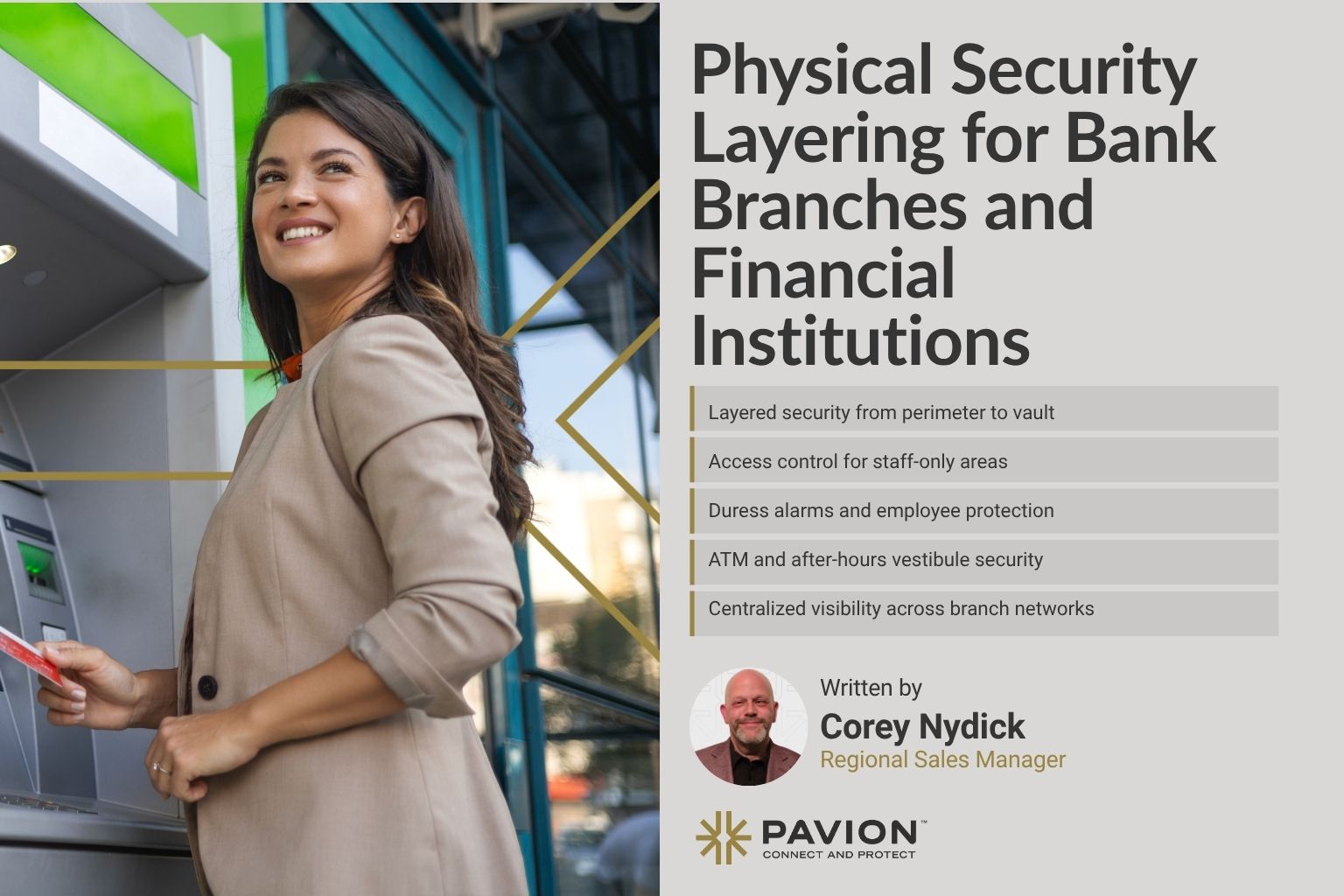
7. ATM and Vestibule Security
ATMs create unique security challenges because they may operate when the branch is closed and may be located in vestibules, drive-through lanes, exterior walls, or standalone areas.
ATM security requires a combination of physical protection, video coverage, lighting, access control, intrusion detection, and monitoring.
ATM-related crime can also include sophisticated methods such as “jackpotting,” in which malicious software or unauthorized access is used to force an ATM to dispense cash.
For physical security planning, financial institutions should ask:
- Is the ATM area clearly visible?
- Is lighting sufficient at night?
- Are cameras positioned to capture user activity and surrounding context?
- Are service panels and machine access points protected?
- Are vestibule doors controlled after hours?
- Are loitering or suspicious activity concerns addressed?
- Are ATM alarms monitored?
- Are service vendors properly managed?
ATM security should be evaluated as its own branch security layer, not as an afterthought.
8. Monitoring and Response Workflows
Monitoring connects security technology to action.
For financial institutions, monitoring may involve intrusion alarms, duress signals, ATM alerts, video verification, environmental sensors, and other branch security events.
But monitoring is not simply about receiving alerts. It is about routing the right information to the right people quickly.
A strong monitoring and response workflow should define:
- Which events are monitored
- Who receives notifications
- Which events require law enforcement dispatch
- How false alarms are handled
- How emergency contacts are updated
- How branch managers are informed
- How video verification is used
- How incidents are documented
- How follow-up service is triggered
Without a clear workflow, alarms can create confusion. With the right workflow, security alerts become actionable.
9. Compliance, Documentation, and Audit Readiness
Financial institutions operate in a highly regulated environment. Physical security is one part of a broader risk management and compliance picture.
The Federal Reserve’s Interagency Guidelines Establishing Information Security Standards address administrative, technical, and physical safeguards for the security, confidentiality, integrity, and proper disposal of customer information. The FDIC also addresses administrative, technical, and physical safeguards designed to protect customer information.
For bank branch security, documentation may include:
- System drawings
- Camera lists and locations
- Access control door schedules
- User permission records
- Alarm response procedures
- Monitoring contact lists
- Service records
- Inspection and testing records
- Video retention policies
- Incident reports
- Vendor access logs
- Branch security assessments
Good documentation can support audits, investigations, maintenance, insurance reviews, internal governance, and future upgrades.
10. Centralized Visibility Across Multiple Branches
For regional banks, national banks, credit unions, and other multi-location financial institutions, physical security becomes more complex as the number of sites grows.
A single branch may be manageable with local oversight. A network of branches requires greater consistency and standardization.
Multi-site financial institutions should consider:
- Standard camera layouts by branch type
- Standard access control policies
- Consistent duress alarm placement
- Centralized monitoring procedures
- Branch-by-branch system health visibility
- Remote video access governance
- Standardized user permissions
- Maintenance schedules
- Technology lifecycle planning
- Consistent documentation across locations
The goal is not to make every branch identical. A flagship urban branch, suburban branch, rural credit union, and headquarters facility may all have different security requirements.
The goal is to make every location easier to manage, support, and improve.
Fragmented Branch Security vs. Integrated Layered Security
| Area | Fragmented Security Approach | Integrated Layered Security Approach |
|---|---|---|
| System Design | Cameras, alarms, and access control are planned separately | Branch security is designed as one connected program |
| Vendor Management | Multiple vendors support different systems | One integration partner can support design, installation, service, and lifecycle planning |
| Incident Response | Alerts, video, and access logs may be disconnected | Events can be verified and escalated with better context |
| Compliance Support | Documentation may be inconsistent by system or branch | Records, service history, and system data are organized across layers |
| Employee Safety | Duress and response procedures may operate in isolation | Employee protection is incorporated into the full branch security workflow |
| Multi-Site Visibility | Branches may operate with inconsistent standards | Enterprise-wide standards support stronger oversight |
| Service | Break/fix support begins after an issue occurs | Preventive maintenance and assessments can help identify issues earlier |
| Long-Term Planning | Upgrades happen one system at a time | A security roadmap aligns technology, operations, and budget |
Common Bank Branch Security Gaps
Many financial institutions already have security systems in place, but older, inconsistent, or disconnected systems can create gaps.
Common issues include:
- Cameras that do not capture usable identifying details
- Blind spots at entrances, ATMs, or teller areas
- Outdated access control permissions
- Former employees with active credentials
- Inconsistent duress alarm placement
- Poor lighting near exterior areas
- Incomplete video retention policies
- Unclear alarm response procedures
- Disconnected intrusion and video systems
- Branches using different technology standards
- Service records spread across multiple vendors
- Lack of lifecycle planning for aging systems
A physical security assessment can help identify these issues before they become larger risks.
What Financial Institutions Should Look for in a Security Integration Partner
Choosing the right security integration partner is critical when designing, upgrading, or managing bank branch security systems.
Financial institutions should look for a commercial security integrator with experience in regulated environments, multi-site deployments, access control, video surveillance, intrusion detection, duress systems, monitoring, documentation, and long-term service.
Important questions include:
- Do you have experience with banks, credit unions, and financial institutions?
- Can you support access control, video surveillance, intrusion, and duress systems?
- Do you understand branch operations and cash-handling environments?
- Can you support multiple locations?
- Can you help standardize security across branches?
- Do you provide ongoing service and maintenance?
- Can you support monitoring and response workflows?
- How do you document systems and service history?
- How do you coordinate with IT and compliance teams?
- Can you help plan future upgrades?
For additional guidance, read Pavion’s How to Choose a Fire and Security Integrator: Questions to Ask Before You Sign.
Why Pavion for Financial Institution Security
Pavion helps banks, credit unions, and financial institutions connect and protect their people, customers, branches, and operations through integrated commercial security solutions.
Our teams support access control, video surveillance, intrusion detection, monitoring, system design, service, maintenance, and multi-site security planning.
For financial institutions, that means working with a partner that can look across the full branch environment — from exterior awareness and teller-line protection to employee safety, ATM security, monitoring, and centralized visibility.
Whether your organization is upgrading one branch, standardizing a regional footprint, consolidating vendors, or planning a broader security roadmap, Pavion can help identify gaps and design practical solutions that support protection, operations, and long-term growth.
Learn more about Pavion’s Commercial Security Solutions: Expert Integration & Design and connect with Pavion to evaluate your bank branch security systems.
Frequently Asked Questions About Bank Branch Security Systems
What are the most important bank branch security systems?
The most important bank branch security systems typically include access control, video surveillance, intrusion detection, duress or panic alarms, ATM security, monitoring, secure cash-area protection, and documented response procedures.
These systems work best when they are designed as connected layers rather than independent devices.
Why do banks need layered physical security?
Banks need layered physical security because they face multiple types of risk, including robbery, unauthorized access, employee safety concerns, ATM threats, after-hours intrusion, fraud investigations, and compliance requirements.
Layered security helps financial institutions deter, detect, delay, verify, respond to, and document security incidents.
How should financial institutions protect ATMs?
Financial institutions should protect ATMs with video surveillance, lighting, intrusion detection, controlled vestibule access, service panel protection, alarm monitoring, and clear response procedures.
ATM areas should be reviewed separately because they often operate after branch hours and may have different risk patterns than the main lobby.
What should banks look for in a commercial security integrator?
Banks should look for a commercial security integrator with financial institution experience, multi-site support, access control expertise, video surveillance design capabilities, intrusion and duress alarm knowledge, monitoring support, strong documentation practices, and ongoing service capabilities.
How often should bank branch security systems be assessed?
Bank branch security systems should be assessed regularly and whenever there are major changes, including branch renovations, new technology, staffing changes, ATM updates, security incidents, compliance reviews, or vendor transitions.
Regular assessments can help identify blind spots, aging equipment, access control issues, and response workflow gaps before they become larger problems.