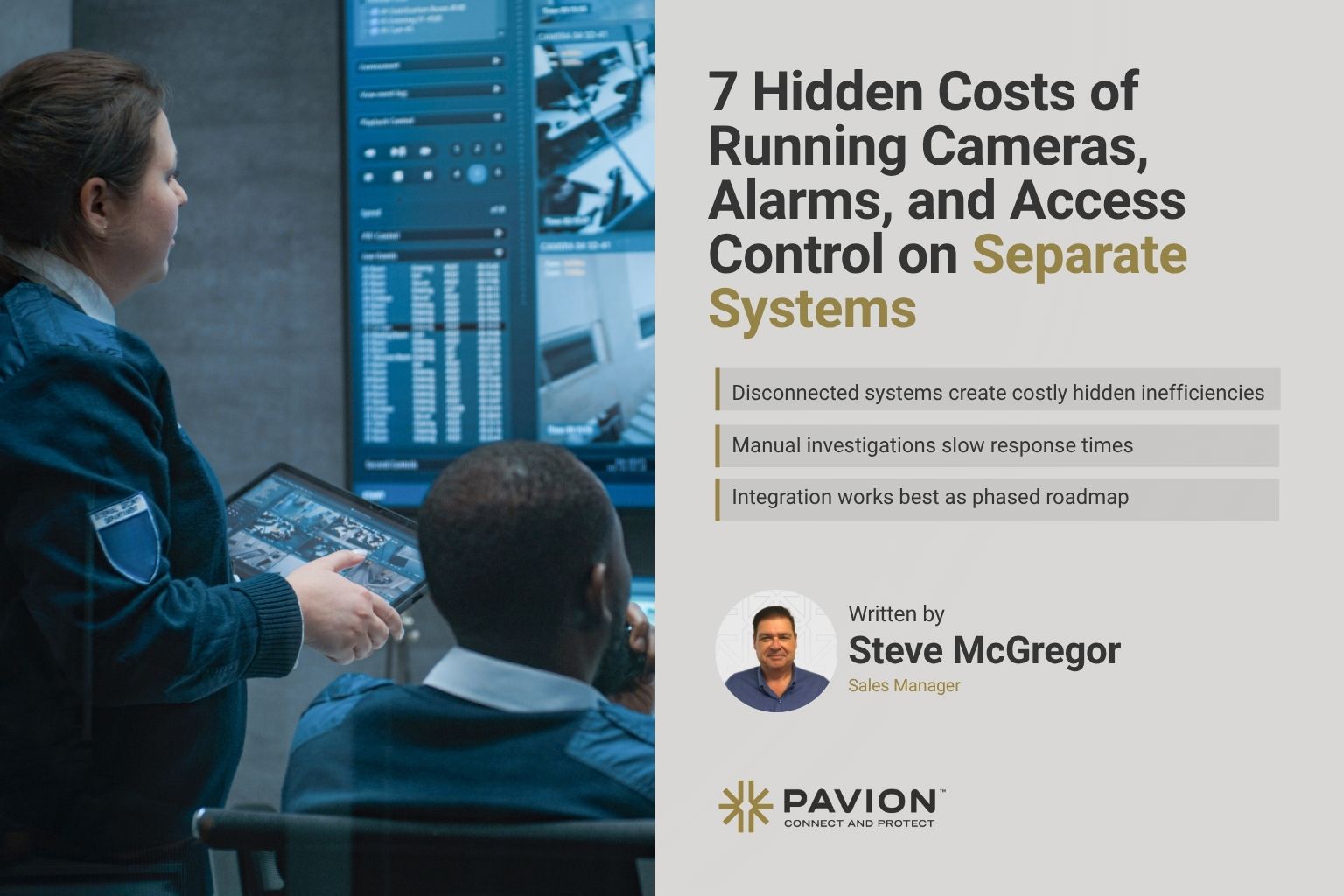
7 Hidden Costs of Running Cameras, Alarms, and Access Control on Separate Systems

What may look like a collection of fully functional standalone solutions can create significant operational costs behind the scenes, especially when dealing with disconnected security systems.
Security teams may have to switch between multiple platforms. IT departments may manage separate servers, software updates, and credentials. Administrators may spend more time investigating incidents because information is scattered across different systems. Meanwhile, organizations can end up paying multiple vendors to maintain technology that could potentially work together.
These costs are not always obvious on a budget sheet, but over time, they can have a major impact on security operations.
Here are seven hidden costs organizations should consider when cameras, alarms, and access control systems remain disconnected security systems.
1. More Time Spent Investigating Security Incidents
Imagine an employee reports that someone entered a restricted area after hours.
If security systems are disconnected, the investigation may require several steps:
- Review access control records to determine which credential opened the door.
- Log into the video surveillance system to locate footage from the same time.
- Check the intrusion system for alarms or sensor activity.
- Compare timestamps between platforms.
- Export information from multiple systems for documentation.
Each step adds time.
With integrated security systems, related events can potentially be connected within a unified environment. An access control event may be associated with nearby video footage, while alarms can provide additional context about what occurred.
Instead of manually reconstructing an incident across several platforms, security teams can gain a more complete picture of the event faster.
The hidden cost of disconnected systems is therefore not just technology. It is the employee time required to connect information manually.
For example, investigating just one incident per week could take an additional 25 hours per year if the systems are not integrated. Having your systems integrated saves not only time but also money.
2. Multiple Software Platforms Increase Training Costs
Every security platform has its own interface, workflows, terminology, and reporting tools.
Understanding the implications of disconnected security systems is crucial for effective risk management.
When organizations operate several independent systems, employees may need to learn:
- Different login procedures
- Multiple dashboards
- Separate reporting tools
- Individual alarm workflows
- Different administrative controls
- Separate troubleshooting procedures
Training becomes even more complicated when new employees join the organization or when responsibilities shift between departments.
Instead of training staff on one coordinated security environment, organizations may repeatedly train employees on several unrelated technologies.
That creates both direct training expenses and an indirect productivity cost.
Integrated security platforms can help simplify day-to-day system management by reducing the number of interfaces employees need to navigate.
3. Separate Maintenance Contracts Can Drive Up Costs
Security environments often grow gradually.
A company may install access control first, add surveillance cameras several years later, and then introduce intrusion detection or additional security technologies.
Over time, the organization may end up working with multiple integrators, manufacturers, monitoring providers, and service companies.
That can mean:
- Multiple maintenance agreements
- Separate service calls
- Different renewal schedules
- Multiple points of contact
- Overlapping support costs
- More complicated vendor management
A problem involving more than one system can become especially frustrating.
If a door event is not triggering the expected video response, for example, the access control vendor may blame the video platform while the video provider points back to the access control system.
The organization is left coordinating the troubleshooting process.
Integrating security technologies reduces this complexity and can establish clearer ownership when problems arise.
4. Unconnected Systems Can Slow Emergency Response
During a security incident, seconds matter.
An intrusion alarm may tell operators that something happened. Video surveillance can help determine what is happening. Access control can show where people entered or where they may be moving.
But if those technologies operate independently, employees may have to gather that information manually.
Consider an alarm at an exterior door.
A security operator might need to:
- Identify the alarm location.
- Open a separate video surveillance platform.
- Locate the correct camera.
- Review the live or recorded video.
- Determine whether someone used an authorized credential.
- Decide whether additional action is necessary.
An integrated approach can provide more context at the moment an alarm occurs.
When systems share information, security teams may be able to move from detecting an event to understanding and responding to it more quickly.
That improved situational awareness can be particularly valuable across large campuses, healthcare environments, schools, data centers, corporate facilities, and other complex sites.
5. IT Teams Carry More Infrastructure Than Necessary
Modern physical security systems increasingly depend on IT infrastructure.
Video management systems, access control databases, mobile applications, cloud services, identity platforms, and security devices may all require network connectivity and ongoing administration.
When technologies operate independently, IT departments may have to manage:
- Multiple servers or appliances
- Separate databases
- Individual software upgrades
- Multiple user directories
- Different cybersecurity requirements
- Additional network connections
- Separate backup procedures
Every additional platform expands the environment IT teams must maintain.
It can also increase the number of systems that must be monitored for vulnerabilities, patches, authentication issues, and compatibility problems.
An integrated security architecture can help simplify this environment by reducing unnecessary duplication and improving alignment between physical security and IT teams.
6. Poor Data Visibility Can Lead to Missed Security Insights
Security systems generate enormous amounts of useful information.
Access control platforms record credential activity. Cameras capture movement and events. Alarm systems identify abnormal conditions. Other sensors can provide additional operational data.
When those systems are isolated, organizations may only use a fraction of that information.
For example, patterns that could indicate a security concern may be harder to identify when data must be compared manually across different platforms.
Integrated security systems can use analytics to make it easier to correlate events and identify patterns such as:
- Repeated access attempts at restricted doors
- Credential activity outside normal hours
- Alarm events associated with specific locations
- Unusual traffic patterns
- Recurring security incidents
- Operational trends across multiple facilities
Better visibility can help security leaders move beyond simply reacting to individual alarms.
Instead, organizations can begin using security data to identify risks, improve policies, and make more informed decisions.
7. Future Expansion Becomes More Expensive
Disconnected security technology can also create long-term scalability problems.
When organizations expand into new facilities, add cameras, upgrade credentials, introduce analytics, or adopt cloud-based security tools, existing systems may not integrate easily.
That can lead to expensive workarounds.
Organizations may need to:
- Replace otherwise functional equipment
- Purchase additional software licenses
- Build custom integrations
- Add middleware
- Operate another management platform
- Maintain legacy infrastructure longer than expected
What initially appeared to be a lower-cost standalone solution can become expensive once the organization needs to scale.
A strategic security architecture should consider not only what the organization needs today, but also how systems will evolve over the next several years.
The Real Cost Is Operational Complexity
The biggest disadvantage of disconnected security systems is not necessarily one specific expense.
It is accumulated complexity.
Each additional platform can add another login, another database, another service agreement, another training requirement, and another system employees must navigate during an incident.
Individually, those challenges may seem manageable.
Together, they can increase operational costs while making the overall security environment harder to manage.
That is why more organizations are evaluating integrated physical security strategies that bring video surveillance, access control, intrusion detection, analytics, and other technologies into a more coordinated environment.
What Should an Integrated Security Strategy Look Like?
Integration does not necessarily mean replacing every security system at once.
In many organizations, the better approach is to develop a roadmap.
A security technology assessment can help identify:
- Existing systems and infrastructure
- Technology nearing end of life
- Current integration capabilities
- Operational pain points
- Cybersecurity considerations
- Future facility expansion plans
- Opportunities to consolidate platforms or vendors
From there, organizations can prioritize upgrades based on risk, operational impact, and available budget.
In some cases, existing technology can remain in place while new systems are introduced gradually. In others, aging or proprietary platforms may need to be replaced to support long-term interoperability.
The goal should be to create a security environment that is easier to operate, maintain, scale, and secure.
Moving From Separate Systems to a Connected Security Environment
Physical security technology has changed significantly.
Cameras are becoming more intelligent. Access control is increasingly connected to identity management. Security platforms are moving toward cloud and hybrid architectures. Analytics are helping organizations identify events faster.
But these capabilities deliver greater value when systems can work together.
Organizations that continue managing cameras, alarms, and access control as completely separate technologies may be carrying hidden costs that are difficult to see until an incident, system failure, or major expansion exposes them.
Evaluating the entire security ecosystem can help organizations identify opportunities to reduce complexity while improving visibility and response.
Pavion helps organizations design, integrate, service, and modernize physical security environments across video surveillance, access control, intrusion detection, and other critical technologies. By taking a system-wide approach, organizations can create security infrastructure that supports both immediate operational needs and long-term growth.
Is your security environment becoming harder to manage as new systems are added?
Contact Pavion to discuss how a more integrated security strategy could help simplify operations, strengthen situational awareness, and prepare your organization for what comes next.