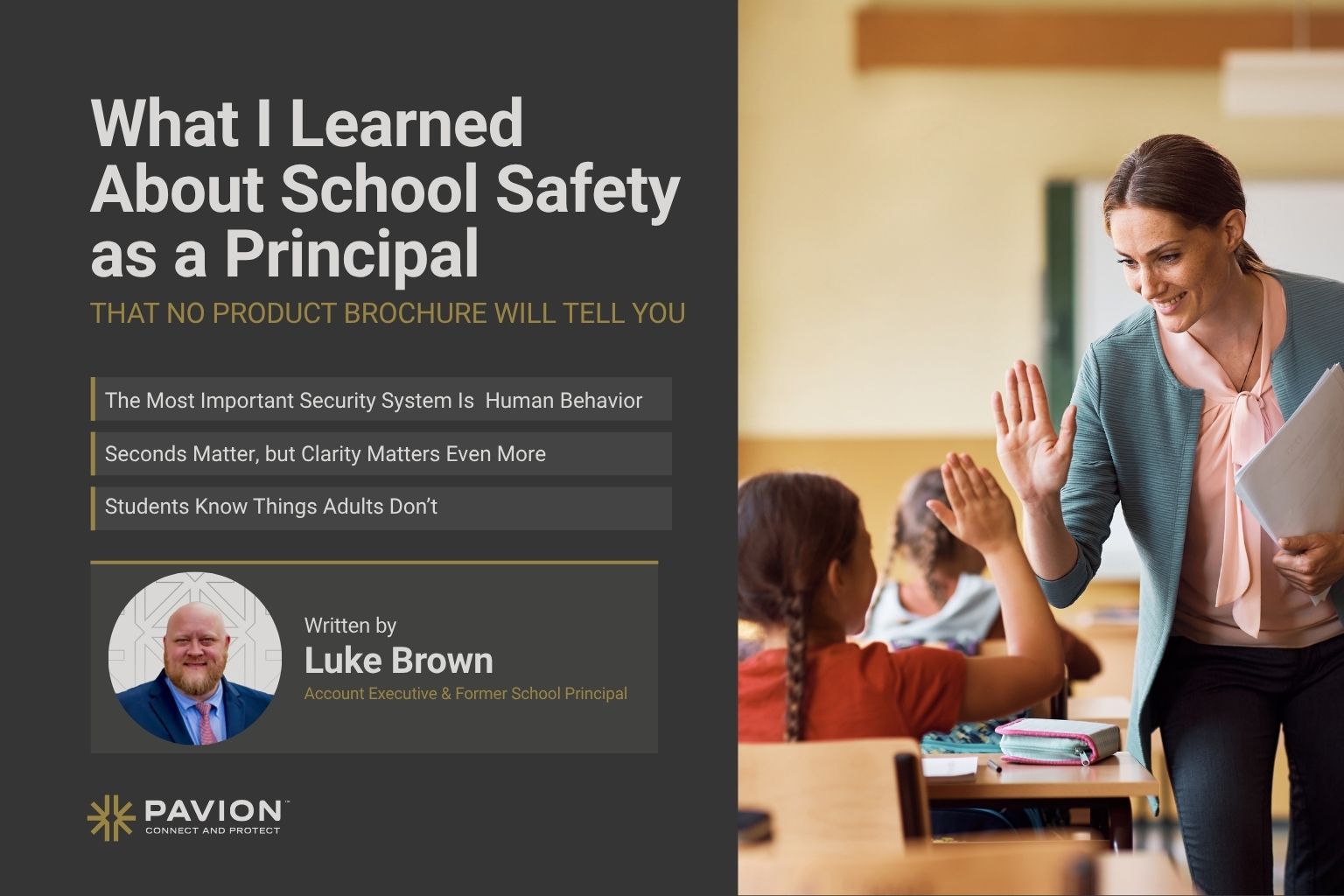
What I Learned About School Safety as a Principal — That No Product Brochure Will Tell You

By Luke Brown, Account Executive and Former School Principal
Before I worked in the security industry, I saw school safety from the other side.
I was a principal.
That meant I wasn’t evaluating security based on a list of features or comparing specifications on a proposal. I was responsible for the students, teachers, staff, and families who trusted our school to be a safe place every day.
I also experienced a shooting on my campus.
That experience changed the way I think about school security. It taught me lessons that are difficult to capture in a product brochure, a technology demonstration, or even an emergency drill.
Today, as an Account Executive working with schools and organizations on security solutions, I still carry those lessons with me.
Because when you’re responsible for a school, the question isn’t simply, “What security technology do we have?”
The real question is:
“Will our people know what to do, and will our systems help them do it, when something goes wrong?”
Here are some of the most important things I learned.
1. The Most Important Security System in a School Is Still Human Behavior
Schools need technology.
Cameras can provide visibility. Access control can help secure entrances. Intercom and mass notification systems can communicate instructions. Emergency alerts can help accelerate response.
But technology does not replace people.
Some of the most important security actions that happen inside a school are remarkably simple.
A teacher notices behavior that doesn’t seem right.
A student trusts an adult enough to tell them something they heard.
A staff member sees a door that should be locked and takes the time to secure it.
Someone challenges an unfamiliar visitor instead of assuming another employee already handled it.
Those decisions matter.
Strong school safety cultures are built when every person understands that security isn’t solely the responsibility of the principal, school resource officer, security department, or facilities team.
Everyone has a role.
The best technology strengthens that culture. It gives people better information, faster communication, and clearer ways to respond. It should never create the assumption that because a security system exists, people no longer need to pay attention.
2. Your Emergency Plan Will Never Unfold Exactly the Way You Practiced It
Emergency drills are essential.
But a drill and an actual emergency are two very different experiences.
After experiencing a shooting on my campus as a principal, one of the things that stayed with me was how quickly a situation can become confusing.
Real emergencies are loud.
They’re emotional.
Information changes.
People are moving.
Questions are coming from every direction.
And even people who have practiced emergency procedures many times may respond differently when they realize the situation is real.
That’s why schools should evaluate security technology through the lens of the people who will actually have to use it during those moments.
Can a teacher understand the alert immediately?
Can an administrator initiate the appropriate response quickly?
Can responders get useful information without navigating multiple disconnected systems?
Can someone perform the necessary action while under tremendous stress?
During an emergency, complexity becomes a liability.
Technology should reduce the number of decisions people have to make, not create additional ones.
3. Seconds Matter, but Clarity Matters Even More
We frequently talk about speed in emergency response, and for good reason.
Seconds can matter tremendously.
But sending information quickly isn’t enough if people don’t understand what that information means.
Imagine receiving multiple alerts from different systems:
An access control notification.
A text message.
An intercom announcement.
A security alarm.
An email.
A mobile app notification.
If those systems aren’t coordinated, more communication can actually create more confusion.
During a crisis, people need answers to three basic questions:
What is happening?
Where is it happening?
What do I need to do right now?
School security systems should be designed around delivering those answers as clearly and quickly as possible.
That is why integration matters.
Access control, video surveillance, emergency communication, intercom, intrusion detection, and other systems shouldn’t operate as isolated pieces of technology when the people using them are trying to manage the same emergency.
4. The Door You Walk Past Every Day May Matter More Than the Million-Dollar Security System
When schools discuss security improvements, the conversation naturally gravitates toward major investments.
New cameras.
New access control systems.
New visitor management technology.
New emergency communication platforms.
All of those investments can be important.
But some of the biggest vulnerabilities I’ve seen aren’t sophisticated technology problems.
They’re everyday operational problems.
A door that doesn’t latch correctly.
A door that’s routinely propped open.
A lost key that was never reported.
A visitor procedure that’s enforced differently depending on who’s sitting at the front desk.
An employee who left the district months ago but remains in an outdated database.
A delivery entrance that’s convenient for staff but difficult to monitor.
These small inconsistencies accumulate.
And because people see them every day, they can eventually stop noticing them.
That’s why physical security assessments shouldn’t only examine technology. They should examine how a school actually operates.
Walk the building.
Test the doors.
Look at arrival and dismissal.
Review visitor procedures.
Talk to teachers.
Talk to custodial and facilities staff.
Look at what happens after school when athletic events, clubs, contractors, and community organizations are using the building.
Sometimes the most important security improvement isn’t a new piece of equipment.
It’s fixing the vulnerability everyone has gotten used to walking past.
5. Students Know Things Adults Don’t
One of the most valuable—and sometimes overlooked—sources of information in any school is the student body.
Students know their environment incredibly well.
They know which doors don’t close properly.
They know which entrances are rarely watched.
They know where people gather when they’re trying not to be seen.
They know where cameras can and cannot see.
And perhaps most importantly, students often recognize changes in their peers long before an administrator does.
They hear conversations.
They see social media posts.
They notice changes in behavior.
They know when something feels wrong.
But that information only helps if students believe they can share it safely.
Schools need to create trusted ways for students to speak up and a culture where reporting a concern is seen as protecting someone rather than getting someone in trouble.
Technology can support those reporting mechanisms, but trust has to come first.
Students will tell adults what they know when they believe adults will listen.
6. A Principal Experiences Security Technology Differently Than the Person Who Buys It
I’ve now sat on both sides of the security conversation.
The purchasing conversation often revolves around things like:
Features.
Specifications.
Integrations.
Coverage.
Lifecycle.
Pricing.
Those things matter.
But when you’re sitting in the principal’s office, your evaluation is much more personal.
You’re thinking about the teacher standing in a classroom with 25 students.
You’re thinking about the front office staff responsible for visitors.
You’re thinking about the custodian working alone after hours.
You’re thinking about parents trying to reach the school.
You’re thinking about first responders trying to understand what’s happening inside the building.
And ultimately, you’re asking one question:
“Will this help my people if the worst day of our lives happens?”
If the answer isn’t obvious, the technology isn’t ready for the school.
School security should be designed around the experience of the people using it—not simply around what the system is technically capable of doing.
7. The Best Safety Technology Is Almost Invisible—Until You Desperately Need It
Schools face a difficult balance.
They need strong security, but they are also places where children should learn, grow, build friendships, and feel comfortable.
A school shouldn’t feel like a prison.
Security technology should operate quietly in the background of everyday life.
Doors should work.
Credentials should work.
Cameras should provide visibility.
Communications should be reliable.
Systems should be maintained.
Administrators should know that everything is functioning without constantly thinking about it.
But when something goes wrong, those individual technologies should suddenly work together.
A door is secured.
A camera provides visibility.
An alert reaches the right people.
An announcement gives clear instructions.
Administrators understand what’s happening.
Responders receive useful information.
That coordination is what transforms individual security products into something much more powerful.
A safety ecosystem.
School Safety Isn’t About Buying More Technology
I believe strongly in security technology. It’s why I work in this industry today.
But my experience as a principal taught me that safer schools aren’t created simply by installing more equipment.
They’re created by bringing together people, procedures, communication, training, and technology.
Schools should ask difficult questions.
Are our everyday security procedures actually being followed?
Can our systems communicate with one another?
Would a substitute teacher understand what to do during an emergency?
Do our students have someone they trust enough to approach with a concern?
Are we maintaining the systems we already have?
Can we communicate clearly when information is incomplete and people are under stress?
And perhaps most importantly:
Are we building our security strategy around how a real school operates—or around how we assume it operates?
Having lived that responsibility as a principal, I know the difference matters.
Because ultimately, school safety isn’t measured by how impressive a system looks during a demonstration.
It’s measured by how well people and technology work together when they’re needed most.