What Lifeguards Can Teach Us About Proactive Video Monitoring

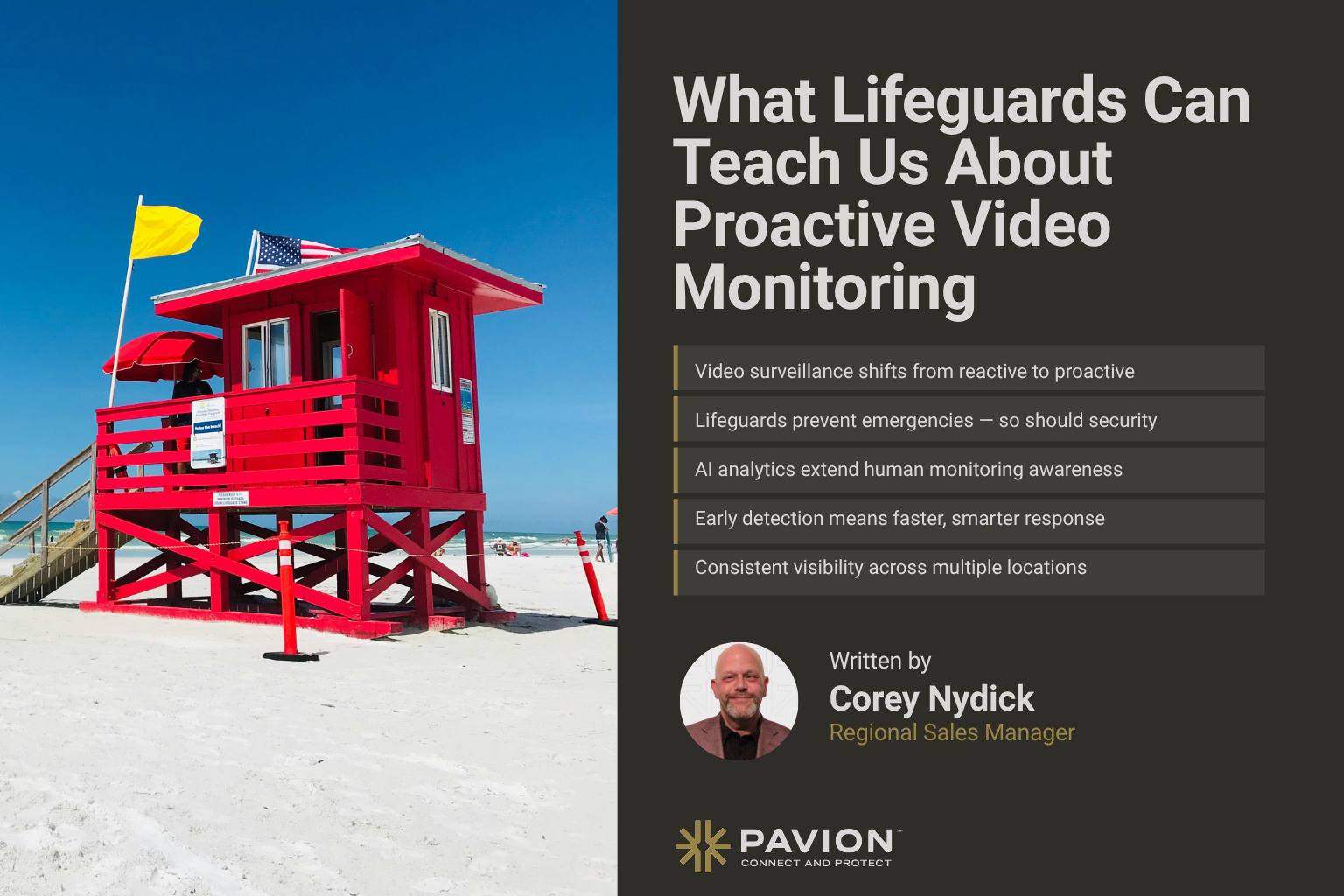
A lifeguard’s job is not simply to respond once someone is already in danger. Their greatest value comes from watching carefully, recognizing early warning signs, and intervening before a situation escalates.
They scan the water, notice changes in behavior, and look for people drifting too far, struggling quietly, entering unsafe areas, or becoming separated from a group. Their objective is clear: identify potential problems early enough to help prevent an emergency.
The same principle applies to modern security and life safety.
For many organizations, traditional video surveillance has primarily served as a record of what already happened. Cameras capture footage, and security teams review it after an incident occurs. Although recorded video remains valuable for investigations and documentation, today’s security challenges require a more proactive approach.
That is where proactive video monitoring can make a difference.
What Is Proactive Video Monitoring?
Proactive video monitoring combines live or near-real-time video surveillance with trained monitoring professionals, intelligent analytics, and established response procedures.
Instead of relying solely on recorded footage after an incident, proactive monitoring helps identify unusual activity, potential threats, safety concerns, and operational issues as they develop. When an event is detected, monitoring personnel can assess the situation and initiate an appropriate response based on predetermined protocols.
The objective is not simply to record more footage. It is to turn video into actionable intelligence.
From Reviewing Incidents to Identifying Risk
Traditional video surveillance is often reactive. An incident occurs, the organization investigates, and recorded footage is reviewed to determine what happened.
Proactive video monitoring changes that model by turning surveillance into an active layer of protection.
Much like a lifeguard watching the shoreline, proactive monitoring focuses on recognizing when something does not look right. Depending on the environment and the system’s configuration, that could include:
- Unauthorized access
- Loitering after hours
- Entry into restricted areas
- Vehicles stopping in unexpected locations
- Movement in areas that should be vacant
- Unusual activity near entrances or property boundaries
- Groups forming in sensitive or high-risk areas
- Potential safety or operational concerns
When these events are identified earlier, organizations have a better opportunity to assess the situation and respond before it becomes a larger disruption.
Proactive monitoring can support commercial facilities, schools, healthcare campuses, retail locations, multifamily properties, industrial sites, critical infrastructure, and other environments where greater real-time awareness is needed.
The Lifeguard Analogy: Why Human Awareness Still Matters
There is a reason the lifeguard comparison works so well.
A lifeguard brings human judgment to a fast-moving environment. They understand context, distinguish normal activity from behavior that may indicate distress, communicate clearly, and coordinate a response when necessary.
Trained video monitoring professionals provide a similar layer of situational awareness.
Not every event captured by a camera represents a threat. A person standing near an entrance may be waiting for an employee, or they may be attempting to gain unauthorized access. A vehicle parked in an unusual area may be completing a delivery, or it may require additional attention. Someone moving through a facility after hours may be authorized, or they may not be.
Human monitoring professionals can evaluate the available information, verify what is happening, and determine whether the event should be escalated.
This verification process helps organizations respond based on context rather than relying on an alert alone.
How AI Video Analytics Improves Visibility
The lifeguard analogy also highlights one of the limitations of human monitoring: one person can only observe so much at a time.
Even highly trained professionals can become distracted, experience fatigue, or miss activity occurring outside their immediate field of view. Those limitations become more significant when teams are responsible for monitoring large, busy, or geographically distributed environments.
AI video analytics can help address that challenge.
AI-enabled video technology can continuously analyze activity across multiple cameras and locations. Depending on the technology and configuration, analytics may be used to identify specific objects, behaviors, movement patterns, or events that require attention.
This allows monitoring teams to focus on verification, decision-making, communication, and response instead of attempting to watch every camera feed simultaneously.
AI does not replace the lifeguard. It gives the lifeguard greater visibility.
For organizations, this means video surveillance systems can do more than passively record. They can help surface relevant activity faster, prioritize potential risks, and support more informed action.
How Proactive Video Monitoring Works
An effective proactive video monitoring strategy typically includes several connected components:
1. Video Surveillance Technology
Cameras provide visibility into entrances, parking areas, loading docks, restricted spaces, perimeters, and other critical locations.
2. AI Video Analytics
Video analytics help identify activity that matches predetermined rules or conditions, such as movement in a restricted area or the presence of a vehicle after hours.
3. Event Verification
A trained monitoring professional reviews the event to determine what is occurring and whether action is required.
4. Defined Response Protocols
The organization establishes clear procedures for different event types. These may include notifying on-site personnel, contacting security teams, activating an audio warning, or escalating the situation to emergency services.
5. Documentation and Reporting
Verified events and responses can be documented to support investigations, operational reviews, compliance requirements, and future security planning.
When these components work together, organizations can move from passive surveillance toward a coordinated security response.
Why Proactive Monitoring Matters for Modern Organizations
Security teams are being asked to manage increasingly complex environments. Facilities are growing, risks are evolving, and many organizations must protect people, property, and operations across multiple locations.
Relying exclusively on after-the-fact video review can leave teams one step behind.
Proactive video monitoring helps organizations move closer to real-time awareness. By identifying potential issues earlier, organizations may be able to:
- Reduce the time between detection and response
- Improve incident verification
- Support emergency preparedness
- Increase awareness during off-hours
- Address unauthorized activity sooner
- Minimize operational disruptions
- Provide additional support for limited security staff
- Strengthen visibility across multiple facilities
This can be especially valuable when seconds matter.
For example, proactive monitoring may help identify an individual entering a restricted area, suspicious behavior near a building entrance, an unauthorized vehicle on-site, or movement in a location that should be empty after hours.
Depending on the organization’s response plan, a verified event may trigger notifications, audio talk-downs, security dispatch, contact with on-site personnel, or other established response measures.
The goal is not simply to see more. The goal is to act sooner.
Improving Security Across Multiple Locations
For organizations with multiple facilities, maintaining consistent visibility can be difficult.
A security team cannot be physically present at every building, parking lot, entrance, loading dock, or remote site at all times. Gaps may become particularly noticeable after hours, during weekends, or when staffing is limited.
Proactive video monitoring and AI video analytics can extend awareness beyond what on-site teams can manage alone.
Events can be detected, reviewed, and escalated according to the organization’s priorities and procedures. This can help support a more consistent security posture across distributed locations while giving centralized teams better insight into what is happening throughout the organization.
This approach may be especially beneficial for organizations with national footprints, remote facilities, centralized security operations, or locations that are difficult to staff continuously.
Turning Video Into Actionable Intelligence
The value of proactive video monitoring does not come from the camera alone. It comes from the technology, people, procedures, and response strategy behind it.
A video surveillance system becomes more effective when it is connected to:
- Intelligent video analytics
- Trained monitoring professionals
- Clear communication procedures
- Site-specific escalation protocols
- Audio communication capabilities
- Security and emergency response teams
- Reporting and documentation processes
Together, these elements can turn raw footage into meaningful action.
That is the difference between simply having cameras and implementing a proactive security solution.
With the right strategy, organizations can use video to support security, safety, operations, compliance, and business continuity. They can gain a clearer understanding of what is happening across their environments and respond with greater confidence.
Proactive Monitoring Does Not Eliminate Every Risk
Proactive video monitoring can strengthen an organization’s security posture, but it should not be viewed as a standalone solution or a guarantee that every incident will be prevented.
Its effectiveness depends on several factors, including camera placement, image quality, lighting, network availability, analytics configuration, monitoring procedures, response protocols, and integration with other security systems.
Organizations should evaluate proactive monitoring as part of a broader security strategy that may also include access control, intrusion detection, fire and life safety systems, emergency communications, and trained personnel.
A well-designed approach connects these technologies and procedures around the organization’s specific risks and operational requirements.
A More Proactive Future for Physical Security
The lesson from lifeguards is simple: the most effective response is often the one that happens before an emergency.
Proactive video monitoring applies that principle to physical security. By combining human expertise, AI video analytics, and real-time monitoring, organizations can improve visibility, recognize potential risks earlier, and take action before minor issues become major disruptions.
At Pavion, we help organizations bring greater clarity and intelligence to their security operations through integrated video surveillance, monitoring, and advanced technology solutions.
From proactive monitoring to AI-enabled video analytics, Pavion delivers scalable solutions designed to help protect people, property, and operations.
Because seeing what happened is important.
Recognizing what may happen next can be even more valuable.
Frequently Asked Questions
What is proactive video monitoring?
Proactive video monitoring uses live or near-real-time video, analytics, trained monitoring professionals, and predefined response procedures to identify and assess potential security events as they occur. Unlike traditional surveillance that is mainly reviewed after an incident, proactive monitoring is designed to support earlier awareness and response.
How is proactive video monitoring different from traditional video surveillance?
Traditional video surveillance often records footage for later investigation. Proactive video monitoring adds real-time event detection, professional verification, and response protocols so that potential threats or safety concerns can be addressed while they are developing.
Does AI replace human video monitoring professionals?
No. AI video analytics helps identify and prioritize activity that may require attention, while trained professionals provide context, verification, judgment, and response coordination. The technologies are most effective when they work together.
What types of events can proactive video monitoring detect?
Capabilities vary by system, but monitoring solutions may help identify unauthorized entry, loitering, vehicles in restricted locations, after-hours movement, perimeter activity, crowd formation, and other predefined events.
Which organizations can benefit from proactive video monitoring?
Proactive monitoring can support commercial properties, schools, healthcare facilities, retailers, multifamily communities, industrial sites, critical infrastructure, and multi-location organizations seeking better real-time security visibility.