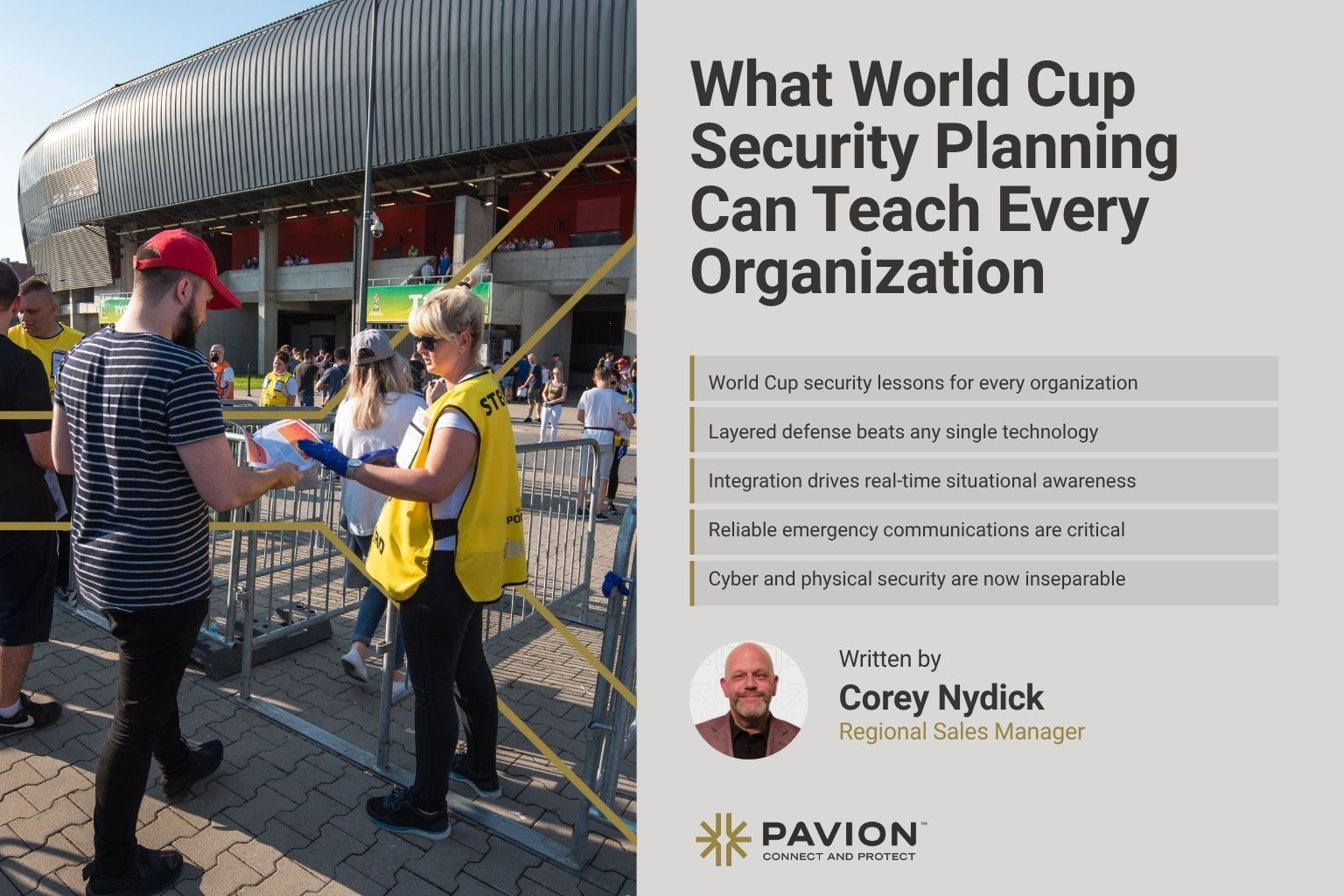
What World Cup Security Planning Can Teach Every Organization

The World’s Biggest Sporting Event Is Also One of the World’s Largest Security Operations
Attention for the FIFA World Cup is naturally focused on the matches, athletes and fan experience. Behind the scenes, however, an equally important effort is underway: one of the most complex security operations ever planned.
The tournament welcomes millions of visitors, involves thousands of employees and contractors, and depends on critical infrastructure operating reliably under immense pressure.
Security teams must prepare for a wide range of risks, including:
- Physical security threats
- Cyberattacks
- Emergency communications
- Crowd management
- Weapons detection
- Transportation safety
- Unauthorized access
- Drone activity
Most organizations will never host a global sporting event. However, the principles guiding World Cup security planning offer valuable lessons for businesses, healthcare systems, campuses, manufacturers, retailers and public-sector organizations of every size.
The scale may differ, but many of the underlying risks are the same.
Layered Security Is Stronger Than Any Single Technology
One of the most important principles in World Cup security planning is that no single system can provide complete protection.
Security leaders employ multiple layers of defense designed to identify, deter, delay and respond to threats. These layers may include:
- Video surveillance
- Access control
- Perimeter protection
- Visitor management
- Cybersecurity tools
- Critical communications
- Security monitoring centers
- Weapons detection
Together, these technologies and processes create a more comprehensive security posture.
At stadiums that can hold 65,000 people or more, the volume of people entering at once presents a significant security challenge. Fans, players, staff, media members, vendors and international visitors must all move safely and efficiently through the environment.
Weapons detection technology, which is already used at many major stadiums and entertainment venues, can help security teams screen large crowds while supporting a smoother visitor experience.
Organizations should take a similar approach.
Relying solely on cameras, access control or alarm systems can create significant gaps. Effective security strategies recognize that risks may emerge from multiple directions and require multiple layers of protection.
A layered security model can help organizations improve visibility, reduce vulnerabilities and respond more effectively when an incident occurs.
Integration Creates Better Situational Awareness
Large-scale events such as the World Cup generate enormous amounts of information.
Security teams must process real-time data from:
- Cameras and video management systems
- Sensors
- Access control systems
- Communication platforms
- Emergency management tools
- Screening technologies
- Security monitoring centers
The challenge is not necessarily a lack of information. The challenge is ensuring that the information is connected, accessible and actionable.
Organizations face the same issue every day.
Many businesses have invested in security technologies over time, resulting in disconnected systems that operate independently. When these systems do not communicate, security teams may lose valuable context during critical moments.
Integrated technology platforms provide a more complete view of operations, enabling faster decisions and more coordinated responses.
When security, life safety, communications and operational technologies work together, organizations can gain greater situational awareness and improve their overall resilience.
Real-Time Monitoring Is Essential for Rapid Response
During the World Cup, security personnel cannot afford delays when responding to potential incidents.
Whether teams are addressing suspicious activity, unauthorized access, severe weather, medical emergencies or crowd movement concerns, response times matter.
That is why real-time monitoring and proactive system oversight play such an important role in event security.
New technologies also continue to expand what security teams can see and how quickly they can respond. Drone-related solutions and aerial monitoring technologies, for example, may help teams:
- Monitor large outdoor areas
- Identify developing crowd concerns
- Locate people or objects of concern
- Assess incidents as they unfold
- Support faster, more informed decisions
The technologies used will vary by city and venue based on regulations, risk assessments and operational requirements. However, the broader lesson is clear: modern security planning increasingly relies on technologies that extend visibility beyond fixed cameras and traditional checkpoints.
Organizations face similar expectations.
Security incidents can escalate quickly, and many businesses operate across multiple locations with limited onsite personnel. Visibility into system performance and security events allows organizations to identify issues sooner and respond more effectively.
Real-time monitoring is no longer reserved for the largest enterprises. It has become an essential component of modern risk management.
The ability to detect problems early can determine whether an incident remains manageable or becomes a significant disruption.
Emergency Communications Must Be Reliable
During a large-scale emergency, communication may become the most critical technology in operation.
World Cup organizers must develop extensive communication strategies so security personnel, first responders, transportation agencies, operational teams and venue staff can coordinate effectively during any situation.
The same principle applies to every organization.
Whether responding to a fire alarm, severe weather event, security threat or operational disruption, organizations need reliable communication channels that reach the right people at the right time.
An effective emergency communication plan should include:
- Mass notification capabilities
- Critical communications systems
- Incident escalation procedures
- Employee communication protocols
- Coordination with emergency responders
- Defined roles and responsibilities
- Backup communication methods
Organizations often invest heavily in technologies that detect threats but overlook how information will be communicated when an incident occurs.
Preparedness depends on both awareness and communication.
Crowd and Visitor Management Are Everyday Challenges
Most organizations are not managing World Cup-sized crowds. However, many still encounter challenges involving visitor access, employee movement, contractor management and public-facing facilities.
The World Cup highlights the importance of understanding:
- Who is entering a facility
- Why they are there
- Where they are permitted to go
- How their movement is monitored
- What happens if an issue occurs
It also demonstrates that security planning does not stop at the stadium gates.
In Philadelphia, for example, the impact of the World Cup will extend throughout the surrounding region. Public transportation systems are preparing for increased ridership as visitors travel to matches, fan events, hotels, restaurants and other destinations.
Fan festivals and related events may also draw thousands of people who do not have tickets to a match but still want to participate in the World Cup experience. Nearby businesses, restaurants, bars, entertainment districts and public spaces may all experience increased traffic.
For security leaders, this provides an important reminder: major events create a ripple effect.
The stadium may be the center of attention, but transportation systems, hospitality venues, public spaces and nearby businesses all become part of the broader security environment.
Effective visitor management contributes to both security and operational efficiency.
Modern organizations increasingly rely on digital visitor management systems, access control platforms, identity verification processes, occupancy visibility tools and coordinated response plans to improve protection while maintaining a positive visitor experience.
Balancing convenience and security remains one of the most important goals in modern facility management.
Cybersecurity and Physical Security Are No Longer Separate
Perhaps the most significant lesson organizations can learn from World Cup security planning is that physical security and cybersecurity have become deeply interconnected.
Modern security systems are connected devices operating across networks and cloud environments.
Cameras, access control systems, communication platforms, monitoring tools, screening technologies and operational systems all generate and share data.
As a result, cyber threats can have physical consequences.
A cyberattack could potentially disrupt access control, interfere with communications, compromise surveillance systems or affect critical operational technologies.
Security leaders responsible for major events understand that protecting facilities requires both physical and digital safeguards.
Organizations should adopt the same mindset.
The most resilient security programs bring together:
- Information technology
- Cybersecurity
- Physical security
- Facilities
- Operations
- Risk management
- Executive leadership
This cross-functional approach allows organizations to address risk holistically instead of treating cyber and physical security as separate disciplines.
Security Is Ultimately About Preparedness
The 2026 World Cup represents an extraordinary security challenge.
Success will depend on planning, coordination, technology integration, reliable communication, transportation readiness, crowd management and the ability to respond effectively when unexpected events occur.
Although most organizations operate on a much smaller scale, the underlying lessons remain highly relevant.
Threats continue to evolve. Technology continues to advance. Expectations for safety, security and operational continuity continue to increase.
Organizations that invest in layered security strategies, integrated technologies, real-time monitoring, emergency communications, visitor management and cross-functional collaboration will be better positioned to navigate today’s complex risk environment.
The biggest lesson from World Cup security planning is not about sports.
It is about preparedness—and preparedness is something every organization can improve.
Strengthen Your Organization’s Security Preparedness
A comprehensive security strategy requires more than purchasing individual technologies. It requires understanding how systems, people and processes work together to support visibility, communication and coordinated response.
Pavion helps organizations integrate security, fire, communication and critical infrastructure technologies to strengthen preparedness and operational resilience.
Contact Pavion to discuss how an integrated security strategy can help protect your people, facilities and operations.
Frequently Asked Questions
What is layered security?
Layered security is a strategy that uses multiple security measures working together to reduce risk and improve protection. These measures may include video surveillance, access control, weapons detection, perimeter security, cybersecurity, monitoring and emergency communications.
Why are integrated security systems important?
Integrated security systems allow organizations to connect technologies and share information across platforms. This improves situational awareness, gives security teams greater context and can accelerate response times during an incident.
How does real-time monitoring improve security?
Real-time monitoring helps organizations identify threats, system failures and operational issues as they occur. Earlier detection enables teams to respond faster and reduce the potential impact of an incident.
Why should organizations address cybersecurity and physical security together?
Many physical security systems operate through connected networks, cloud platforms and other digital infrastructure. A cyberattack can therefore affect physical operations, making a unified security strategy increasingly important.
What can businesses learn from World Cup security planning?
Businesses can learn the importance of layered protection, integrated technologies, real-time monitoring, emergency communications, visitor management, transportation coordination and clearly defined response procedures.