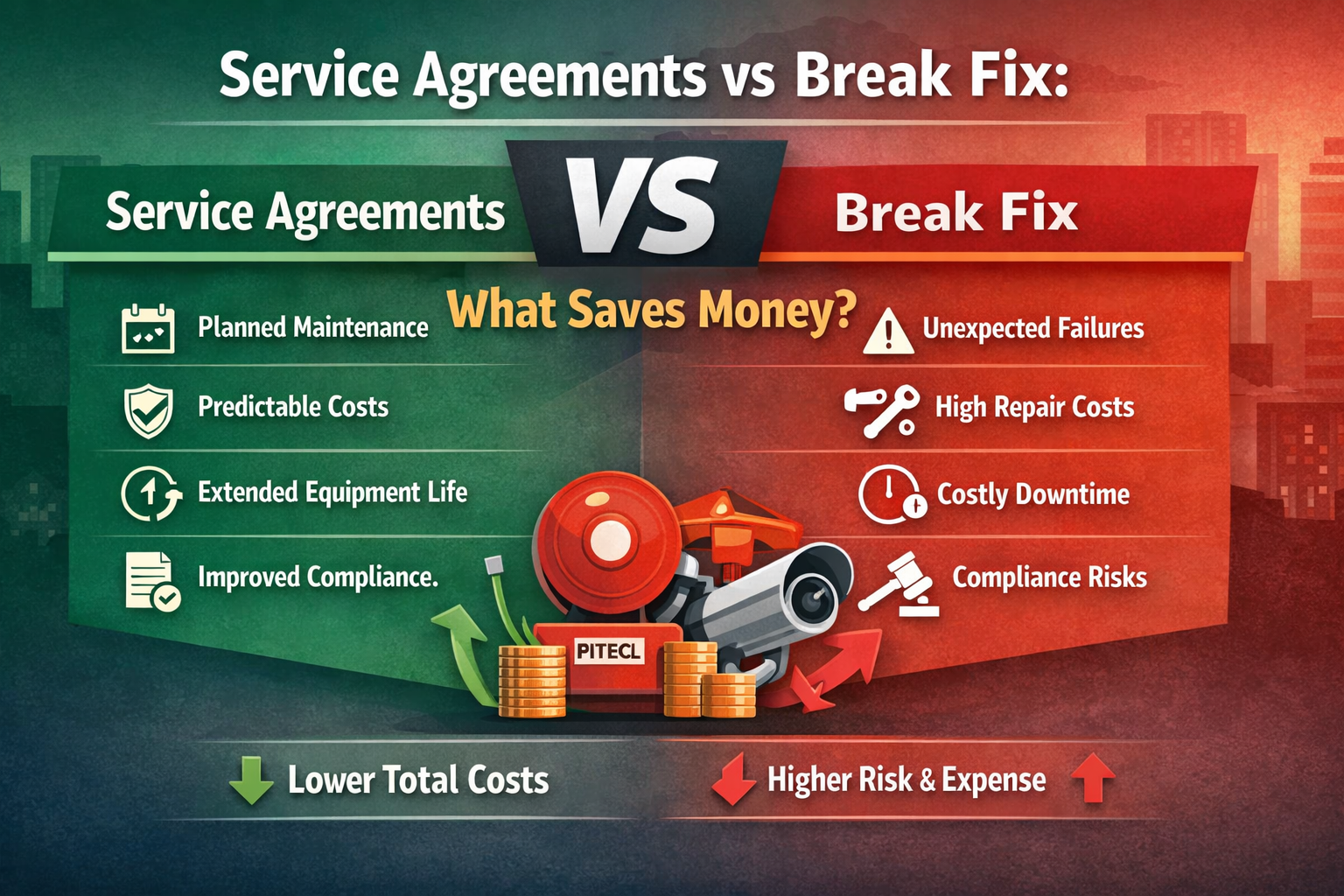
Service Agreements vs Break-Fix: Which Model Actually Saves Money?

When evaluating fire, security, and life safety systems, the question is often framed as cost:
Invest in a service agreement or pay only when something fails?
From a facilities standpoint, choosing between service agreements vs break fix impacts financial predictability, risk exposure, and long-term asset performance. For fire alarm and life safety systems, there’s one more factor: inspection and testing are required by code no matter which model you choose.
Break-Fix: Unplanned Cost and Risk
The break-fix model addresses issues only after failure occurs. While it may appear cost-effective initially, it introduces financial variability and operational disruption.
Key business impacts include:
- Unplanned repair expenses that disrupt budgets
- Emergency labor and expedited parts costs
- Operational downtime and internal coordination strain
- Increased compliance exposure
- Shortened equipment lifespan due to lack of preventative oversight
Break-fix shifts maintenance from a controlled operating expense to an unpredictable liability.
Paying for repairs one emergency at a time?
Contact Pavion today to review your service options.
Service Agreements: Structured Asset Management
Service agreements provide scheduled inspections, preventative maintenance, and defined response expectations. This creates cost stability and reduces operational surprises.
Business advantages include:
- Predictable, budgeted expenses
- Reduced emergency repair frequency
- Documented compliance support
- Extended asset life and improved capital planning
- Greater operational continuity
This model aligns maintenance with financial discipline and risk management.
What a Fire and Security Service Agreement Includes
A well-structured service agreement typically covers:
- Inspection, testing, and maintenance on the schedule required by NFPA 72 and your local fire code
- Preventive maintenance to catch failing devices, batteries, and communicators before they fail
- Priority response when something does break
- Inspection reports and documentation for your AHJ and insurance carrier
- Optional monitoring and remote diagnostics
Keep in mind that code-required inspection and testing of fire alarm systems is not optional. Under a break-fix approach, you still have to schedule and pay for those inspections separately. Pavion’s PXMaintenance program bundles these services into one plan.
Service Agreements vs Break Fix at a Glance
| Factor | Break-Fix | Service Agreement |
|---|---|---|
| Cost pattern | Unpredictable, per incident | Fixed, budgeted |
| Response priority | Scheduled as available | Priority response |
| Code-required inspections | Arranged and paid separately | Included |
| Documentation | Ad hoc | Maintained for AHJ and insurer |
| Equipment life | Shortened by deferred maintenance | Extended by preventive care |
| Best for | New, warrantied, or non-critical equipment | Life safety and mission-critical systems |
When Break-Fix Can Make Sense
Break-fix isn’t always the wrong choice. It can work for:
- New equipment still under manufacturer warranty
- Non-critical systems where downtime has little impact
- Very small sites with few devices
Even then, fire alarm and life safety systems still need their code-required inspections. Break-fix only changes how repairs are handled, not whether testing happens.
See what Pavion’s PXMaintenance covers.
Explore Pavion’s PXMaintenance.
Total Cost of Ownership
Evaluating maintenance strategy requires looking beyond repair invoices. Unplanned failures often carry indirect costs: productivity loss, administrative time, compliance deficiencies, and potential liability exposure.
Preventative service reduces both the likelihood and severity of these events, supporting stronger long-term financial outcomes. Common examples include failed inspections, failing POTS lines on fire alarm communicators, and proprietary panels that can no longer be serviced.
The Bottom Line
Break-fix may lower short-term spending but increases volatility and risk. Service agreements provide structured cost control, compliance support, and sustained system performance.
The decision is not simply about maintenance — it is about whether your organization prioritizes reactive expense management or disciplined operational control.
Build a Maintenance Plan That Fits Your Budget
Pavion inspects, tests, maintains, and services fire, security, and communication systems under predictable service agreements.
Contact Us Today to compare service options for your buildings.
FAQs: Service Agreements vs Break Fix
What is the difference between a service agreement and break-fix?
A service agreement covers scheduled inspection, preventive maintenance, and priority repairs for a set fee. Break-fix means paying for each repair when something fails, with no ongoing coverage.
Are fire alarm inspections required if I choose break-fix?
Yes. Inspection and testing are required by NFPA 72 and local fire codes regardless of how repairs are handled. Break-fix only applies to repairs.
Do service agreements actually save money?
Often, for critical systems. They reduce emergency labor, expedited parts, downtime, and compliance issues. For new or non-critical equipment, break-fix may cost less in the short term.
What should a fire alarm service agreement include?
Code-required inspection and testing, preventive maintenance, priority response, documentation for your AHJ and insurer, and clearly defined coverage for parts and labor.