Securing The Food Supply Chain

The food industry operates under relentless pressure: razor-thin margins, high employee turnover, complex regulatory requirements, and nonstop operational uptime. From quick-service restaurants (QSRs) like Chick-fil-A and Jack in the Box to large-scale food manufacturing plants and distribution centers, safety, security, and reliability are no longer “back-office” concerns—they are business-critical imperatives.
As the food supply chain becomes more digitized, distributed, and vulnerable to disruption, organizations are rethinking how integrated security, fire, and life safety systems can protect people, product, and brand reputation at scale.
The Unique Risk Landscape of Food Retail and Production
Food-focused environments face a convergence of physical, operational, and compliance risks that few other industries experience simultaneously:
- High foot traffic and public-facing locations (QSRs, convenience-style retail)
- 24/7 operations with limited downtime
- Strict fire and life safety codes due to cooking equipment, refrigeration, and combustible materials
- Supply chain vulnerabilities at manufacturing plants and distribution hubs
- Employee safety and shrinkage concerns
- Brand trust risks tied to safety incidents or operational disruptions
Traditional, siloed security systems struggle to keep up with this complexity. Forward-looking organizations are moving toward integrated, intelligent platforms that unify security, fire, and life safety into a single operational view.
Why Integration Matters More Than Ever
Disconnected systems create blind spots—especially across multi-site food operations. Integration enables food retailers and producers to move from reactive response to proactive risk management.
An integrated approach can help organizations:
- Detect and deter theft, vandalism, and unauthorized access
- Improve employee safety in kitchens, production floors, and loading docks
- Maintain compliance with fire and life safety regulations
- Reduce downtime caused by system failures or incidents
- Gain centralized visibility across hundreds—or thousands—of locations
For multi-unit QSR brands and regional or national food distributors, this level of consistency and insight is essential to scaling safely.
Innovation Across the Food Ecosystem
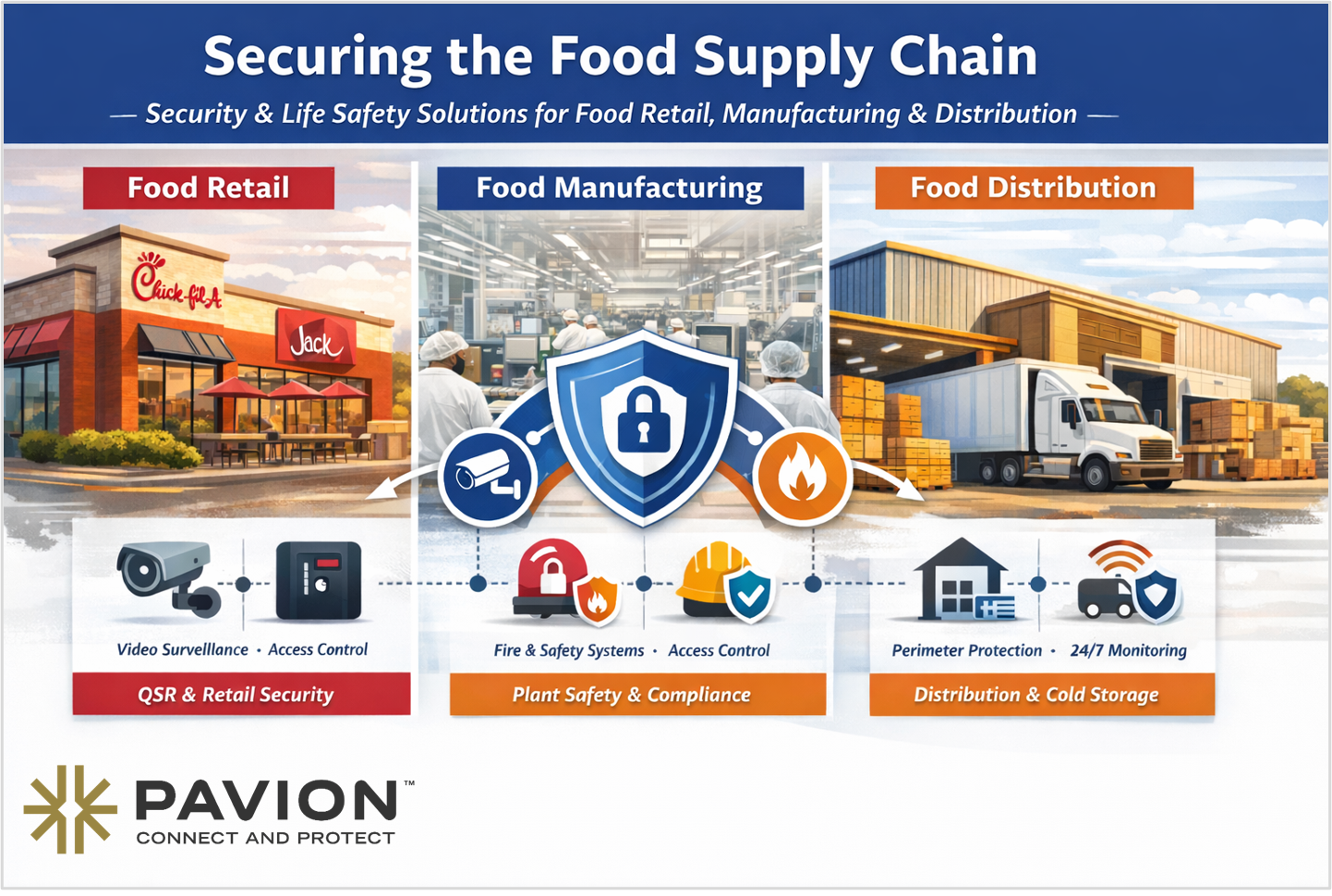
Food Retail & QSR
In fast-paced restaurant environments, security and safety must operate quietly in the background—without disrupting customer experience or speed of service.
Modern solutions support:
- Video surveillance and analytics for loss prevention and incident review
- Access control to restrict back-of-house and after-hours entry
- Fire detection and suppression systems designed for commercial kitchens
- Proactive remote video monitoring to support lean on-site staffing models
Food Manufacturing
Manufacturing facilities demand a different level of rigor, where employee safety, product integrity, and operational continuity intersect.
Key considerations include:
- Controlled access to sensitive production areas
- Fire and life safety systems aligned with complex layouts and machinery
- Monitoring of perimeter and internal movement to reduce risk
- Integration with operational workflows and compliance requirements
Food Distribution & Cold Storage
Distribution centers are the backbone of the food supply chain—and prime targets for disruption.
Integrated systems help:
- Secure large perimeters and loading docks
- Monitor high-value inventory and temperature-sensitive goods
- Support 24/7 operations with centralized monitoring
- Improve incident response across geographically dispersed facilities
A Strategic Partner Approach to Security and Life Safety
What distinguishes leaders in this space is not just technology, but how it’s designed, deployed, and supported. Food organizations increasingly seek partners who understand the operational realities of food environments—not just individual systems.
Pavion brings together security, fire, and life safety expertise under one integrated model, helping food retailers, manufacturers, and distributors simplify complexity while strengthening resilience. By aligning technology with operational goals, Pavion supports safer workplaces, more secure facilities, and uninterrupted service—from farm to fork.
Looking Ahead: Resilience as a Competitive Advantage
As labor challenges persist, regulations evolve, and consumer expectations rise, the ability to operate safely and securely at scale will separate industry leaders from the rest.
For food retail, manufacturing, and distribution organizations, integrated security and life safety are no longer cost centers—they are enablers of growth, trust, and operational excellence.