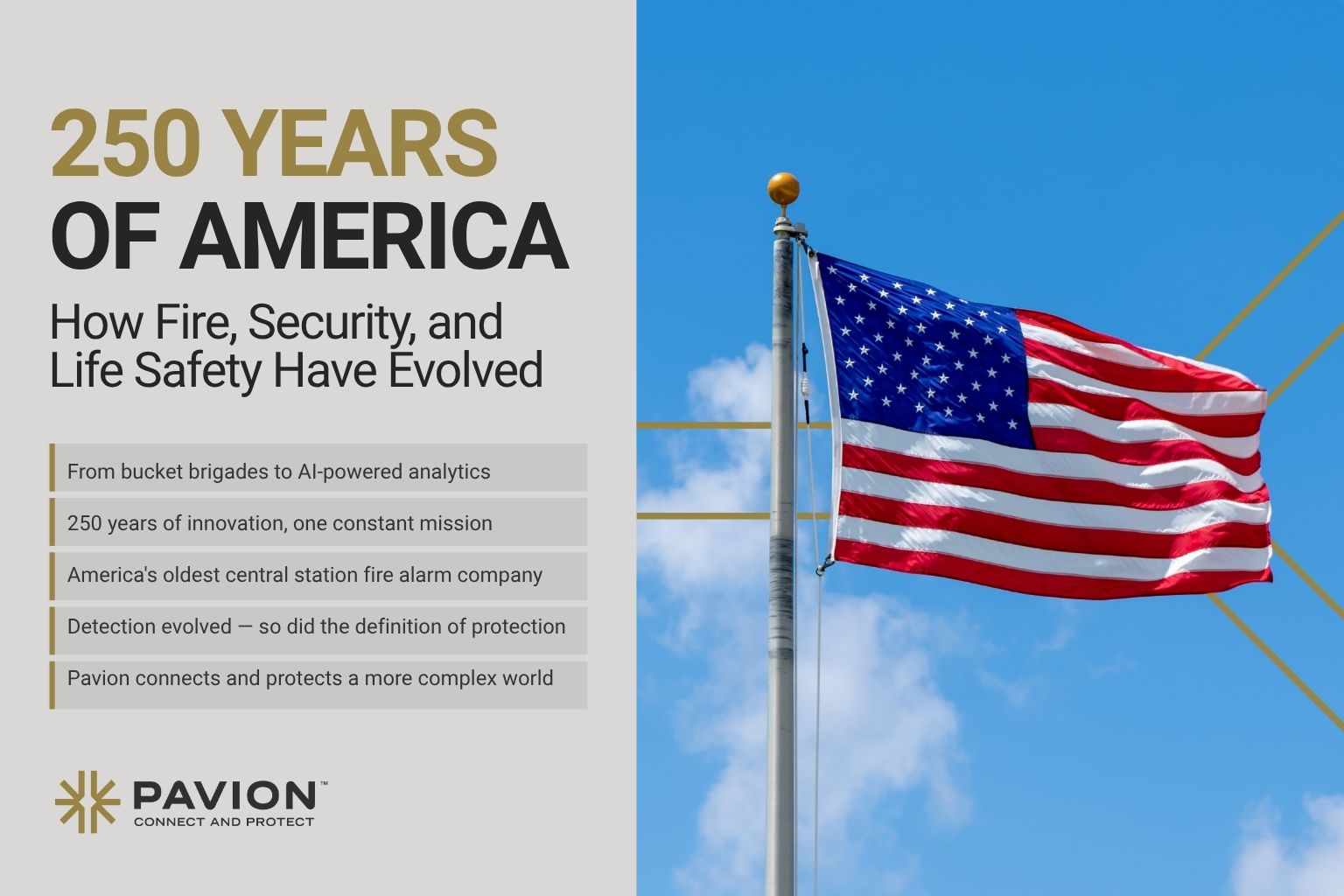
250 Years of America: How Fire, Security, and Life Safety Have Evolved

As America celebrates 250 years, the way we protect people, property, and communities has changed dramatically.
In 1776, protection depended on people. Neighbors, night watchmen, church bells, bucket brigades, locks, lanterns, and word-of-mouth were often the first lines of defense. If there was a fire or security threat, someone had to see it, hear it, and physically alert others.
Today, the industry looks very different. Fire alarm, security, video, access control, emergency communications, monitoring, cybersecurity, analytics, and service technologies are increasingly connected — helping organizations detect issues sooner, respond faster, and protect more complex environments.
The technology has changed. The mission has not.
For 250 years, fire and security professionals have worked to protect what matters most.
1776: Protection Was Personal
In 1776, America’s earliest fire and security efforts were built around people and community response.
Fire protection often meant bucket brigades, volunteers, bells, and local watchmen. Security was largely physical: locks, guards, patrols, gates, and human observation.
There were no monitored systems. No central stations. No automatic alerts. No cameras. No connected buildings.
If something happened, response depended on someone being close enough to notice.
As Cities Grew, So Did the Need for Faster Response
As America moved into the 1800s, cities became larger, denser, and more industrial. More homes, businesses, factories, warehouses, and public buildings meant greater risk.
A fire in a crowded city could spread quickly. A security incident could go unnoticed until it was too late. Communities needed better ways to communicate emergencies and coordinate response.
This period marked an important shift: protection was no longer only about reacting. It was becoming about creating systems that could help people respond faster.
The Telegraph Era: Buildings Begin to Communicate
The mid-1800s changed the future of fire and security. Telegraph technology made it possible to send emergency signals across distance, helping move the industry beyond bells, runners, and word-of-mouth.
In 1852, Boston placed the first municipal electric fire alarm system into operation, using call boxes and automatic signaling to identify the location of a fire. The system was developed by William Channing and Moses Farmer and became an important milestone in emergency communication.
This was a major turning point. For the first time, technology could help communicate danger from one location to another in a faster, more organized way.
It was the beginning of a powerful idea that still defines the industry today: when something goes wrong, the right people need the right information as quickly as possible.
1873: AFA Protective Systems Helps Shape Central Station Fire Alarm Monitoring
In 1873, the company that would become AFA Protective Systems was established. AFA Protective Systems, a Pavion company, traces its roots to the Automatic Signal Telegraph Company of New York City, which was incorporated in 1873 under the Telegraph Company Act of 1848.
AFA’s heritage as the nation’s oldest central station fire alarm company remains a meaningful part of its history.
By 1875, the Mayor of New York City asked the company to transmit fire alarm signals directly to Fire Department headquarters, showing the growing importance of central station monitoring and faster emergency communication.
For Pavion, this legacy is especially meaningful. Long before today’s connected systems, AFA was helping pioneer the idea that fire alarms should not only sound locally — they should communicate critical information to the people who could respond.
Standards, Sprinklers, and the Professionalization of Safety
By the late 1800s and early 1900s, fire protection became more formal, technical, and standardized.
Sprinkler systems, electrical signaling, fire alarm systems, and inspection practices became increasingly important as commercial buildings and industrial facilities grew. The National Fire Protection Association traces its origins to an 1895 meeting in Boston focused on sprinkler installation consistency, and NFPA was officially established in 1896.
That standardization helped move fire protection from a patchwork of local practices toward a more consistent, professional industry.
The focus was expanding from “How do we respond to an emergency?” to “How do we reduce risk before an emergency becomes a disaster?”
Detection, Monitoring, and Video Expand the Mission
By the mid-20th century, the industry had entered a new era. Fire alarm systems, smoke detection, intrusion alarms, central station monitoring, and early video surveillance continued to expand.
Facilities were becoming more complex. Hospitals, schools, government buildings, offices, manufacturing plants, and large commercial spaces needed more advanced protection.
The industry’s role grew too. Fire and security were no longer just about individual devices. They were becoming part of a larger safety strategy that included detection, notification, monitoring, verification, and response.
The Digital Shift: Systems Become Smarter and More Connected
By the late 20th century and early 2000s, the industry changed again.
Analog systems gave way to digital technology. Security cameras moved from tape-based recording to networked video. Access control became more advanced. Fire alarm panels became more intelligent. Monitoring centers gained better tools. Customers began expecting more visibility across multiple locations.
The rise of IP-based systems opened the door to remote access, digital storage, video analytics, integrated dashboards, and more scalable enterprise solutions.
This was another major shift: fire and security systems were no longer just standalone tools. They became connected platforms that could support operations, compliance, safety, and business continuity.
The AI and Analytics Era: From Detection to Intelligence
The newest chapter in the industry is being shaped by artificial intelligence, analytics, automation, and cybersecurity.
Modern systems are no longer limited to detecting that something happened. Increasingly, they help organizations understand what is happening, where it is happening, and what may need attention next.
In security, AI-powered video analytics can help identify unusual activity, detect objects or motion patterns, support perimeter protection, and reduce false alarms. In cybersecurity, AI can help organizations monitor for suspicious behavior, detect potential threats faster, and support stronger response strategies. In fire and life safety, connected systems and data-driven insights can help teams better understand system health, maintenance needs, and risk across their environments.
AI does not replace the need for experienced professionals, trusted partners, or human decision-making. Instead, it helps provide better information faster — giving teams more visibility, more context, and more confidence when responding to potential issues.
This evolution is moving the industry from reactive protection toward more proactive awareness.
For customers, the value is not just more technology. It is better visibility, stronger decision-making, and faster response.
Today: Pavion Connects and Protects in a More Complex World
Today, fire, security, and life safety are more connected — and more important — than ever.
Organizations are protecting more than buildings. They are protecting people, data centers, healthcare environments, schools, campuses, retail networks, critical infrastructure, government facilities, and enterprise operations. At the same time, they are navigating evolving compliance requirements, cybersecurity concerns, labor challenges, aging systems, and the growing need for real-time visibility.
That is where Pavion’s One Pavion approach becomes especially important.
As a service-based systems integrator, Pavion provides fire, security, audiovisual, and critical communications solutions across industries including education, healthcare, government, technology, and data centers.
Across the business, our teams work together as one Pavion to bring customers deep expertise, national reach, local service, and a shared commitment to helping them connect and protect what matters most. The work now goes far beyond installing individual systems. Today’s customers need a partner who can help them design, install, monitor, inspect, service, modernize, and integrate critical technologies across their environments.
Modern protection may include fire alarm and life safety systems, security and intrusion detection, video surveillance and analytics, access control, emergency communications, AV and critical communications, central station monitoring, cybersecurity, testing and inspections, maintenance, service support, and lifecycle planning.
The industry has moved from simple alarms to intelligent, connected ecosystems. Pavion reflects that evolution by bringing together fire, security, communications, AV, monitoring, analytics, cybersecurity, and service to create safer, smarter, and more resilient environments for the customers and communities we serve.
From 1776 to Today: The Mission Continues
In 1776, protection depended on someone seeing danger and calling for help.
In the 1800s, telegraph systems helped emergencies travel faster than a person could run.
In 1873, AFA helped shape the future of central station fire alarm monitoring.
In the 1900s, standards, detection, monitoring, and video expanded what protection could mean.
By 2000, digital systems began connecting facilities in new ways.
Today, Pavion continues that story by helping organizations connect and protect the people and places that matter most.
America has changed dramatically over the last 250 years. So has the fire, security, and life safety industry.
But the purpose remains the same: protect lives, reduce risk, and help people respond when every second matters.