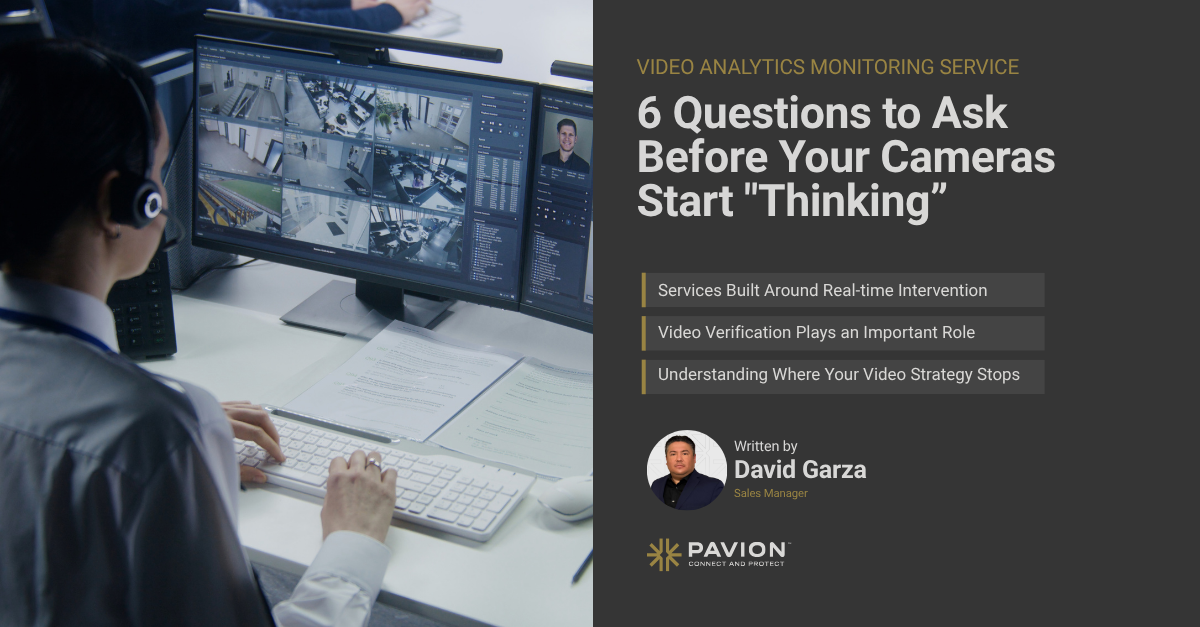
Video Analytics Monitoring Service: 6 Questions to Ask Before Your Cameras Start “Thinking”

Most commercial properties aren’t short on cameras. They’re short on attention.
A typical facility can have dozens or even hundreds of cameras recording around the clock, yet almost no one is watching most of that footage in real time. Video often becomes valuable only after something has already gone wrong, when someone has to scroll back through hours of recordings to piece together what happened.
That’s the gap a video analytics monitoring service is designed to close. By pairing intelligent video analytics with trained monitoring professionals, organizations can move from reviewing incidents to responding while they’re still unfolding.
But not every approach to video analytics delivers the same results. Before investing, here are six questions worth asking.
1. What Problem Are You Really Trying to Solve?
Video analytics can do a lot, which is exactly why it’s important to start with a clear goal.
Are you trying to stop after-hours trespassing at a distribution yard? Reduce loitering near entrances? Protect a vacant property? Cut down on false alarms that pull staff or police away from real issues? Each of those goals points toward different analytics, camera placements, and response procedures.
Organizations that start with specific problems tend to get far more value than those that turn on every available feature and hope for the best. Define the outcome first, then choose the analytics that support it.
2. Can the System Tell the Difference Between Movement and a Real Threat?
Traditional motion detection was a meaningful step forward, but it has a well-known weakness: it reacts to change, not context. Shadows, weather, headlights, and animals can all trigger alerts.
AI-powered analytics take a more sophisticated approach by identifying objects and evaluating activity against defined rules. Instead of simply asking whether something moved, an intelligently configured system can help answer more useful questions, such as whether a person has crossed a perimeter or is lingering in a restricted area longer than expected.
Pavion explores this shift in detail in AI-Powered Video Analytics: Beyond Motion Detection, which explains why context matters more than movement alone.
When evaluating a video analytics monitoring service, ask how alerts are filtered and what happens to the noise. Fewer, better alerts are usually worth more than a constant stream of them.
Want trained specialists behind your analytics?
See Pavion’s proactive security video monitoring and how verified threats get a real-time response.
3. Who Is Watching When the Analytics Flag Something?
Analytics are excellent at noticing. People are still essential for judging.
The most effective monitoring models combine both. Software detects a potential threat, and a trained specialist reviews the video, verifies what’s happening, and decides on the right next step.
That human layer matters. It helps separate a delivery driver who took a wrong turn from someone testing door handles at 2 a.m. It also helps ensure that when police or keyholders are contacted, it’s for a verified reason.
Pavion’s proactive security video monitoring follows this model: intelligent software detects a threat, an expert assesses and verifies it, a security specialist intervenes, keyholders respond, and incident reports are shared within 24 hours.
4. Does Monitoring Lead to Intervention or Just a Report?
There’s a big difference between learning about an incident the next morning and interrupting it while it’s happening.
Some services focus on recording and reporting. Others are built around real-time intervention, such as live audio talk-down through on-site speakers, contacting keyholders, or dispatching authorities once an event is verified.
Ask potential partners to walk you through an actual scenario:
- An alert fires after hours. How quickly is it reviewed?
- What does the monitoring specialist see?
- What actions can they take in the moment?
- Who gets notified, and in what order?
- What documentation do you receive afterward?
The answers will tell you whether the service is designed for prevention or simply documentation.
Video verification plays an important role here. By pairing alarm signals with live video, security teams can confirm what’s happening before dispatching help, which supports faster, more accurate response and fewer false alarms. Learn more about Pavion’s video verification.
Wondering if your existing cameras can support analytics?
Explore Pavion’s commercial video surveillance solutions and request an assessment of what you already have.
5. Will It Work With the Cameras and Systems You Already Have?
Many organizations assume that adding analytics means replacing their camera infrastructure. That isn’t always the case.
Depending on the environment, analytics and monitoring may be layered onto existing IP cameras and video management systems. The right approach depends on camera quality, placement, network capacity, and the analytics you want to run.
It’s also worth asking how video analytics will connect with the rest of your security environment. When monitoring works alongside access control, intrusion detection, and alarm systems, operators get a far more complete picture of every event.
A good evaluation should identify what can stay, what should be upgraded, and where a few targeted changes could make a meaningful difference.
6. Is Video Analytics Only About Security?
Security is usually the starting point, but it doesn’t have to be the finish line.
The same analytics that detect intrusions can also reveal occupancy trends, traffic patterns, high-activity areas, and operational bottlenecks. Operations, facilities, and even HR teams may find value in insights that were already being captured by cameras but never analyzed.
Pavion’s article on how AI video analytics turn security into business intelligence explores how organizations are using these insights across departments.
That broader value can strengthen the business case for investment, especially when multiple teams benefit from the same technology.
From Recording the Past to Responding in the Present
Cameras have always been good at remembering. With the right analytics and the right people behind them, they can also help organizations act.
A strong video analytics monitoring service doesn’t just generate alerts. It filters noise, verifies real threats, supports timely intervention, and fits into the broader security environment you’ve already built.
For organizations exploring this shift, the best first step is understanding where your current video strategy stops, and where you need it to go. Explore Pavion’s commercial video surveillance solutions and broader commercial security solutions to see how monitoring and analytics fit together.
Ready to see what your cameras could catch?
Contact Pavion to schedule a personalized consultation today.
FAQs About Video Analytics Monitoring Services
What is a video analytics monitoring service?
A video analytics monitoring service combines intelligent video analytics software with live monitoring by trained specialists. The analytics detect potential threats, and monitoring professionals verify activity and determine the appropriate response.
How is video analytics different from traditional motion detection?
Traditional motion detection reacts to changes in an image, which can trigger alerts from shadows, weather, or animals. AI-powered video analytics identify objects and evaluate activity against defined rules, providing more context about whether an event actually matters.
Can video analytics reduce false alarms?
Yes. Pairing analytics with human verification helps confirm whether an alert reflects a real threat before anyone is dispatched, which helps reduce false alarms.
Do I need new cameras to use video analytics monitoring?
Not necessarily. Depending on camera quality, placement, and network infrastructure, analytics and monitoring may be added to existing IP cameras and video management systems. A site assessment can determine what is needed.
What industries benefit from video analytics monitoring?
Organizations across retail, distribution and storage, education, healthcare, property management, government, finance, and technology and data centers use video monitoring to protect people, property, and assets. Learn more about Pavion video monitoring.