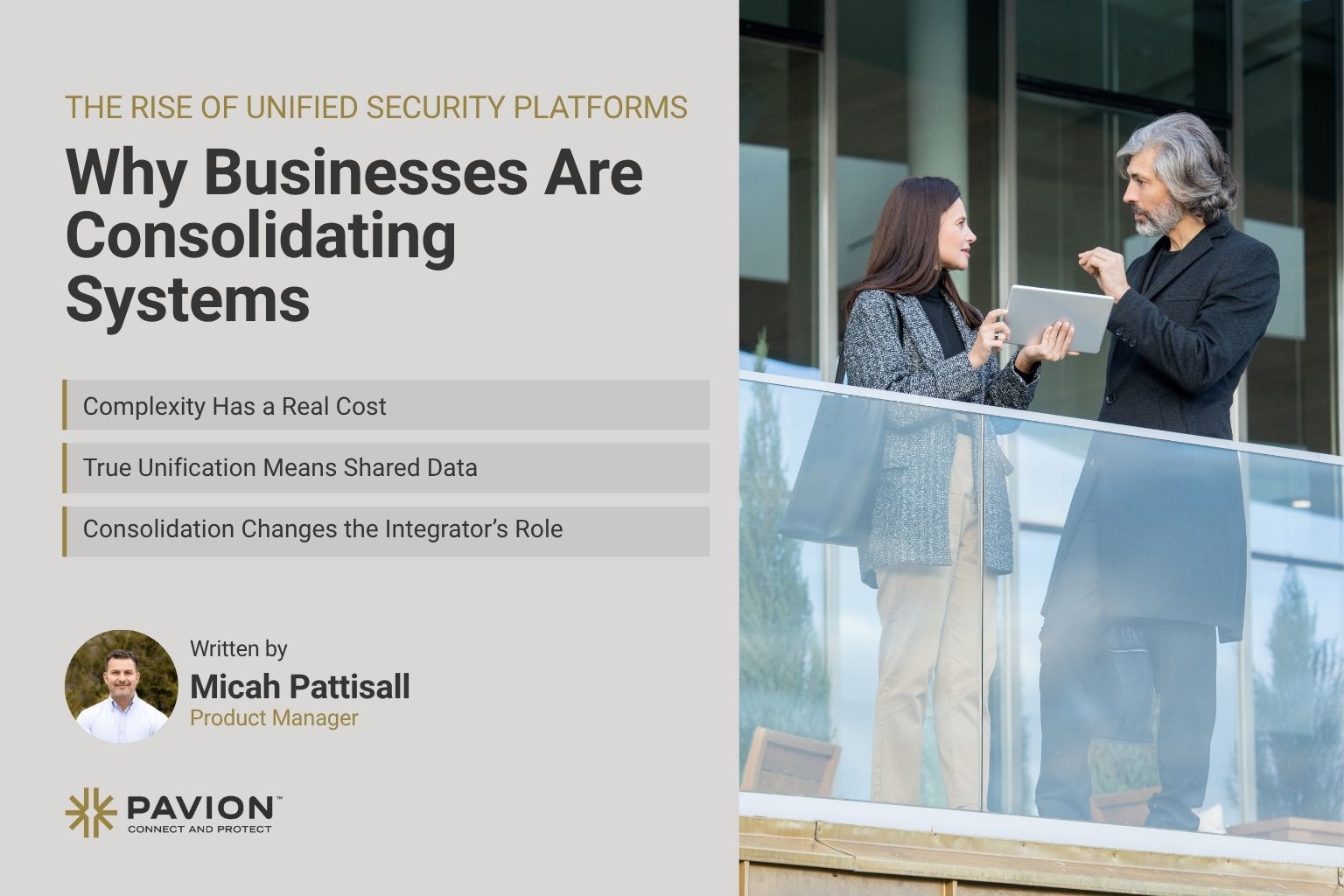
The Rise of Unified Security Platforms: Why Businesses Are Consolidating Systems

Walk into almost any mid-size facility’s security operations room today and you’ll still find four or five different logins open on the same desk: one for video, one for access control, one for intrusion, maybe a separate app for visitor management. Ask the operator which system caught last month’s tailgating incident, and it took three screens and a phone call to confirm.
That gap between what security technology can do and how most organizations actually operate it isn’t a training problem. It’s an architecture problem, and it’s the reason unified security platforms have moved from a nice-to-have to a board-level priority.
For years, security stacks grew the way most IT environments do: organically. Video gets added first, then access control from a different manufacturer, then an intrusion panel bolted on during a renovation, then a visitor management tool because a compliance audit demanded it.
Each addition solved an immediate problem but brought along another vendor relationship, another maintenance contract, and another interface an operator had to learn.
Genetec’s 2026 State of Physical Security survey found that more than 70% of end users now run unified or integrated systems, and 60% cited the ability to add new capabilities as their top reason for replacing legacy technology.
Customers aren’t asking for more features anymore. They’re asking for fewer places to look when something goes wrong.
Complexity Has a Real Cost, Not Just an Inconvenience
Industry research on enterprise security operations has found that the average organization juggles dozens of security-related tools across two to three dozen vendors, a figure that tracks closely with what integrators see in the field.
That sprawl isn’t just an operator annoyance. It slows incident response and inflates total cost of ownership through duplicate licensing, redundant support contracts, and staff hours spent reconciling data that should have matched in the first place.
Every extra system is another point of failure and another renewal date to track.
True Unification Means Shared Data, Not Just Shared Dashboards
Vendors have gotten good at marketing “unified” platforms, but there’s a meaningful difference between systems that share a common data layer and systems that simply pass information back and forth through APIs.
In a genuinely unified architecture, an access event and its corresponding video clip are the same record, correlated in real time, not two separate logs an operator has to line up by timestamp after the fact.
Integrators evaluating platforms on behalf of clients should press vendors on this distinction before assuming consolidation has actually been achieved, because a dashboard that aggregates screens isn’t the same thing as a platform that aggregates data.
Consolidation Changes the Integrator’s Role, Not Just the Customer’s Stack
As platforms absorb more of the integration work that used to be custom-built on-site, the value an integrator delivers shifts toward system architecture, cybersecurity hardening, and lifecycle management rather than a one-time installation.
Organizations moving to unified platforms increasingly expect a partner who can design the right hybrid model for their sites, weigh interoperability and migration rights, and stay accountable after commissioning, not simply connect boxes and hand over a punch list.
Unified platforms won’t eliminate best-of-breed point solutions overnight, and vendor lock-in remains a legitimate concern worth weighing carefully.
But the direction is clear: organizations that keep stacking disconnected tools will keep paying for that complexity in slower response times and higher overhead.
Before your next system refresh, take stock of how many logins your team actually needs, and ask whether your roadmap is built around outcomes or simply around inventory.
Frequently Asked Questions About Unified Security Platforms
What is a unified security platform?
A unified security platform brings multiple physical security systems, such as video surveillance, access control, intrusion detection, and visitor management, into a single environment. Rather than managing separate applications, organizations can monitor security events, access information, and coordinate responses through a centralized platform.
What are the benefits of unified security platforms for businesses?
Unified security platforms help businesses simplify security operations, improve incident response, and reduce the complexity of managing multiple systems. By connecting security technologies and centralizing information, organizations can improve operational efficiency, increase visibility across facilities, and potentially lower long-term maintenance and support costs.
What is the difference between unified and integrated security systems?
Integrated security systems connect separate technologies, often through APIs or third-party software, allowing them to exchange information. Unified security platforms are designed to operate within a more closely connected architecture, providing a consistent user experience and shared data management. Both approaches can improve security operations, but the level of interoperability and functionality varies by platform.
Why are businesses consolidating their physical security systems?
Businesses are consolidating physical security systems to reduce operational complexity, eliminate redundant tools, and improve coordination between security technologies. Managing video surveillance, access control, and intrusion detection through fewer platforms can help security teams respond more efficiently while supporting future growth and technology upgrades.
Can unified security platforms work with existing security systems?
Yes, many unified security platforms can connect with existing cameras, access control hardware, and other security technologies. However, compatibility depends on the manufacturers, system architecture, and supported integrations. A qualified security integrator can evaluate existing infrastructure and recommend a migration strategy that minimizes disruption while protecting current investments.
How can businesses transition to a unified security platform?
Transitioning to a unified security platform begins with evaluating existing security systems, identifying operational challenges, and establishing long-term security goals. Working with an experienced security integrator like Pavion can help organizations assess compatibility, develop a phased migration plan, address cybersecurity considerations, and create a scalable security infrastructure that supports evolving business needs.