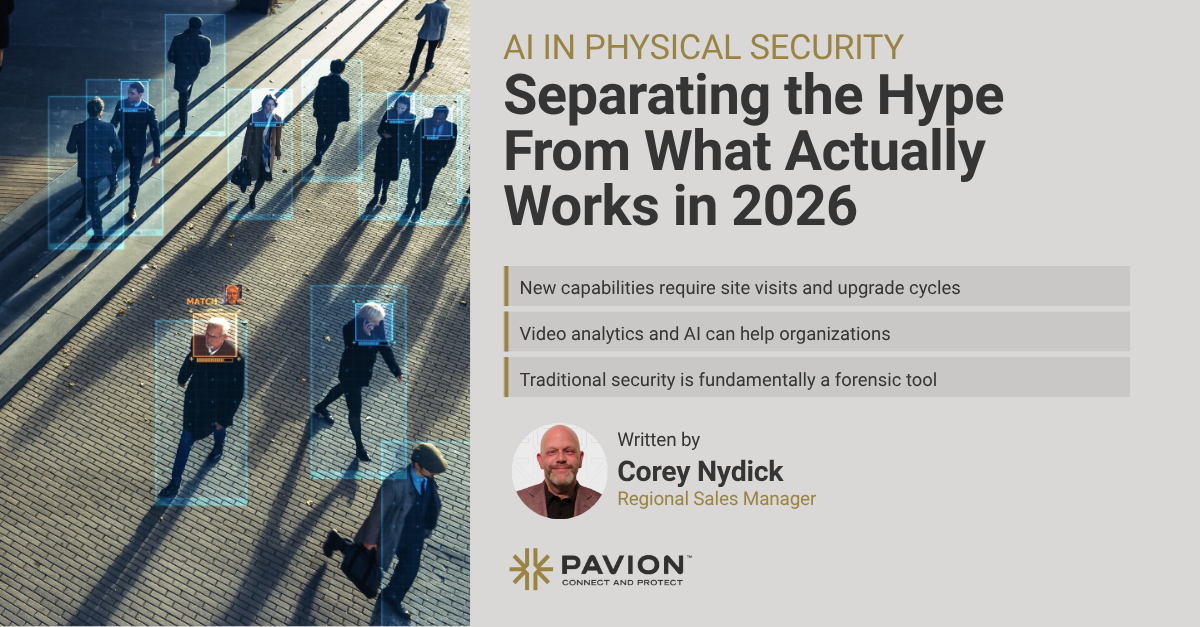
AI in Physical Security: Separating the Hype From What Actually Works in 2026

Walk any security trade show floor this year and you will hear the same two letters over and over. Every camera is an AI camera. Every platform has an AI engine. Every brochure promises intelligence.
And yet, when you ask a security director what their AI actually did for them last quarter, the room usually gets quiet.
That gap between the promise and the proof is the real story of 2026. The technology is genuinely good now. The problem is that most organizations have not figured out how to move from a pilot in one building to a program that changes how their security operation runs.
But the opportunity extends well beyond security alone. When implemented correctly, AI-enabled physical security systems can support customer experience, operations, marketing, staffing, and revenue generation in addition to protecting people and property.
Here is what the data says, what is actually working, and how to tell the difference.
The Pilot Problem Nobody Talks About
A global survey of 2,741 IT and security leaders found that 80 percent of organizations have started with AI in physical security. Only 41 percent are past the pilot stage.
Read that again, because it is the most important number in the industry right now. Four out of five organizations have kicked the tires. Fewer than half of those have taken it anywhere.
Starting with AI is easy. Operationalizing it is the hard part, and that is where most security programs are stuck.
The same research found something else worth paying attention to. Fully cloud-managed organizations actively use AI at 2.6 times the rate of fully on-premise ones. Fifty-seven percent versus 22 percent. Hybrid environments land in the middle at 38 percent.
The reason is structural. With on-premise hardware, your compute is fixed the day you buy it. New capabilities require site visits and upgrade cycles. If your infrastructure cannot absorb new features, no amount of AI enthusiasm will help you.
Architecture is not a side conversation to AI strategy. It is the prerequisite.
The Market Has Gotten Skeptical, and That Is a Good Thing
The industry conversation has shifted in a way that should make buyers feel better, not worse. Analysts now describe the move from AI hype to what they call intelligent automation: practical, outcome-driven capabilities that make operators measurably more effective rather than features that demo well and sit unused.
End users are also asking sharper questions. How does the model work? What data does it rely on? Where is that data stored, and who can see it?
Those are exactly the right questions, and any vendor who cannot answer them clearly should give you pause.
What Intelligent Automation Actually Looks Like
- Pattern detection across devices to flag genuine threats instead of drowning your team in alerts.
- Natural language search so an operator can describe what they are looking for instead of scrubbing hours of footage.
- Proactive deterrence that warns a person on your property before an alarm is ever raised, escalating only if the behavior continues.
- AI-verified alarm monitoring that reduces false dispatches and the costs that come with them.
- Digitized workflows for compliance and inspection tasks that currently consume hours of your team’s week.
Notice what these have in common. Every one of them replaces or streamlines a repetitive human task, and every one can produce a measurable business outcome.
But that is only part of the opportunity.
When Security Technology Creates Business Value
AI-enabled video and physical security systems can increasingly provide intelligence that supports other parts of the organization.
Consider a theater, museum, cultural institution, or nonprofit that depends heavily on donations. With the appropriate consent, governance, and privacy safeguards in place, facial recognition technology could help identify opted-in VIP guests or major donors when they arrive and alert designated personnel.
Instead of discovering the next day that an important supporter attended an event, the organization could provide a personalized experience while that person is on site. A staff member might greet them at the entrance, have their preferred cappuccino waiting, or offer the type of hospitality typically reserved for a known VIP.
That experience is no longer simply about surveillance. It becomes part of donor relations and customer experience.
The same principle applies across industries. Physical security technology can generate operational intelligence that organizations can use to make better business decisions.
Video analytics and AI can help organizations:
- Identify patterns that may indicate theft or suspicious activity before a loss occurs.
- Analyze traffic and heat maps to understand how customers move through a retail environment.
- Provide data that can help retailers understand the value of high-traffic areas such as end caps or promotional displays.
- Identify predictable periods of higher or lower occupancy.
- Give operations and HR teams additional information to help align staffing levels with expected demand.
- Reduce investigation time and the labor associated with manually reviewing footage.
- Minimize false alarms, unnecessary dispatches, and avoidable operational costs.
That changes the financial conversation around physical security.
Traditionally, security has often been viewed primarily as an expense: necessary for protecting people, property, and operations but difficult to connect directly to revenue.
AI and intelligent automation create the opportunity to view that investment differently.
When the same infrastructure can help prevent losses, improve staffing decisions, provide business intelligence, enhance customer experiences, and create operational efficiencies, physical security begins contributing measurable value across the organization.
The strongest AI business case is not simply better security. It is better security combined with better business intelligence.
From Watching to Preventing
The most meaningful change in physical security is not that cameras got smarter. It is that systems stopped waiting.
Traditional security is fundamentally a forensic tool. Something happens, you go find the footage, and you file the report. The value shows up after the loss.
Proactive systems invert that model. They detect the behavior that precedes an incident, such as loitering after hours near a restricted area, and they intervene while intervention still matters. A voice message. A strobe. A live agent. A dispatch, but only if it is warranted.
A camera that tells you what happened is a record. A system that keeps it from happening is a result.
For a car dealership, that is the difference between reviewing catalytic converter theft footage and preventing the theft.
For a school, it is preventing vandalism instead of budgeting for the cleanup.
For a distribution center, it is intercepting a perimeter breach rather than reconciling the inventory loss afterward.
And for business leaders, the value becomes even greater when those same systems can contribute information that improves operations beyond the security department.
Five Questions to Ask Before You Buy
If you are evaluating AI capabilities this year, skip the feature list and ask these instead:
- What specific task does this remove from my team’s day? If the answer is vague, the ROI will be too.
- How will we measure it in 90 days? False alarm reduction, investigation time, response time, loss prevention, staffing efficiency, and other operational metrics can all be tracked.
- Can our current infrastructure support it? Or does this quietly require a refresh we have not budgeted for?
- Where does the data live and who governs it? Get this in writing, not in a sales deck.
- Does it work with what we already own? Open architecture helps protect the investment you have already made.
One more thing is worth saying out loud. Your physical security systems are now networked devices, which makes them a cybersecurity consideration.
Roughly 70 percent of security professionals now rank cyber-physical convergence as a top priority. A camera that can be taken offline remotely is a door left open. Treat it that way.
Where Pavion Fits
We sit in a useful spot in this conversation.
We are not a manufacturer defending a product roadmap, and we are not simply moving boxes. We design, integrate, monitor, and maintain fire, security, and integration systems across thousands of sites, which means we see what actually performs in the field versus what performs in a demo.
That perspective matters most in the messy middle, where you may have a mix of legacy panels, newer cloud cameras, multiple manufacturers, evolving operational requirements, and a compliance deadline.
The goal is not to rip everything out.
It is to get the systems you already own talking to each other, then layer intelligence where it produces a result you can measure.
And increasingly, that result does not have to live solely within the security department. The right technology strategy can support security, operations, customer experience, marketing, HR, and the broader business case for the investment.
The organizations that will pull ahead this year are not the ones with the most AI. They are the ones that identified two or three meaningful use cases, proved them with real numbers, and scaled from there.
Ready to Move Past the Pilot?
Pavion’s team helps organizations evaluate where AI, video analytics, and proactive monitoring can deliver measurable value and build a path to get there without replacing everything they already own.
Connect and Protect with confidence.
Frequently Asked Questions About AI in Physical Security
What is AI in physical security?
AI in physical security refers to the use of artificial intelligence to improve how organizations monitor, detect, investigate, and respond to potential security threats. AI-powered security systems can analyze video footage, identify unusual activity, automate repetitive tasks, and provide real-time alerts, helping organizations improve security operations and reduce manual workloads.
How is AI changing physical security in 2026?
In 2026, AI is helping physical security shift from reactive monitoring to proactive threat detection and intelligent automation. Instead of relying solely on recorded footage after an incident, organizations can use AI video analytics, automated alerts, and proactive monitoring to identify potential risks earlier, improve response times, and support more informed operational decisions.
What are the benefits of AI video analytics for businesses?
AI video analytics can help businesses detect suspicious activity, reduce investigation time, monitor occupancy trends, and better understand how people move through physical spaces. Beyond security, these insights can support staffing decisions, operational efficiency, customer experience, and loss prevention, creating measurable value across multiple departments.
Can AI-powered physical security systems help reduce costs?
Yes. AI-powered physical security systems can help reduce operational costs by minimizing false alarms, reducing unnecessary dispatches, automating time-consuming monitoring tasks, and helping prevent losses before they occur. Organizations may also gain additional value by using security analytics to improve staffing efficiency and business operations.
What is the difference between traditional security monitoring and proactive AI security?
Traditional security monitoring often focuses on recording incidents and reviewing footage after an event occurs. Proactive AI security uses intelligent analytics to identify potentially concerning behavior in real time and trigger appropriate responses, such as automated warnings, alerts to security personnel, or live monitoring interventions. This allows organizations to address potential threats before they escalate.
Can AI security technology integrate with existing security systems?
Many AI-enabled security solutions can integrate with existing video surveillance, access control, and security management platforms, depending on system compatibility and infrastructure requirements. Working with an experienced security systems integrator like Pavion can help organizations evaluate their current technology, identify integration opportunities, and implement AI capabilities without unnecessarily replacing existing investments.
How can businesses measure the ROI of AI in physical security?
Businesses can measure the return on investment (ROI) of AI in physical security by tracking metrics such as false alarm reduction, investigation time, incident response times, prevented losses, operational efficiency, and staffing productivity. Establishing clear goals and performance benchmarks before implementation helps organizations evaluate results and determine which AI capabilities are worth expanding.
How can Pavion help businesses implement AI in physical security?
Pavion helps organizations evaluate, integrate, monitor, and maintain physical security technologies, including AI-enabled video analytics and proactive security solutions. By assessing existing infrastructure and identifying practical use cases, Pavion helps businesses develop scalable security strategies that improve protection, streamline operations, and deliver measurable business value.