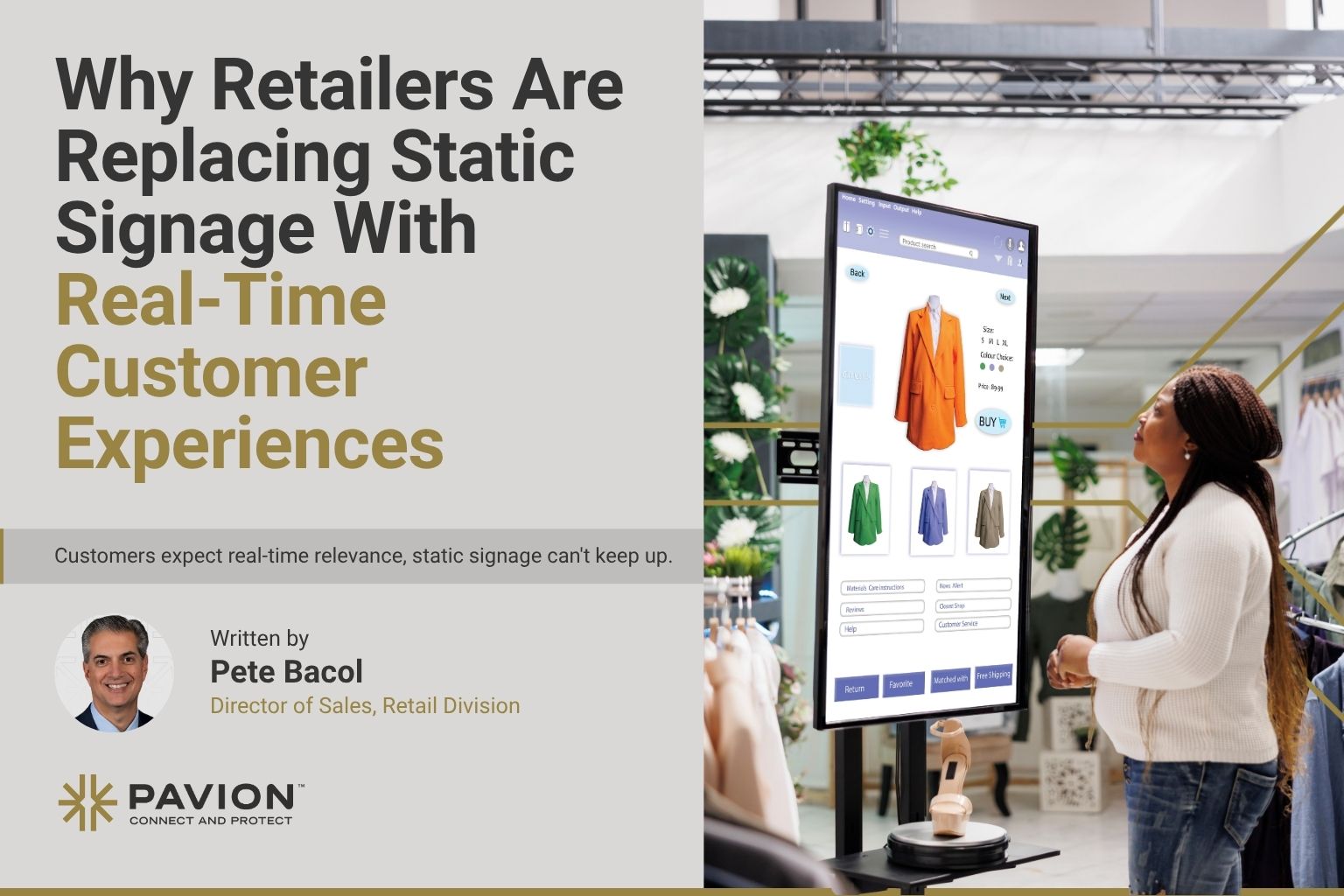
Why Retailers Are Replacing Static Signage With Real-Time Customer Experiences

Walk into almost any successful retail environment today and you’ll notice something has changed.
Customers are no longer interacting with stores the same way they did even a few years ago. They move seamlessly between online and in-store experiences, expect immediate access to information, and are increasingly influenced by dynamic content throughout their purchasing journey.
As consumer expectations continue to evolve, retailers are rethinking how they communicate with shoppers inside their stores.
For many, that shift is leading away from traditional static signage and toward digital experiences that can adapt in real time.
The goal is no longer simply to display information.
The goal is to create more engaging, responsive, and personalized customer experiences.
The Retail Environment Has Become a Media Channel
Historically, signage served a straightforward purpose.
Retailers used printed displays to communicate pricing, promotions, product information, and brand messaging.
While these materials remain useful in certain applications, they present limitations in today’s rapidly changing retail environment.
Promotions change.
Inventory fluctuates.
Consumer preferences evolve.
Seasonal campaigns come and go.
Printed signage requires time, labor, and ongoing replacement to keep pace.
Digital signage allows retailers to communicate more dynamically while maintaining greater consistency across locations.
Increasingly, retailers are viewing their physical stores as media channels capable of delivering timely and relevant content throughout the customer journey.
Today’s Consumers Expect More Relevant Experiences
Consumers have become accustomed to personalized digital experiences.
Online platforms deliver tailored recommendations, dynamic content, and real-time information based on customer behavior and preferences.
As a result, expectations have shifted.
Customers increasingly expect the same level of relevance and responsiveness when they enter physical stores.
Digital signage helps bridge that gap by enabling retailers to update messaging instantly, highlight targeted promotions, showcase new products, and respond to changing conditions throughout the day.
Rather than relying on static messaging that remains unchanged for weeks or months, retailers can create environments that feel more current, engaging, and aligned with customer interests.
Agility Has Become a Competitive Advantage
Retail operates in an environment where timing matters.
A promotion may need to be launched immediately.
Inventory levels may require product priorities to shift.
Regional stores may need location-specific messaging.
Market conditions may change unexpectedly.
Digital signage provides retailers with the flexibility to respond quickly without the operational burden associated with traditional printed materials.
This agility allows organizations to maintain consistent messaging while adapting to changing business needs in real time.
For multi-location retailers, the ability to manage content centrally while supporting local customization can be particularly valuable.
Digital Signage Supports More Than Marketing
One of the most common misconceptions about digital signage is that it exists primarily as a marketing tool.
While promotional messaging remains an important use case, retailers are increasingly leveraging digital signage to support broader business objectives.
Applications may include:
Wayfinding and navigation
Queue management
Product education
Brand storytelling
Employee communications
Event promotion
Safety messaging
Operational updates
As retail environments become more connected, digital signage is evolving into a platform that supports both customer engagement and operational efficiency.
Data Is Changing How Retailers Think About Content
Retailers have access to more information than ever before.
Sales data, customer behavior insights, inventory levels, and operational metrics all contribute to decision-making.
Digital signage creates opportunities to align messaging more closely with those insights.
Rather than relying on static campaigns, organizations can deliver content that reflects current priorities and business conditions.
This capability helps retailers move from generalized communication toward more responsive customer engagement strategies.
The result is often a more relevant experience for customers and greater flexibility for store operations.
The Future of Retail Is Dynamic
The retail industry continues to evolve as organizations seek new ways to differentiate themselves and strengthen customer relationships.
While e-commerce has changed consumer behavior, physical stores continue to play a critical role in the customer journey.
The most successful retailers are finding ways to combine the strengths of digital experiences with the advantages of in-person engagement.
Digital signage plays an important role in that strategy by helping create environments that are more informative, adaptable, and engaging.
Rather than treating signage as a static display, retailers are increasingly viewing it as a dynamic communication platform capable of supporting both customer experience and business performance.
How Pavion Helps Retailers Create More Engaging Environments
Pavion helps retailers design, deploy, and manage digital signage and audiovisual solutions that support customer engagement, operational efficiency, and brand consistency.
From single-store deployments to enterprise-wide networks, our experts help organizations implement scalable solutions that enable real-time communication and more connected retail experiences.
By combining technology, strategy, and ongoing support, Pavion helps retailers transform digital signage from a display tool into a business asset.
Frequently Asked Questions
What are the benefits of digital signage in retail?
Digital signage helps retailers improve customer engagement, update content quickly, support promotions, enhance brand experiences, and improve operational flexibility.
How does digital signage improve the customer experience?
Digital signage provides shoppers with timely information, product education, promotional messaging, wayfinding support, and more engaging in-store experiences.
Can digital signage be managed across multiple locations?
Yes. Modern digital signage platforms allow organizations to centrally manage content while supporting location-specific messaging when needed.
Is digital signage only used for promotions?
No. Retailers also use digital signage for wayfinding, queue management, employee communications, safety messaging, operational updates, and brand storytelling.
Why are retailers investing in digital signage?
Retailers are investing in digital signage to create more dynamic customer experiences, improve communication, increase flexibility, and support evolving consumer expectations.
Conclusion
Retailers are operating in an environment where customer expectations continue to evolve and speed matters more than ever.
Static signage still has a place, but it can no longer provide the flexibility and responsiveness many organizations require.
Digital signage allows retailers to communicate more effectively, adapt more quickly, and create experiences that feel relevant in the moment.
As stores continue to evolve, the ability to deliver real-time customer experiences may become one of the most valuable advantages a retailer can have.