Weapons Detection Is No Longer Just a School Security Conversation

Why More Organizations Are Reassessing How They Protect People, Facilities, and Operations
For years, conversations about weapons detection were largely focused on schools, government facilities, and high-profile venues. Today, that conversation has expanded.
Organizations across healthcare, corporate campuses, manufacturing facilities, houses of worship, entertainment venues, retail environments, and large public spaces are taking a closer look at how they protect employees, visitors, customers, and critical operations from evolving threats.
The reality is that workplace violence and active threat incidents are no longer isolated concerns. Security leaders are being asked difficult questions by executive teams, boards, employees, and customers:
Are we doing enough to keep people safe?
How quickly could we identify a potential threat?
How would we respond if an incident occurred?
What impact would an event have on our operations, employees, customers, and reputation?
As a result, weapons detection technology is becoming an increasingly important part of a comprehensive physical security strategy.
The Evolution of Weapons Detection
Traditional security screening methods have served organizations for decades. Metal detectors, bag checks, and security personnel remain valuable tools in many environments.
However, today’s organizations face new challenges.
Facilities often manage high visitor volumes, multiple entry points, staffing shortages, and increasing pressure to maintain a positive visitor experience. Long security lines, manual screening processes, and operational bottlenecks can create friction while still leaving gaps in coverage.
Modern weapons detection solutions are helping organizations address these challenges by enabling faster, more efficient screening while integrating with broader security ecosystems.
Rather than relying only on standalone screening processes, many organizations are implementing weapons detection technologies that can work alongside video surveillance, access control, visitor management, emergency communications, and incident response platforms.
The result is a more proactive approach to identifying potential threats before they become incidents.
Why Organizations Are Reassessing Weapons Detection
Weapons detection is no longer limited to one type of facility or one type of threat. Organizations are evaluating these solutions because the risks they face are more complex, more unpredictable, and often more personal.
In many situations, a threat may come from someone who knows the building, understands the entry points, or has a specific reason for targeting the organization or an individual inside.
Disgruntled Former Employees
One important use case is the risk of a disgruntled former employee.
When an employee is terminated, the situation can sometimes become emotional, tense, or unpredictable. While most departures do not create a security issue, organizations cannot ignore the possibility that a former employee may return with the intent to intimidate, threaten, or cause harm.
In some cases, facilities may already have cameras, access control, or turnstiles in place, but those systems alone may not stop someone from entering with a weapon. Weapons detection can add another layer of protection by helping identify a threat earlier in the entry process.
Employee Conflict and Workplace Violence
Weapons detection is also relevant when internal conflict escalates.
Disputes between employees, contractors, or individuals connected to the workplace can become serious when someone decides to bring a weapon into the environment. These situations can develop quickly and may not always be predictable through access control or surveillance alone.
By adding weapons detection to a broader workplace safety strategy, organizations can better support early threat identification and strengthen their ability to respond before a situation becomes more dangerous.
Music Venues, Nightclubs, and Entertainment Spaces
Smaller music venues, larger nightclubs, event spaces, and entertainment facilities are also reassessing their security strategies.
These environments often bring large groups of people together in crowded spaces. When crowds, alcohol, limited visibility, and emotionally charged situations mix, aggressive behavior can escalate quickly. If a gun, knife, or other weapon is involved, the risk to guests, employees, performers, and security teams increases significantly.
For venues focused on creating a positive guest experience, weapons detection can help improve security without creating unnecessary delays or disruption at the entrance.
Healthcare, Corporate, Retail, and Public Environments
Healthcare facilities, corporate campuses, retail centers, houses of worship, and public-facing environments are also evaluating weapons detection as part of their broader safety planning.
In healthcare, staff may interact with patients, family members, and visitors during stressful situations. In corporate settings, organizations are thinking more carefully about employee safety, visitor access, and workplace violence prevention. In retail and public spaces, security teams must balance customer experience with the need to identify potential threats quickly.
Weapons detection can support these environments by adding an important layer of protection at key entry points.
Security and Experience Must Work Together
One of the most significant shifts in physical security is the recognition that safety and user experience are no longer competing priorities.
Historically, stronger security often meant more inconvenience.
Today, organizations are looking for solutions that enhance protection without creating unnecessary disruption for employees, patients, customers, students, or guests.
This is especially important in environments where first impressions matter.
Healthcare facilities must maintain a welcoming atmosphere for patients and families. Corporate offices are focused on employee experience and collaboration. Retail environments depend on customer satisfaction and ease of access. Entertainment venues need to move guests inside efficiently while still maintaining a safe environment.
The most effective security strategies balance protection with operational efficiency.
When implemented correctly, weapons detection can support both objectives.
A Layered Security Approach Is Essential
No single technology can eliminate risk.
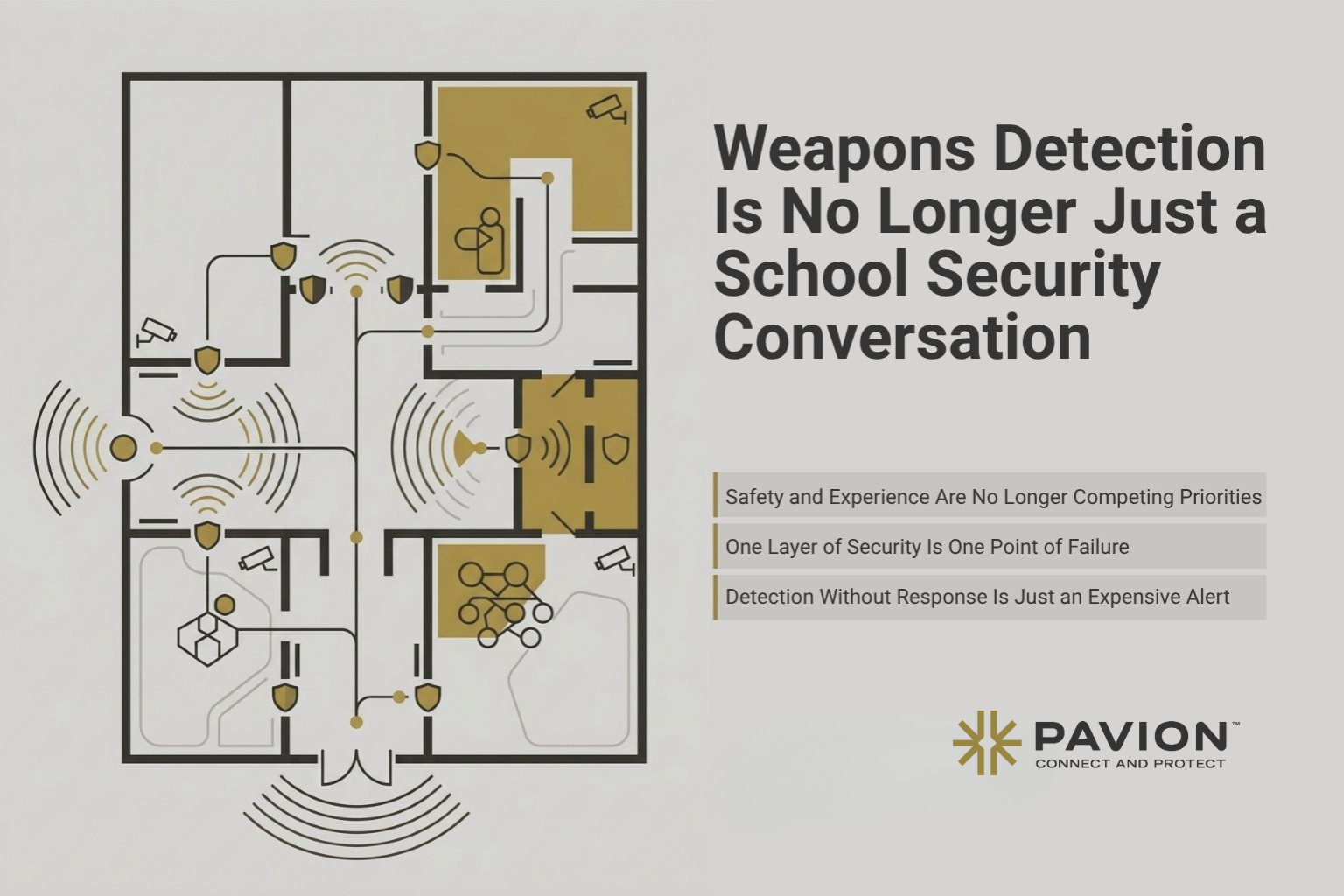
The organizations seeing the greatest success are those that view weapons detection as one component of a larger security ecosystem.
A comprehensive approach may include:
Access control systems that manage and monitor facility entry
Video surveillance that provides real-time visibility and forensic evidence
Visitor management platforms that verify and track guests
Emergency communication systems that enable rapid notification
Security monitoring and response capabilities
Employee training and preparedness programs
Incident response planning and coordination
When these systems work together, organizations gain greater situational awareness and a stronger ability to respond effectively during critical events.
Technology alone is not the answer. The real value comes from integrating people, processes, and technology into a unified security strategy.
The Business Case for Weapons Detection
Security investments are often viewed through the lens of risk reduction, but their impact extends much further.
A serious security incident can result in:
Operational disruption
Business downtime
Employee retention challenges
Reputational damage
Legal and regulatory consequences
Loss of customer confidence
Emotional impact on employees and communities
For many organizations, the question is no longer whether security threats exist. The question is whether current security measures align with today’s risk landscape.
Forward-thinking leaders are evaluating how emerging technologies, including weapons detection, can help strengthen resilience while supporting broader business objectives.
Considering the Investment
Another important factor is affordability.
Weapons detection technology has evolved significantly, and there are now more options available than ever before. As these solutions continue to gain popularity, many organizations are finding that weapons detection is more accessible than they may have assumed.
Organizations should work with a trusted security partner to evaluate the right solution for their environment, risk profile, traffic flow, and operational needs.
It is also worth discussing whether weapons detection can be structured as an operating investment rather than one large capital expense. In some cases, a subscription-based model or monthly investment approach may help organizations move forward with improved security while better aligning with budget planning.
The right security partner can help assess available options, integration opportunities, and investment models that make sense for the organization.
Looking Ahead
As threats continue to evolve, so will the technologies designed to address them.
Weapons detection is becoming an important part of modern physical security strategies because it enables organizations to move beyond reactive security models and toward earlier threat identification, better situational awareness, and more informed response.
The organizations that will be best positioned for the future are those that take a holistic view of security. That means prioritizing safety, operational continuity, employee confidence, visitor experience, and long-term resilience.
Protecting people remains the ultimate goal.
Achieving that goal requires organizations to continually evaluate whether their security strategies are keeping pace with the world around them.
Talk to Pavion About Weapons Detection Solutions
Every organization has a different risk profile, facility layout, visitor flow, and operational environment. The right weapons detection strategy should be built around those unique needs.
Pavion works with organizations to design, integrate, and support security solutions that connect weapons detection with broader physical security systems, including video surveillance, access control, visitor management, emergency communications, and monitoring.
If your organization is reassessing workplace safety, entry screening, or active threat preparedness, Pavion can help you evaluate the right approach.
FAQs
What industries are adopting weapons detection technology?
Healthcare, education, corporate campuses, manufacturing facilities, houses of worship, government buildings, sports venues, entertainment facilities, nightclubs, music venues, and retail organizations are increasingly evaluating weapons detection solutions.
Can weapons detection replace security personnel?
No. Weapons detection technology is most effective when used as part of a layered security strategy that includes trained personnel, policies, procedures, emergency response planning, and integrated security systems.
How does weapons detection improve security operations?
Modern weapons detection solutions can help organizations identify potential threats earlier, streamline screening processes, improve situational awareness, and support faster incident response.
Is weapons detection only for high-risk environments?
No. Many organizations are implementing weapons detection as part of broader workplace safety, visitor management, and business continuity initiatives, even in environments that have not traditionally been considered high risk.
Is weapons detection affordable for smaller organizations?
Weapons detection solutions have become more flexible and accessible as the technology has evolved. Organizations should speak with a security partner about available options, including subscription-based or monthly investment models that may reduce the need for a large upfront capital expense.
How should an organization start evaluating weapons detection?
Organizations should begin by assessing their facility layout, entry points, visitor volume, current security systems, risk profile, and response procedures. A security partner can help determine where weapons detection fits within a broader layered security strategy.