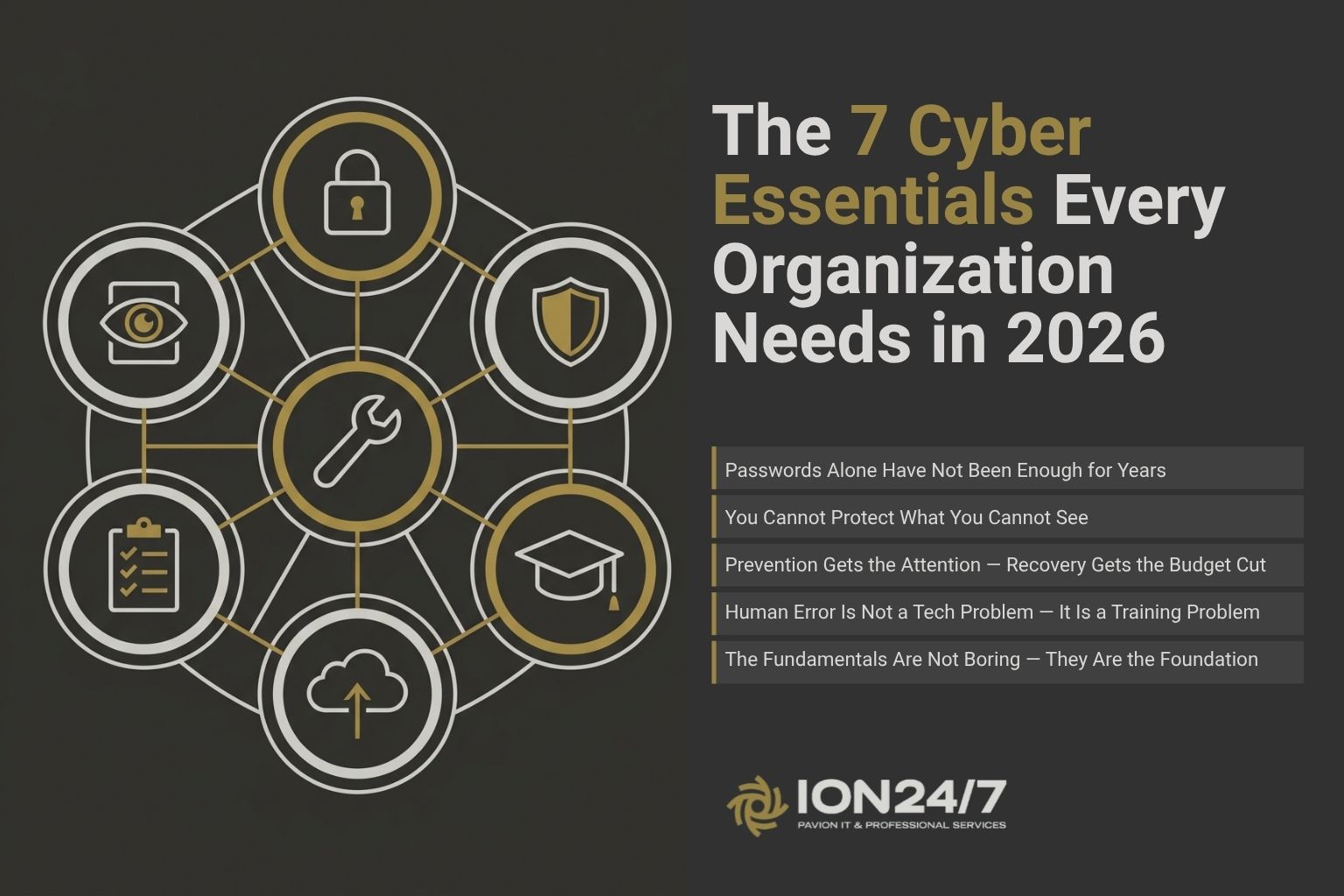
The 7 Cyber Essentials Every Organization Needs in 2026
Cyber threats are no longer just an IT problem. They impact operations, customer trust, revenue, compliance, and business continuity.
As organizations become more connected through cloud applications, remote work, IoT devices, and integrated security systems, the attack surface continues to grow. While cybersecurity technologies continue to evolve, the fundamentals remain the foundation of a strong security strategy.
Organizations that consistently focus on the basics are often better positioned to prevent attacks, limit damage, and recover quickly when incidents occur.
Here are seven cyber essentials every organization should prioritize in 2026.
1. Multi Factor Authentication
Passwords alone are no longer enough.
Stolen credentials remain one of the most common ways attackers gain access to corporate networks, email platforms, and cloud environments. Multi Factor Authentication, also known as MFA, adds an important layer of protection by requiring users to verify their identity through a second method, such as a mobile device, authentication app, or biometric verification.
Organizations should require MFA across:
- Email platforms
- VPN access
- Cloud applications
- Administrative accounts
- Remote access solutions
Implementing MFA can significantly reduce the risk of unauthorized access, even when passwords are compromised. As a cyber essential, MFA is one of the most practical and effective steps organizations can take to strengthen access control.
2. Endpoint Protection and Monitoring
Every laptop, desktop, smartphone, tablet, and server connected to your network represents a potential entry point for attackers.
Modern endpoint protection goes beyond traditional antivirus software. Today’s solutions help organizations detect suspicious behavior, monitor activity, and respond quickly to potential threats across connected devices.
Strong endpoint protection should include:
- Behavioral analysis
- Threat detection
- Automated response capabilities
- Continuous monitoring
- Ransomware protection
Organizations should maintain visibility into all connected devices and ensure security policies are consistently enforced across the environment. Without endpoint visibility, security teams may miss early warning signs of an attack.
3. Regular Patch Management
Many cyberattacks exploit known vulnerabilities that already have available fixes.
Unfortunately, organizations often delay updates due to operational concerns, limited resources, or lack of visibility into vulnerable systems. This can leave critical systems exposed to unnecessary risk.
An effective patch management program should include:
- Operating systems
- Business applications
- Security software
- Network equipment
- IoT and connected devices
Timely patching remains one of the simplest and most effective ways to reduce cyber risk. By keeping systems updated, organizations can close security gaps before attackers have the opportunity to exploit them.
4. Security Awareness Training
Technology alone cannot stop every cyberattack.
Employees continue to be targeted through phishing emails, social engineering tactics, malicious links, and fraudulent requests. Human error remains one of the leading contributors to security incidents, which makes employee education a critical part of any cybersecurity strategy.
Organizations should provide ongoing training that helps employees:
- Identify phishing attempts
- Recognize suspicious activity
- Handle sensitive information properly
- Follow security best practices
- Report potential incidents quickly
Security awareness should be an ongoing initiative, not an annual compliance exercise. When employees understand what to look for and how to respond, they become an important layer of defense.
5. Data Backup and Recovery Planning
Cybersecurity is not only about prevention. It is also about resilience.
Even organizations with strong defenses can experience cyber incidents, ransomware attacks, hardware failures, or accidental data loss. A reliable backup and recovery strategy helps ensure that critical systems and data can be restored quickly when disruption occurs.
A comprehensive backup strategy should include:
- Automated backups
- Offsite or cloud storage
- Backup testing
- Recovery procedures
- Business continuity planning
The ability to quickly restore critical systems and data can dramatically reduce operational downtime, financial impact, and business disruption.
6. Network Visibility and Monitoring
You cannot protect what you cannot see.
Organizations need visibility into users, devices, applications, and network activity to identify unusual behavior before it becomes a serious security event. As environments become more complex, proactive monitoring becomes even more important.
Key capabilities include:
- Network monitoring
- Security event logging
- Threat detection
- User activity monitoring
- Real time alerting
Proactive monitoring helps security teams identify potential threats faster and respond before significant damage occurs. It also supports stronger decision-making by giving organizations a clearer view of their security environment.
7. Incident Response Planning
Many organizations spend significant time preparing to prevent cyberattacks, but far less time preparing for what happens after one occurs.
An incident response plan establishes clear procedures for identifying, containing, communicating, and recovering from cyber incidents. Without a documented and tested plan, teams may lose valuable time during a crisis.
An effective incident response plan should include steps for:
- Identifying threats
- Containing attacks
- Communicating with stakeholders
- Recovering systems
- Meeting regulatory requirements
- Reviewing lessons learned after an incident
Organizations that regularly test and update their response plans are typically able to reduce downtime, limit disruption, and recover more efficiently when incidents occur.
Cybersecurity Starts with the Fundamentals
Emerging technologies such as artificial intelligence, advanced analytics, and automation are reshaping cybersecurity. However, the organizations that achieve the strongest security posture are often those that consistently execute the fundamentals.
The seven cyber essentials outlined above provide a practical framework for reducing risk, improving resilience, and strengthening overall security operations.
As cyber threats continue to evolve, businesses should regularly evaluate their security posture to identify gaps, address vulnerabilities, and ensure their defenses align with today’s operational realities.
Cybersecurity is not a one time project. It is an ongoing commitment to protecting people, data, systems, and the continuity of your business.
Frequently Asked Questions
What are the most important cybersecurity basics for businesses?
The most important cybersecurity basics include Multi Factor Authentication, endpoint protection, employee security awareness training, patch management, data backups, network monitoring, and incident response planning.
Why is Multi Factor Authentication important?
Multi Factor Authentication is important because it helps prevent unauthorized access by requiring users to verify their identity using more than just a password. This significantly reduces the risk of credential-based attacks.
How often should organizations conduct cybersecurity training?
Most organizations should provide cybersecurity awareness training throughout the year. Training should be supported by phishing simulations, reminders, and updates on emerging cyber threats.
What is the biggest cybersecurity risk for businesses today?
While risks vary by industry, phishing attacks, ransomware, credential theft, and unpatched vulnerabilities remain among the most common cybersecurity risks businesses face today.
How can organizations improve cyber resilience?
Organizations can improve cyber resilience through proactive monitoring, regular backups, employee training, strong access controls, tested incident response plans, and ongoing security assessments.
Why are cyber essentials important in 2026?
Cyber essentials are important in 2026 because organizations are operating in increasingly connected environments. Cloud platforms, remote access, IoT devices, and integrated systems create more potential entry points for cyber threats, making strong security fundamentals more important than ever.