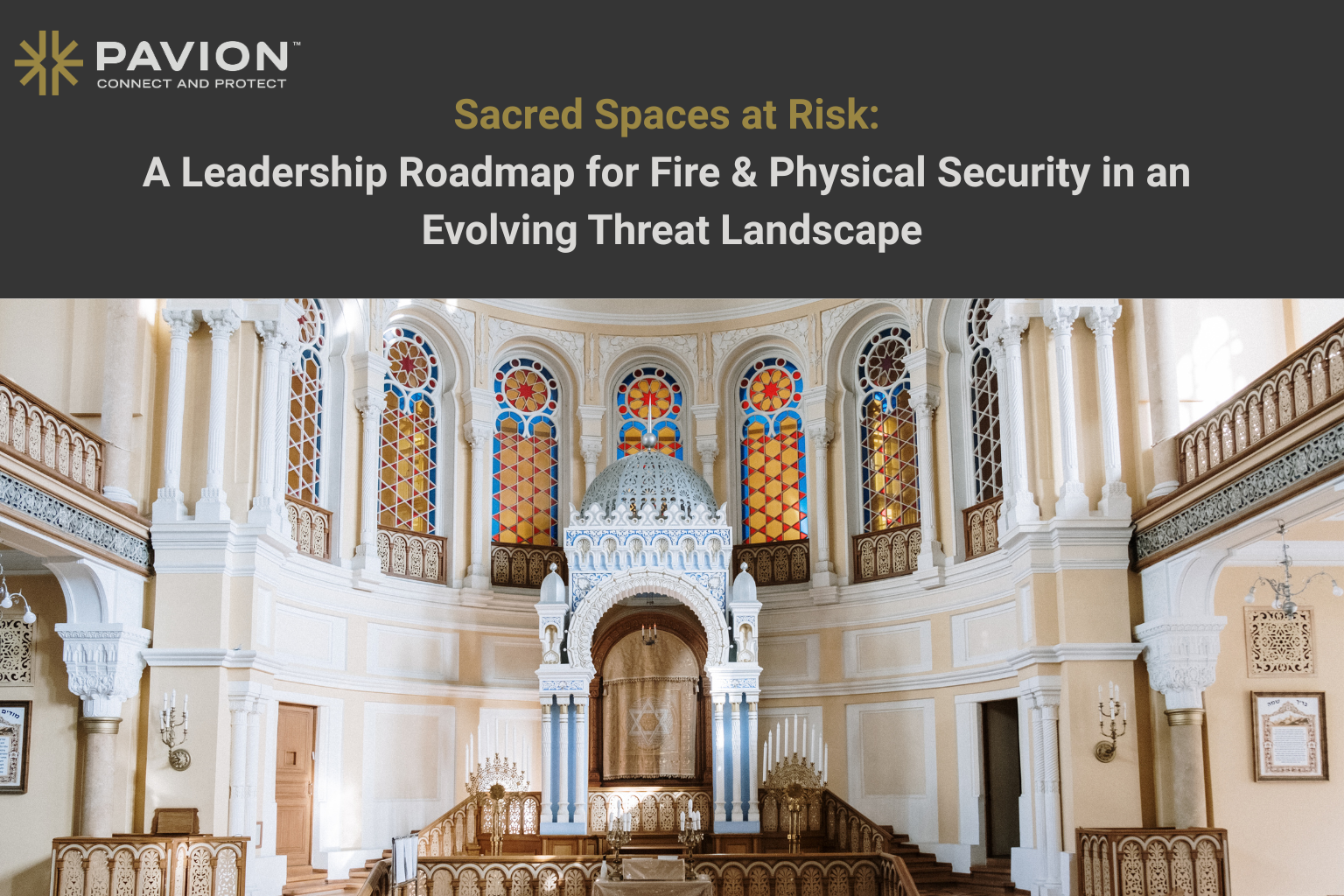
Sacred Spaces at Risk: A Leadership Roadmap for Fire & Physical Security in an Evolving Threat Landscape

Today’s security leaders face a harrowing new reality: community institutions once considered safe havens are now targeted with violence that blends active shooter threats, vehicle attacks, and fire hazards — all in a single incident.
On Thursday, March 12, 2026, law enforcement responded to reports of an active shooter at Temple Israel, a Reform Jewish synagogue in West Bloomfield Township, Michigan. According to initial police reports, a vehicle was driven into the building, followed by gunfire, and observers reported smoke and signs of fire at the scene. Authorities have issued active shooter alerts, shelter-in-place advisories, and precautionary lockdowns in nearby communities and at other houses of worship and schools as the situation continues to unfold.
This attack underscores a critical shift in how threats manifest at public gathering places — from traditional single-mode emergencies to multi-vector assaults requiring integrated fire and security strategies.
Many houses of worship are taking proactive steps to protect their staff and congregants from unexpected weapon attacks. One example is a shooter detection system, which can be deployed both indoors and outdoors. This technology identifies the ballistic signature of a bullet leaving a firearm, immediately alerting people on site and law enforcement while also helping pinpoint the location of the shooter.
In addition, for congregations concerned about weapons entering through main entrances, some houses of worship are implementing weapons detection systems. These systems can identify a variety of weapons carried by visitors while differentiating them from benign items such as cell phones or keys, providing an added layer of security without disrupting the flow of entry.
When Violence Meets Fire: The New Operational Paradigm
In incidents like the West Bloomfield synagogue situation, security failures and fire hazards can compound rapidly, creating a chaotic environment that overwhelms traditional response models. Here’s why modern threats demand an integrated approach:
Integrated Detection and Alerting
A vehicle breaching a building creates fire risks immediately:
- Crash impact can rupture gas lines or electrical systems.
- Accelerant sources — whether from vehicle fuel or deliberate ignition — amplify fire spread.
- Early integration of intrusion alarms, fire detection, and emergency alert systems ensures that all relevant teams are notified immediately.
Coordinated Emergency Response
Security and fire teams must work together to:
- Rapidly evacuate occupants along safe routes.
- Alert first responders to both the presence of a threat and potential fire hazards.
- Manage communication with building staff, congregants, and community stakeholders in real time.
Preparing for the Unthinkable: Leadership Priorities
This moment calls for leaders in fire and physical security to shift from siloed thinking to holistic risk management:
- Unified Fire & Security Platforms: Deploy systems where intrusion detection and fire alarms feed into a single command center to streamline response.
- Realistic Drills: Traditional fire drills or lockdown exercises aren’t enough. Organizations must simulate overlapping crises — such as an active shooter incident coinciding with fire hazards — to stress-test response plans.
- Community-Centered Resilience: Security leaders must foster strong ties with local fire, police, EMS, and neighboring organizations. Pre-incident planning ensures preparedness when every second counts.
Learning from Broader Context
The attack in West Bloomfield is part of a troubling pattern. Previous incidents — including a mass shooting at a church in Grand Blanc Township, Michigan, where an assailant used a vehicle and firearms before setting the building on fire — demonstrate how attackers are increasingly combining multiple threats at once.
These multi-mode attacks target not just people’s physical safety, but the psychological sense of sanctuary and community.
A Leadership Imperative: Protecting People and Purpose
While some incidents can be anticipated, many — such as the recent events in Michigan — are unpredictable. That’s why it is critical for houses of worship to establish a dedicated safety committee. This team should continuously assess potential threats, develop and update a comprehensive safety plan, and lead regular drills to practice responses. By routinely reviewing and improving the plan, the committee ensures not only the safety of everyone in the building but also the comfort and confidence of congregants and staff in responding effectively to emergencies.
The West Bloomfield tragedy underscores a vital lesson: security and fire solutions must be fully integrated, capable of responding to both violence and fire while supporting a coordinated emergency response.
Protect what matters most. Visit pavion.com to see how Pavion can keep your people and property secure.