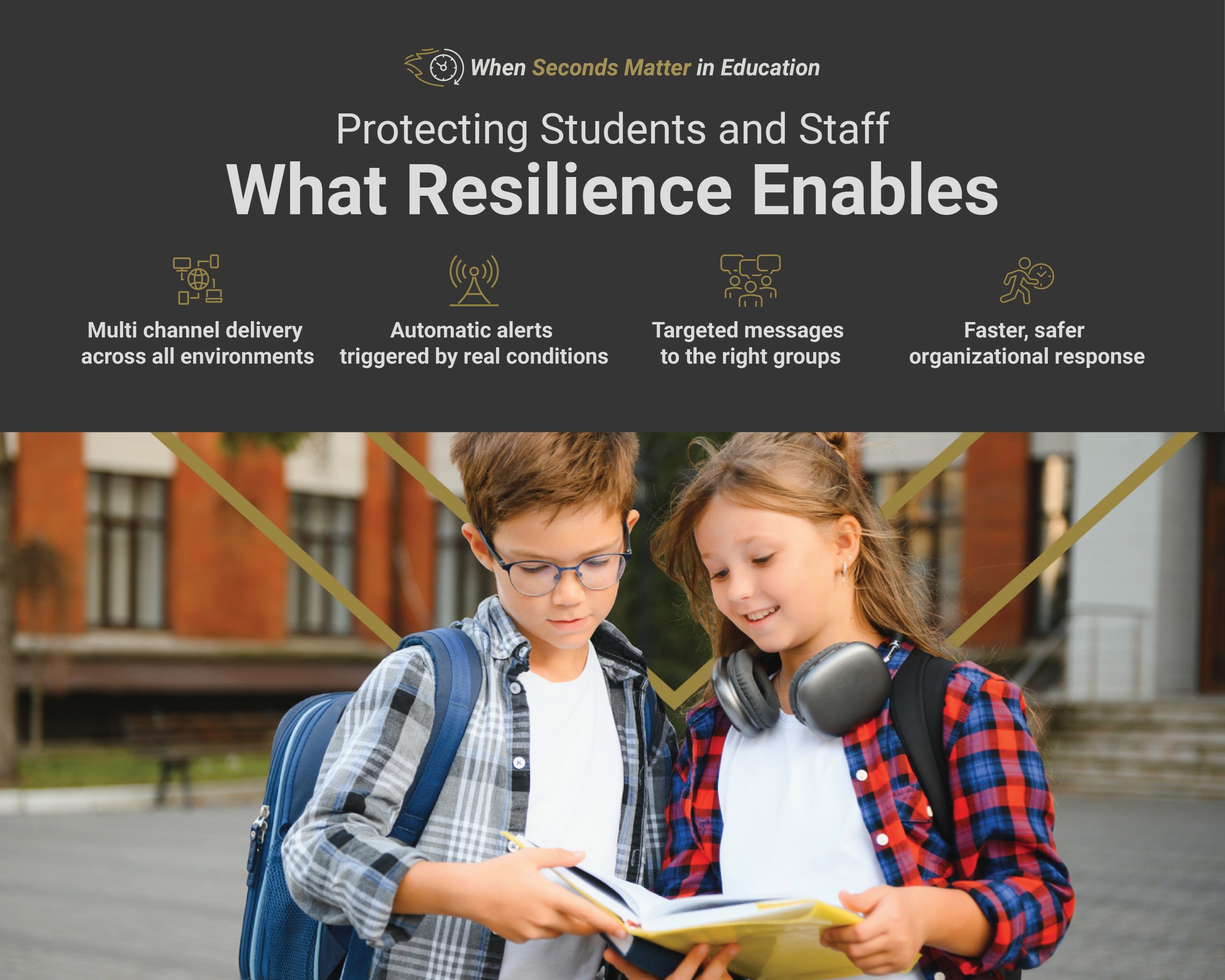
Building Resilient Communication Systems for Educational Environments

In working with educational environments across the country, one consistent finding continues to surface:
Even well-secured campuses can be compromised by communication gaps.
Locked doors, access control, surveillance cameras, and visitor management systems are critical layers of protection. However, during real-world incidents, outcomes are often determined by one factor — how quickly and clearly information moves. That is the job of a school emergency communication system.
For Security Directors, the challenge is operational.
For parents, the concern is personal.
BOTH perspectives matter.
What Patterns We’re Seeing Across the Country
Through system assessments and post-incident reviews, several patterns emerge:
- Communication systems operating in silos
- Overreliance on single-channel alerts (PA only or text only)
- Delays caused by manual notification processes
- Limited redundancy during power or network disruptions
- Inconsistent parent notification protocols
From a security standpoint, these gaps increase risk exposure.
From a parent’s standpoint, these gaps create uncertainty.
When seconds matter, communication must be immediate, multi-layered, and resilient.
Where are the communication gaps on your campus?
Contact Pavion today to schedule a school security consultation.
The Parent Expectation Factor
Security Directors today are not only managing risk — they are managing community confidence.
Parents want to know:
- How quickly will staff be alerted?
- Will my child receive clear directions?
- How will I be notified?
- What happens if one system fails?
These concerns are valid. In many cases, we find campuses have strong safety infrastructure but lack integrated communication strategies that support both operational response and family transparency.
Resilient communication bridges that gap.
Multi-Channel Communication Is No Longer Optional
Our evaluations consistently show that single-channel systems create vulnerability.
Effective educational safety environments rely on layered communication, including:
- Overhead paging and voice evacuation
- Mass notification text alerts
- Desktop and device pop-ups
- Digital signage
- Outdoor speakers
- Visual strobes for ADA compliance
- Mobile safety applications
- Classroom panic buttons and wearable duress alerts
Redundancy is not excess — it is risk mitigation.
If one system fails, others must continue operating without hesitation.
Automation Reduces Operational Risk
Manual activation remains one of the most common delays in emergency response.
Security Directors often depend on designated personnel to issue alerts. In high-stress moments, even trained staff can hesitate or miss steps.
Integrated systems tied to fire alarm panels, access control platforms, weapon screening, visitor management, video management systems, and environmental sensors can automatically initiate pre-scripted messaging the moment a trigger is detected.
Automation reduces response time and removes dependency on a single decision point.
Operationally, this lowers liability.
Practically, it protects students faster.
Targeted Messaging Prevents Alert Fatigue
One of the biggest concerns we hear from districts is alert fatigue.
When every notification goes campus-wide, staff and students begin tuning them out. Over time, urgency loses meaning.
Modern systems allow campuses to issue:
- Building specific alerts
- Grade-level messaging
- Role-based instructions
- Transportation notifications
Precision strengthens response and maintains credibility.
For parents, this means communication feels controlled rather than chaotic.
Clarity Under Stress
Post-incident evaluations consistently show that complex messaging slows response.
Effective emergency communication uses short, direct language:
“Lockdown. Remain in your classroom.”
“Evacuate to the south parking lot.”
“Shelter in place. Severe weather approaching.”
Clarity reduces panic, especially among younger students who rely entirely on adult guidance.
Security planning must account not only for technology — but for human behavior.
Integration Creates a True Safety Ecosystem
The strongest educational safety environments we evaluate share one characteristic: INTEGRATION.
Communication platforms that operate in coordination with fire systems, access control, video surveillance, environmental monitoring, and building automation create unified situational awareness.
Disconnected systems require manual coordination. Integrated systems respond instantly.
For Security Directors, integration improves command visibility.
For parents, it increases confidence that systems are working together.
Learn how Pavion supports safer learning environments with integrated security solutions for schools.
Explore Pavion’s Education Solutions.
Codes and Standards for School Emergency Communication Systems
A school emergency communication system is shaped by several codes and guidelines:
- NFPA 72, Chapter 24, covers emergency communications systems, including voice intelligibility and the survivability of in-building mass notification.
- The U.S. Department of Education’s REMS Technical Assistance Center treats communication as a core part of a school emergency operations plan.
- Visual notification, such as strobes, helps alerts reach people who are deaf or hard of hearing.
- A growing number of states have passed Alyssa’s Law, which requires silent panic alarms connected to law enforcement.
Requirements vary by state and district, so confirm them with your AHJ and state school safety office.
Communication Extends Beyond the Incident
Parent concern does not end when an emergency alert is cleared.
Recovery communication is just as important:
- Reunification instructions
- Transportation updates
- Schedule adjustments
- Ongoing safety updates
Districts that invest in resilient communication frameworks consistently report stronger community trust following incidents.
Silence creates speculation. Timely updates build reassurance.
Planning for Power, Network, and Cellular Failures
Resilience means alerts still go out when infrastructure fails. Plan for:
- Battery and generator backup for notification panels, amplifiers, and network switches
- Paths that don’t depend on the internet, such as overhead paging and voice evacuation tied to the fire alarm system
- Redundant network paths and cloud failover for text, app, and desktop alerts
- In-building radio coverage so staff and first responders can communicate where cell signals drop
For a broader look, see building resilient communication systems in an uncertain world.
Training Remains Critical
Technology alone does not create resilience.
The most effective districts pair integrated systems with consistent drills and staff training, ensuring:
- Alert types are clearly understood
- Response protocols are automatic
- Communication tools are familiar
Prepared people amplify strong systems.
In Summary
The campuses best positioned for modern threats are not simply those with strong perimeter security — they are those with resilient, integrated communication ecosystems.
From our findings, campuses that prioritize multi-channel redundancy, automation, integration, and clarity consistently:
- Reduce response time
- Improve coordination
- Lower operational risk
- Strengthen parent trust
Security Directors are managing more than infrastructure — they are safeguarding confidence.
Parents may never see the technology behind the scenes. But they feel the difference when communication is fast, clear, and transparent.
Resilient communication is not an upgrade. It is a foundational layer of modern school safety.
Schedule Your School Security Risk Assessment
Pavion helps K-12 and higher education campuses evaluate communication systems, close redundancy gaps, and integrate alerts with fire, access control, and video.
Contact Us Today to schedule your Pavion Security Risk Assessment and strengthen communication before the next incident.
FAQs: School Emergency Communication Systems
What should a school emergency communication system include?
At minimum: overhead paging and voice evacuation, mass notification by text and email, desktop and digital signage alerts, visual strobes, and panic or duress alerts, all integrated with fire alarm and access control and backed by power and network redundancy.
What is resilient communication for school safety?
Resilient communication for school safety uses integrated, multi-channel systems to ensure alerts reach staff, students, and parents quickly during emergencies.
Why is multi-channel communication important in schools?
Using multiple channels like paging, text alerts, and digital signage ensures messages are delivered even if one system fails.
How do integrated communication systems improve emergency response?
Integration allows alerts to trigger automatically, reducing delays and improving coordination during incidents.
How are parents notified during school emergencies?
Modern systems provide targeted updates through text, email, mobile apps, and other channels to keep families informed.
Can automation improve school safety communication?
Yes. Automated alerts reduce manual delays and help schools respond faster with pre-scripted messaging.