School Safety in 2026: Gunshot Detection, Weapons Screening, and Access Control That Actually Works

Ensuring school safety has never been more critical, and educational institutions are investing millions in AI-powered gunshot detection, weapons screening, and other advanced security technologies to protect students and staff. But the honest answer to the question, “Do these systems work?” is: it depends on the system, how it is deployed, and what other safety measures it is paired with. No single sensor, camera, or algorithm can reliably detect every weapon or threat in every scenario. That is not a reason to avoid the technology—it is a reason to evaluate it the same way any other life-safety system should be evaluated: based on what it has been proven to do, how well it integrates into a broader security strategy, and whether it supports a faster, more effective response.
Luke Brown, Pavion Senior Account Executive stated, “As a former school administrator, I believe weapons detection technologies serve as a vital layer of protection, not just to detect threats but to reassure students, staff, and parents that their safety is the school’s highest priority.”
Advanced Detection Technology and Proactive Measures
Modern safety solutions are revolutionizing how schools address threats. Advanced detection systems integrate cutting-edge security technology with real-time monitoring to mitigate risks before they escalate. Here’s how these proactive measures are shaping the future of school safety:
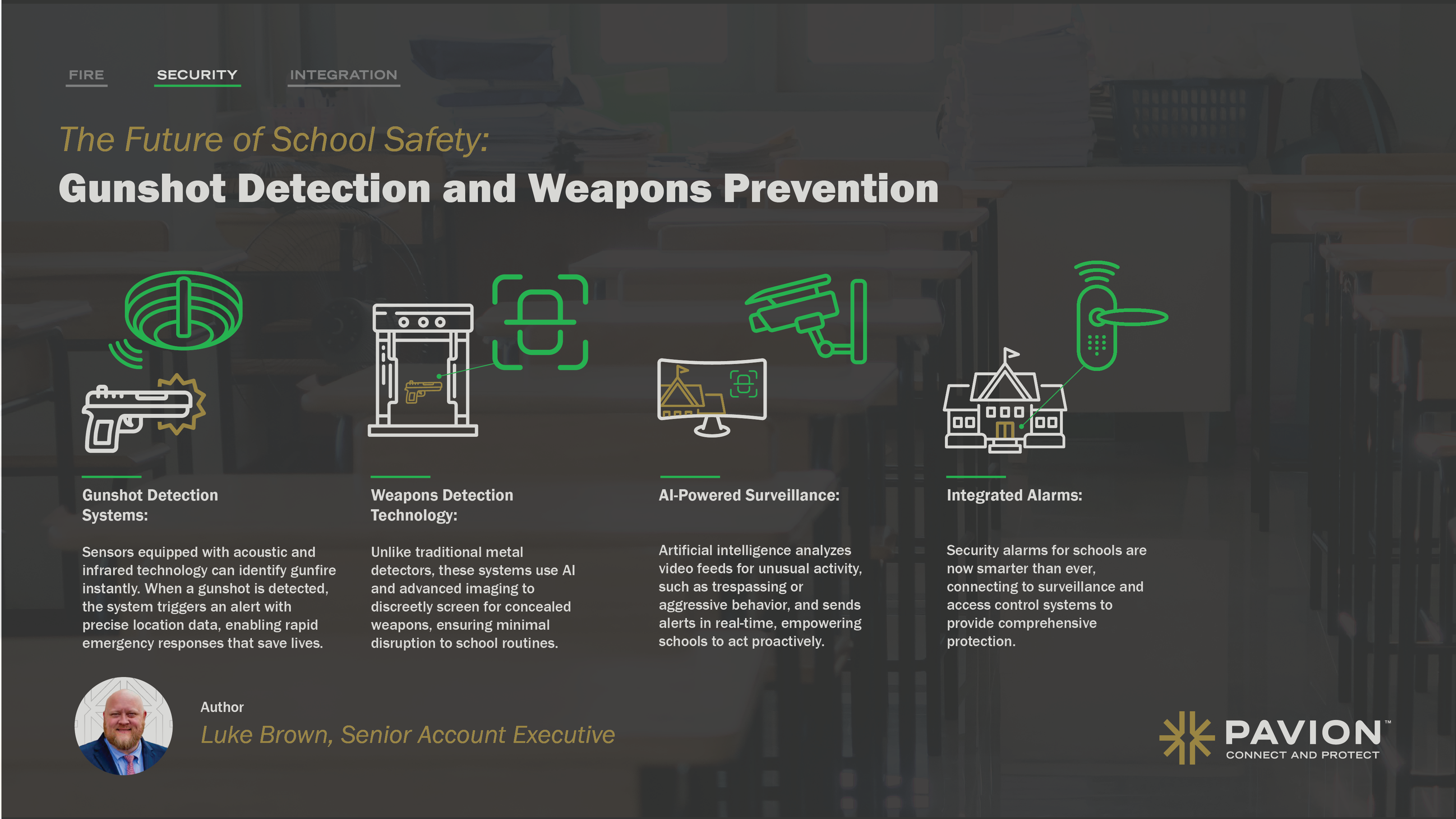
- Gunshot Detection Systems: Sensors equipped with acoustic and infrared technology identify the sound signature of gunfire and alert responders with location data in seconds. This doesn’t prevent a weapon from entering a building – it shortens response time after a shot is fired.
- Weapons Detection Technology: Unlike traditional metal detectors, these systems use AI and imaging to flag concealed weapons without requiring people to empty pockets or bags. This is the technology that came under FTC scrutiny in December 2024 (see below) – accuracy varies significantly by vendor and calibration.
- AI-Powered Surveillance: Artificial intelligence analyzes video feeds for unusual activity, such as trespassing or aggressive behavior, and sends alerts in real-time, empowering schools to act proactively.
- Integrated Alarms: Security alarms for schools are now smarter than ever, connecting to surveillance and access control systems to provide comprehensive protection.
By combining these tools with a clear student safety plan, schools can create an environment where students feel safe to learn and thrive.
Why the Skepticism Is Fair – and What It Gets Wrong
Public skepticism about AI weapons detection isn’t unreasonable. In December 2024, the FTC settled with a major weapons-detection vendor over claims that its system could detect all weapons and reduce false alarms, after schools reported the scanners missed knives used in two stabbing incidents. That settlement confirmed a concern a lot of administrators already had.
Where the skepticism misses the mark is treating “does it work” as one yes/no question. Gunshot detection, weapons screening, and AI video analytics solve three different problems and none is designed to work alone – which is why a layered approach, not a single vendor’s sensor, is what actually closes the gap.
How Gunshot Detection Systems Work
Gunshot detection systems represent one of the most effective advancements in school safety for students. These systems operate in three stages:
- Detection: Acoustic and infrared sensors monitor for gunfire, instantly recognizing the unique sound signature of a gunshot.
- Verification: The system’s AI verifies the sound, ruling out false alarms caused by other loud noises.
- Response: Alerts are sent immediately to school administrators, local law enforcement, and emergency responders, providing critical location details for swift action.
The speed and accuracy of these systems significantly reduce response times during emergencies, potentially preventing further harm.
Building a Student Safety Plan
Technology alone cannot ensure safety; it must be part of a comprehensive student safety plan. Schools must integrate these tools with training, communication, and collaboration to maximize their effectiveness. A well-rounded safety plan includes:
- Regular emergency drills and training for staff and students.
- Clear procedures for reporting and responding to potential threats.
- Utilizing technologies like security alarms for schools and AI-driven behavioral monitoring.
- Partnering with local law enforcement to perform regular safety assessments.
When combined with proactive measures, these steps create a culture of vigilance and preparedness, ensuring school safety remains a top priority.
What a Realistic 2026 School Security Budget Looks Like
Public schools spend an average of roughly $22.84 per student annually on security, though high-risk districts report spending up to $87 per student. Technology typically represents 65-70% of a security budget, with annual maintenance running 18-22% of the initial cost. The 2026 COPS School Violence Prevention Program offers grants of up to $500,000 per K-12 district specifically for security upgrades, including weapons-detection systems and access control.
The Latest Innovations in School Safety
Advancements in technology continue to raise the bar for school safety for students. From weapons detection systems to behavioral analytics, schools now have access to tools that were once unimaginable. Some of the most impactful innovations include:
- Emergency Communication Platforms: Real-time notifications and alerts keep everyone informed during crises, reducing confusion and improving coordination.
- Behavioral Analytics: AI systems analyze patterns to identify potential risks, offering schools the ability to intervene before threats materialize.
Creating Secure Learning Environments
Brown states, “The constant worry of students and staff stems from a world where safety feels increasingly fragile, creating an environment where teaching and learning are often overshadowed by concerns for personal security.”
The combination of advanced technology and proactive planning is reshaping how schools address safety concerns. These solutions not only protect students and staff but also foster environments where learning and personal growth can flourish without fear.
At Pavion, we’re proud to support schools in their mission to ensure school safety through innovative security solutions.
Contact us today to learn how we can help create a safer future for your school
Frequently Asked Questions
Do AI gun detection systems have false positives?
Yes. All AI-based weapons screening systems generate some false alarms, and accuracy varies significantly by vendor, calibration, and object type. This was central to the FTC’s December 2024 action against a leading vendor, which found the company’s marketing overstated real-world accuracy. Ask any vendor for independent, third-party accuracy data, not just internal marketing claims, before you sign.
What’s the difference between gunshot detection and weapons screening?
Gunshot detection identifies a weapon after it’s fired and speeds up emergency response. Weapons screening tries to catch a concealed weapon before it enters a building. They solve different problems and are typically used together, not interchangeably.
How much does a school security system cost?
It depends heavily on scope, but plan for technology to represent 65-70% of your total security budget, with ongoing maintenance at roughly 18-22% of the initial cost annually. Federal programs like the 2026 COPS School Violence Prevention Program can offset a significant share of upfront costs for eligible districts.
Can’t schools just use metal detectors?
Traditional metal detectors are lower-cost but require people to remove items from pockets and bags, which slows entry significantly at scale. AI-based weapons screening is designed to reduce that bottleneck, but it comes with its own accuracy trade-offs, which is exactly why layered systems and human oversight still matter.