Traditional vs. Proactive Video Monitoring: How to Choose the Right Security System for Your Business

Security technology has evolved far beyond passive cameras and recorded footage. Today, businesses face a critical choice: continue relying on traditional video monitoring or upgrade to proactive video monitoring that detects threats in real time and helps prevent incidents before they escalate.
Understanding the differences between these two approaches can help you choose the right video surveillance system to protect your people, property, and operations while strengthening your bottom line.
What Is Traditional Video Monitoring?
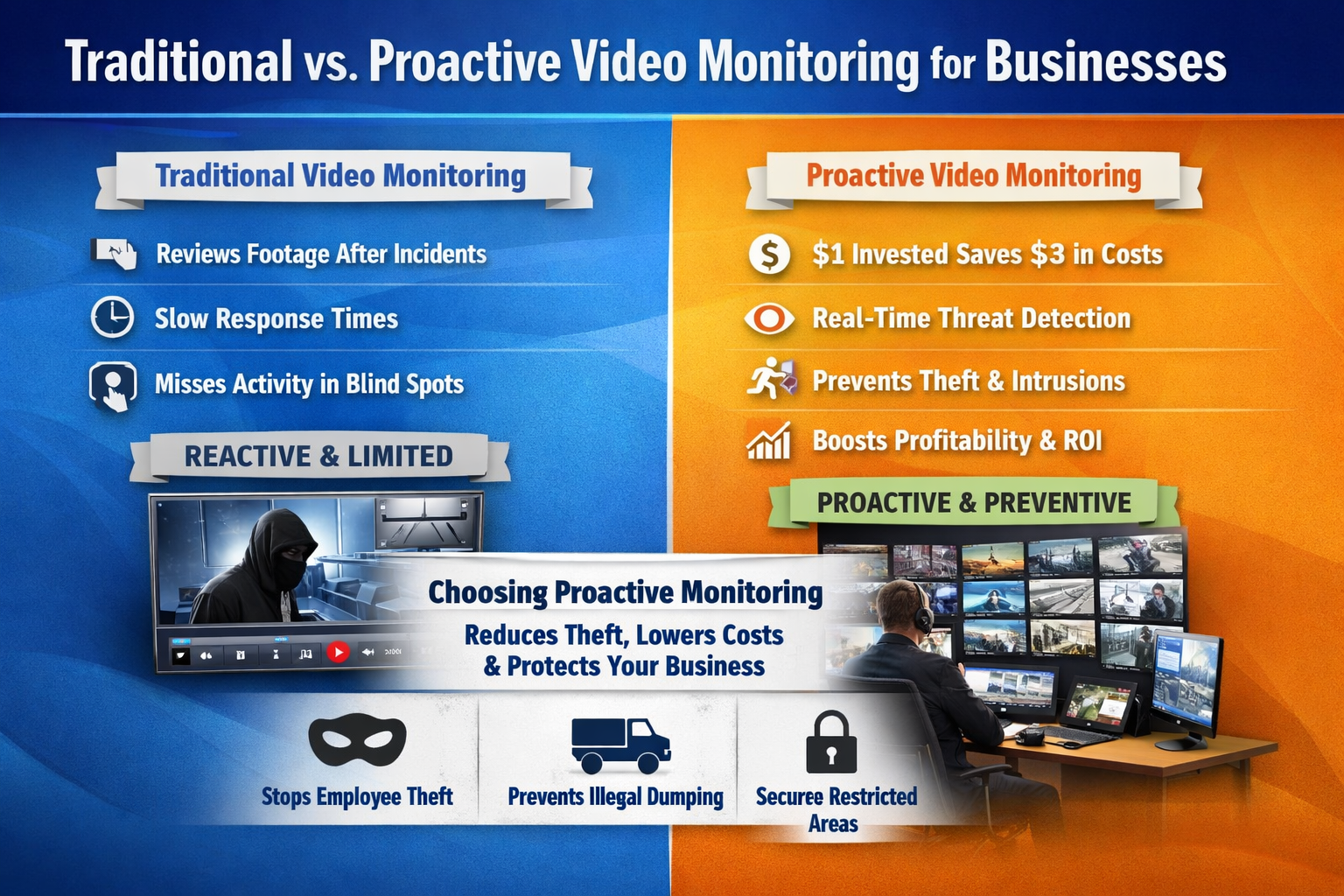
Traditional video monitoring focuses on recording footage that can be reviewed after an incident occurs. Cameras capture activity, and security teams or law enforcement analyze the video for investigation or evidence.
This approach is widely used for:
- Recording theft or vandalism after it happens
- Providing visual proof for insurance claims
- Reviewing incidents to understand what went wrong
While traditional security video monitoring plays an important role in many security programs, it is reactive by nature. The system does not intervene while a threat is unfolding. It documents events after the fact.
Limitations of Traditional Monitoring
Traditional systems can leave security gaps, including:
- Discovering events after damage or loss has already occurred
- Slower response times during emergencies
- Missed activity during off-hours
- Limited deterrence capability
As risks grow more sophisticated, many organizations are evaluating proactive video monitoring to strengthen protection and response.
What Is Proactive Video Monitoring?
Proactive video monitoring uses advanced analytics, AI-assisted detection, and trained remote monitoring specialists to identify, verify, and respond to threats in real time.
Instead of simply recording footage, proactive systems actively monitor live feeds to detect behaviors such as:
- Loitering near restricted areas
- Perimeter breaches or trespassing
- Suspicious vehicle activity
- Forced entry attempts
- After-hours movement on property
When unusual behavior is detected, alerts are sent instantly to a monitoring center. Trained specialists verify the threat and take action, such as issuing live voice warnings, dispatching security personnel, or contacting law enforcement.
A Proactive Investment That Delivers ROI
Proactive monitoring is not just a security upgrade. It is a strategic investment. Studies have long shown that for every $1 a business invests in proactive measures, it saves an average of $3 in reactive expenses. Preventing incidents reduces loss, operational disruption, liability exposure, and emergency response costs before they escalate.
Proactive monitoring functions like an additional employee or extra set of eyes dedicated solely to protecting your business. Instead of reviewing footage after something happens, this digital “employee” is actively watching for specific behaviors in real time and issuing alerts instantly. With advanced analytics, systems can even be trained to recognize patterns and predictive indicators before incidents occur.
This transforms remote video security monitoring from passive observation into an active, preventive security strategy.
Key Benefits of Proactive Video Monitoring
Upgrading to proactive video surveillance offers measurable advantages across industries.
1. Real-Time Threat Detection and Intervention
Security teams can respond as events unfold, reducing damage, loss, and downtime.
2. Stronger Crime Deterrence
Live audio warnings and visible monitoring discourage intruders before incidents occur.
3. Expanded Coverage Without On-Site Guard Costs
Organizations can enhance security across multiple locations without significantly increasing staffing expenses.
4. Better Incident Outcomes and Faster Recovery
Early detection minimizes disruption and supports safer environments.
5. Data-Driven Security Insights
Analytics provide behavioral trends that support smarter property security strategies.
6. Direct Impact on Profitability
Proactive monitoring helps reduce and eliminate employee theft, organized retail crime, illegal dumping, and unauthorized access to secure areas. Illegal dumping alone can trigger costly unscheduled waste pickups, while internal theft often goes unnoticed in traditional systems. By addressing these risks in real time, proactive video monitoring becomes more than a security tool. It becomes an operational investment that protects margins and increases profitability.
While traditional video remains acceptable in some lower-risk environments, proactive monitoring offers broader protection and measurable financial impact.
Traditional vs. Proactive Video Monitoring: Which Is Right for Your Company?
Both approaches have value. The right choice depends on your risk profile, facility layout, and operational goals.
Choose Traditional Video Monitoring If You Need:
- Evidence documentation
- Insurance validation
- Post-incident investigation
Choose Proactive Video Monitoring If You Want To:
- Prevent incidents instead of reacting afterward
- Strengthen perimeter and after-hours security
- Reduce false alarms through human verification
- Improve response time and situational awareness
- Protect people, assets, and operations in real time
- Improve operational efficiency and reduce avoidable costs
Many organizations implement a hybrid strategy, combining recorded footage with proactive monitoring for complete visibility and incident support.
Why Choosing the Right Security Partner Matters
Selecting the right security partner is just as important as selecting the right technology.
A trusted partner takes time to understand your business, risk tolerance, compliance requirements, and operational concerns. They identify what keeps you up at night — whether it is employee theft, after-hours intrusion, liability exposure, or operational disruption — and design a monitoring solution tailored to those priorities.
The right security partner ensures your video surveillance system is not a one-size-fits-all product but a strategic investment aligned with your organization’s goals.
Is It Time to Upgrade Your Security Monitoring Strategy?
As threats evolve, businesses need solutions that go beyond passive recording. Proactive video monitoring empowers organizations to stay ahead of risk with faster awareness, smarter response, and measurable financial impact.
Upgrading your monitoring strategy can help protect facilities, employees, customers, and your bottom line.
Learn More About Our Proactive Video Monitoring Services
If you are evaluating video surveillance options or looking to strengthen your existing monitoring program, our team can help you design a solution tailored to your business needs.
Contact us today to learn more about our proactive video monitoring services.
People Also Ask — FAQs About Choosing the Right Video Monitoring System
How do I choose a video surveillance system for my business?
Start by identifying your security goals, such as preventing theft, monitoring after-hours access, or protecting outdoor perimeters. Determine whether traditional recording is sufficient or if proactive video monitoring with real-time detection and response would better protect your environment. Evaluate camera placement, lighting conditions, storage needs, analytics capabilities, and integration with access control or intrusion systems. Partnering with an experienced security provider ensures your system is professionally designed, installed, and supported.
How do I choose the right CCTV system?
The right CCTV system depends on your facility layout, risk exposure, and operational needs. Higher-risk environments often benefit from proactive video surveillance that detects suspicious behavior before incidents occur. Consider image quality, storage capacity, analytics capabilities, remote monitoring options, cybersecurity protections, and scalability.
What choices need to be made when deciding on a video surveillance system?
Organizations should evaluate:
- Traditional vs. proactive video monitoring
- On-site vs. remote monitoring
- Camera types and coverage zones
- Integration with alarms and access control
- Cybersecurity and data storage requirements
- Industry compliance regulations
Choosing proactive monitoring allows businesses to move beyond passive recording and adopt a real-time, preventive security strategy.
What is the best security camera system for a small business?
The best security camera system balances coverage, affordability, and protection. Many small businesses benefit from proactive video monitoring because it provides real-time awareness and deterrence without the cost of full-time on-site guards. A well-designed system should include high-resolution cameras, secure remote access, professional monitoring options, and scalability for future growth.
What is proactive video monitoring?
Proactive video monitoring is a security approach that uses advanced analytics, AI-assisted detection, and trained monitoring specialists to identify and respond to threats in real time. Instead of only recording incidents, proactive systems detect behaviors such as trespassing, loitering, or forced entry and allow immediate intervention through live voice warnings, dispatching security personnel, or contacting law enforcement.