Service Renewals Are Only the Beginning

Why Lifecycle Strategy Is the Next Priority for Security Leaders
Security technology is no longer static infrastructure. It is a living ecosystem made up of hardware, software, analytics, integrations, cloud connections, and network dependencies.
Many organizations have improved their approach to service renewals. They understand the value of coverage, uptime, and preventative maintenance. But renewals alone are no longer enough.
Today’s security leaders must think beyond annual agreements and adopt a full lifecycle strategy. In modern environments, performance, cybersecurity, compliance, and operational continuity depend on more than reactive support. They depend on long-term planning.
Forward-looking organizations are shifting from simple renewals to structured lifecycle management, ensuring their systems remain secure, scalable, and aligned with business objectives over time.
The Financial Case for Proactive Strategy
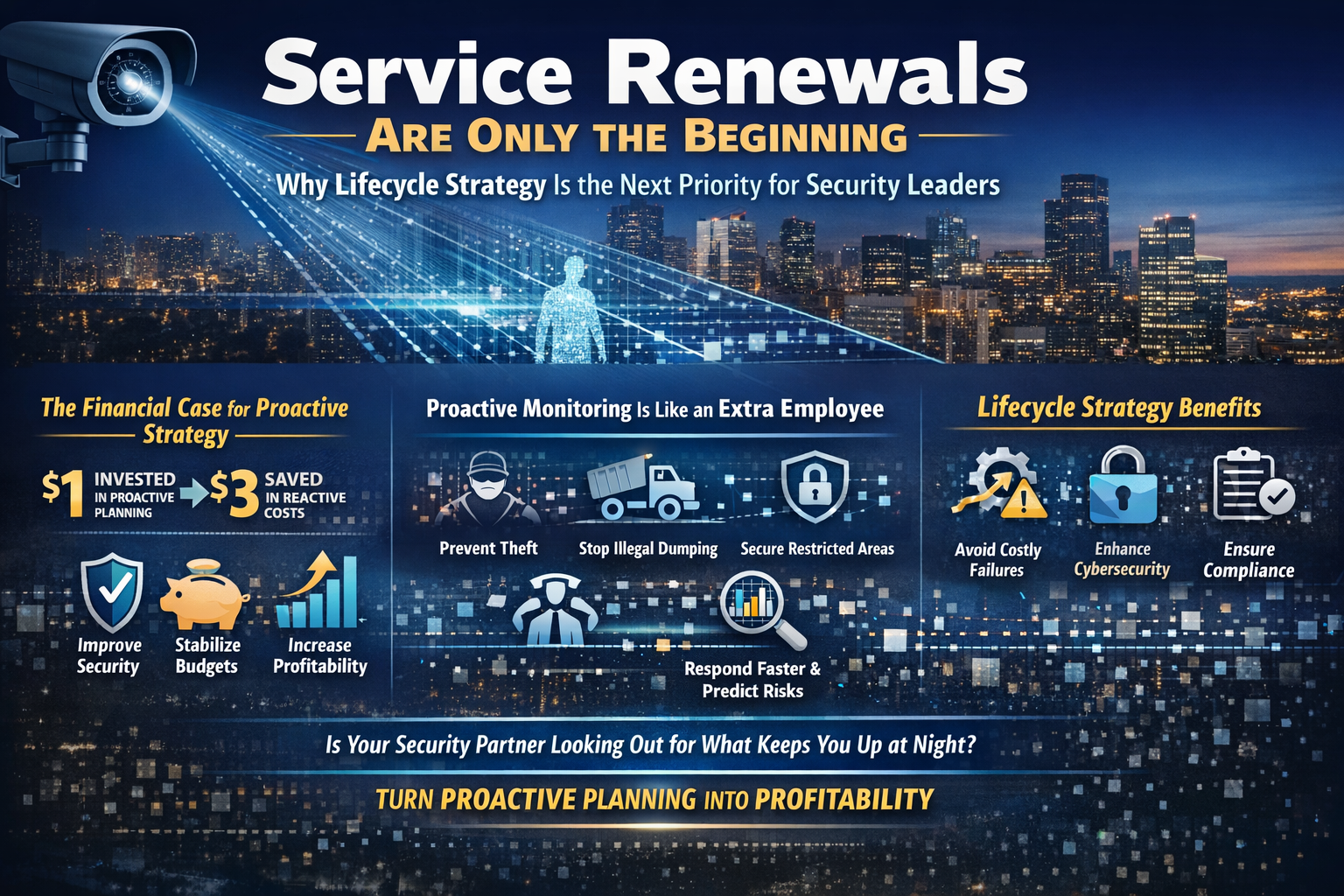
It has long been demonstrated that for every $1 a business invests in proactive planning, it saves an average of $3 in reactive expenses.
The same principle applies to security infrastructure.
Reactive models wait for failure. Proactive lifecycle strategy anticipates it. Instead of scrambling during outages, compliance gaps, or cyber exposure events, organizations modernize deliberately and strategically.
This approach stabilizes budgets, protects uptime, and strengthens long-term profitability.
1. Systems Age Even When They Appear to Work
Technology does not fail overnight. It degrades gradually.
Components reach end-of-support status. Firmware becomes outdated. Integrations drift. Software versions stop receiving patches.
Even if systems appear functional, hidden risks accumulate:
• unsupported hardware
• incompatible updates
• diminished analytics performance
• integration breakdowns
• limited manufacturer support
Lifecycle strategy ensures leaders know where every asset stands from deployment through end-of-life so upgrades are planned instead of forced by failure.
2. Proactive Monitoring Multiplies Operational Visibility
Proactive monitoring functions like an additional employee — an always-on set of intelligent eyes.
Traditional video systems record events for later review. Proactive monitoring actively watches for defined behaviors and anomalies, notifying teams instantly. With modern analytics and AI capabilities, these systems can even become predictive in nature.
This shift transforms video from a passive recorder into an active business tool.
The impact extends beyond security:
• reduction in employee theft
• deterrence of external theft
• prevention of costly illegal dumping
• monitoring of restricted areas
• reduction in unnecessary service calls
• faster incident response
For some environments, traditional video may be sufficient. But in many cases, proactive monitoring reduces loss, lowers operating expenses, and directly improves the bottom line.
What was once viewed as a cost center becomes an investment that drives measurable profitability.
3. Budget Stability Requires Long-Term Visibility
Unplanned capital expenses create operational stress. When systems fail unexpectedly, organizations are forced into urgent replacement decisions that limit options and inflate costs.
A structured lifecycle plan provides:
• multi-year upgrade forecasting
• capital planning alignment
• phased modernization strategies
• reduced emergency spending
• clearer ROI on security investments
Instead of reacting to equipment failure, organizations modernize on their terms.
4. Integration Complexity Is Increasing
Security systems no longer operate independently.
Access control integrates with HR systems. Video connects with analytics platforms. Critical communications tie into mass notification software. Devices connect to enterprise networks and cloud services.
As ecosystems grow more interconnected, small disruptions can create cascading impact.
Lifecycle management ensures integrations are reviewed, tested, and optimized over time, preventing compatibility issues and protecting operational continuity.
5. Cybersecurity Is a Moving Target
Security infrastructure is now part of the broader IT attack surface.
Manufacturers release firmware updates. Vulnerabilities are discovered. Encryption standards evolve. Compliance expectations shift.
Without structured oversight, systems fall behind modern benchmarks.
Lifecycle strategy supports:
• coordinated patch management planning
• vulnerability assessment alignment
• secure configuration reviews
• documentation of network dependencies
• collaboration with IT stakeholders
This reduces cyber exposure and protects the organization’s broader digital ecosystem.
6. Compliance and Documentation Expectations Continue to Rise
Regulators increasingly expect documented maintenance, verified performance, and traceable service history.
A lifecycle approach strengthens compliance by ensuring:
• inspection schedules remain current
• documentation is centralized
• performance metrics are tracked
• systems align with evolving code requirements
Rather than scrambling during audits, organizations maintain continuous readiness.
7. Modern Security Leadership Requires Strategic Oversight
Security leaders today are expected to contribute to business resilience, risk mitigation, and operational efficiency.
That requires:
• visibility into system health across locations
• modernization forecasting
• alignment with organizational growth
• collaboration with finance and IT
• executive-level reporting
Lifecycle strategy transforms service from a maintenance function into a strategic business enabler.
The Risk of Treating Renewals as the Finish Line
When organizations treat service renewal as the final step instead of part of a broader strategy, they often encounter:
• unexpected end-of-life disruptions
• rushed capital approvals
• unsupported technologies
• growing cyber vulnerabilities
• integration instability
• reactive modernization
In complex environments, this approach introduces avoidable risk.
Choosing the Right Security Partner Matters
Lifecycle strategy is not just about technology. It is about partnership.
The right security partner takes time to understand what keeps you up at night. They align solutions with operational realities, regulatory requirements, financial constraints, and long-term business goals.
When a partner truly understands your environment, the result is not just system maintenance. It is a tailored strategy designed to protect what matters most while supporting measurable business outcomes.
Lifecycle Strategy Is a Competitive Advantage
Security infrastructure now supports employee safety, regulatory compliance, brand reputation, and operational continuity.
Organizations that move beyond annual renewals and adopt structured lifecycle planning gain visibility into asset health, modernization timelines, and system evolution.
Service renewals remain essential. But in today’s environment, they are only the starting point.
True resilience comes from treating security technology not as a static purchase, but as a continuously managed ecosystem designed to evolve alongside the organization it protects.