Is Your Proprietary Fire Panel No Longer Serviceable? Here’s What to Do.

Proprietary fire alarm panels are becoming obsolete at an accelerating pace. Although they may continue to function for 10–20 years, their practical lifespan is decreasing due to rapid technological advancements, discontinued components, and the growing demand for open-protocol systems that provide greater flexibility and reduced long-term maintenance costs.
Given this trend, organizations should take a proactive approach rather than waiting for failure or forced replacement. The most effective strategy is to evaluate current system age, parts availability, service history, and manufacturer support, then develop a phased migration plan toward a non-proprietary, open-protocol platform. This allows for budget forecasting, minimizes disruption, and reduces long-term service dependency on a single vendor. By planning upgrades strategically—rather than reactive, facilities can improve reliability, maintain compliance, and gain greater flexibility for future expansion or integration.
Contact your Authority Having Jurisdiction (AHJ)—typically your local fire marshal.
Under National Fire Protection Association standards such as NFPA 72:
- Fire alarm systems must be maintainable and functional
- Replacement parts must be available
- Impaired systems require documented action
If the system can’t be repaired, it may be considered impaired, which triggers required procedures.
Budget for a Fire Panel Replacement.
Costs vary widely depending on:
- Number of devices
- Addressable vs conventional
- Remote annunciators
- Monitoring requirements
- Elevator recall, suppression release, etc.
If you’ve had recent inspection deficiencies, plan to address those simultaneously.
Insurance and Liability
Insurance carriers may:
- Increase premiums
- Require replacement
- Deny claims if system is knowingly non-serviceable
If your proprietary fire panel cannot be serviced or repaired, it is no longer a sustainable life-safety solution. The longer it remains in place, the greater your compliance and liability exposure.
Proprietary Panels vs Non-Proprietary Systems: What Building Owners Need to Know Before They Decide
In today’s evolving security and life safety landscape, one of the most important decisions a building owner can make is whether to invest in a proprietary panel or a non-proprietary system.
This choice impacts far more than initial installation. It affects long-term flexibility, service options, scalability, lifecycle cost, and even how quickly your organization can adapt to new technology.
If you are planning a fire alarm system upgrade, expanding security infrastructure, or evaluating integrated building systems, understanding the difference between proprietary and non-proprietary panels is critical.
What Is a Proprietary Panel?
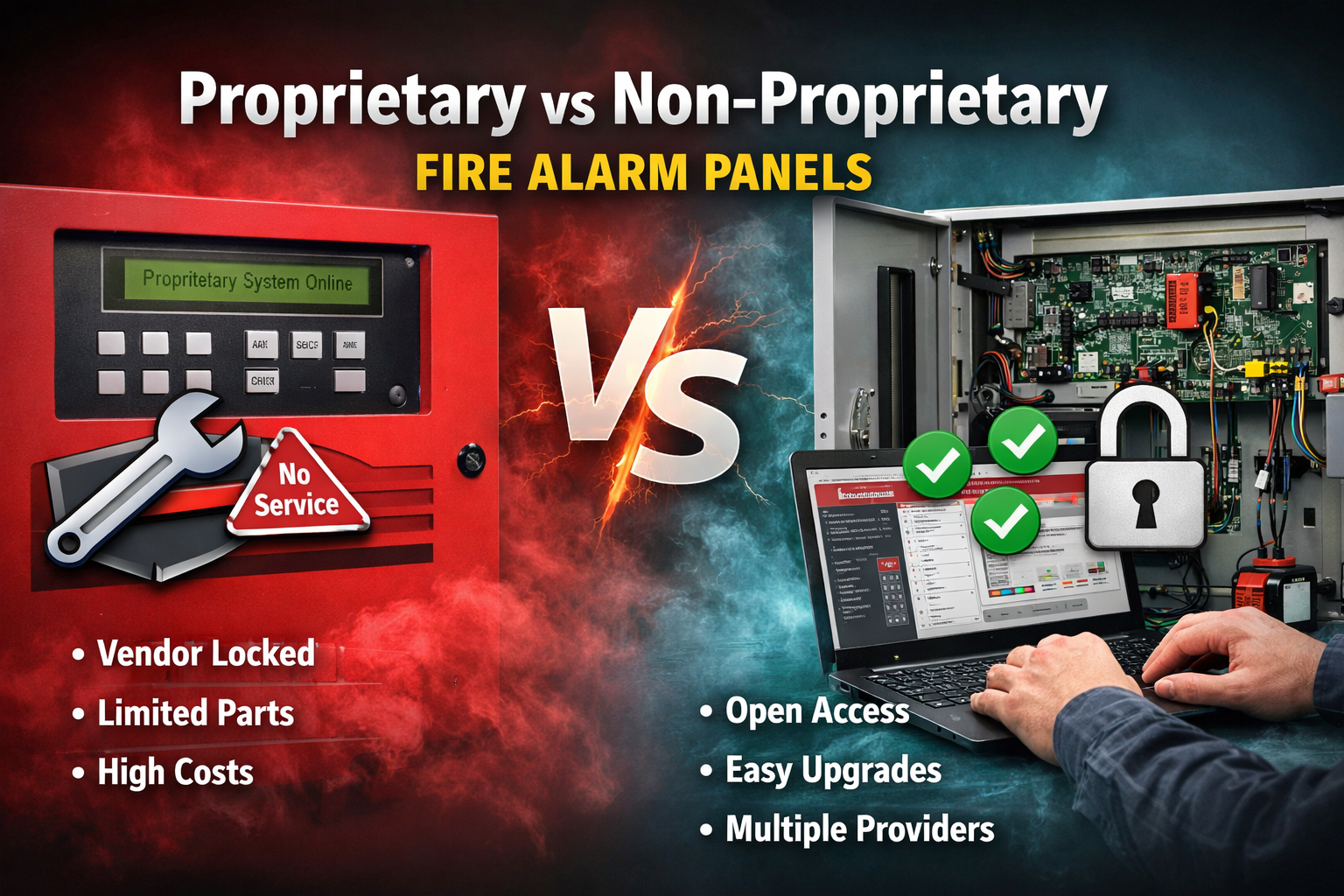
A proprietary panel is a control panel that can only be serviced, programmed, or expanded by the manufacturer or an authorized dealer network.
In most cases:
- Software access is restricted
- Replacement parts are brand-specific
- Programming tools are locked
- Service agreements are limited to approved vendors
This means if you install a proprietary fire alarm control panel, intrusion system, or access control platform, you are typically locked into that ecosystem for the life of the system.
Common Characteristics of Proprietary Systems
- Closed architecture
- Limited third-party integration
- Restricted programming access
- Vendor-controlled upgrades
- Brand-dependent service model
For some organizations, this structure provides simplicity and standardized support. For others, it can create long-term constraints.
Standardized-only Service Approach
- Service must typically be performed by the original installer or manufacturer
- Switching vendors can be difficult or impossible without replacing the panel
Long-Term Cost of Ownership
Upfront costs do not tell the full story. With proprietary panels:
- Replacement parts may carry higher premiums
- Software access fees may apply
- Limited competition can affect service pricing
Limited Integration and Scalability
Modern buildings require systems that communicate with one another.
- Fire alarm systems
- Access control
- Video surveillance
- Mass notification
- Building management systems
Proprietary platforms may limit integrations outside their ecosystem. Non-proprietary systems are typically designed for broader compatibility, allowing organizations to scale and adapt as technology evolves.
This becomes especially important in healthcare, education, commercial real estate, and industrial environments where operational continuity matters.
Examples of Proprietary Fire Panels:
- Simplex (Johnson Controls)
- Edwards (EST/UTC)
- Mircom (FX series)
- Siemens
What Is a Non-Proprietary Panel?
A non-proprietary panel uses open architecture or widely supported technology that allows multiple qualified service providers to program, service, and maintain the system.
In a non-proprietary environment:
- Programming access is not restricted to a single vendor
- Replacement parts are widely available
- Integrators can compete on service
- System expansion is more flexible
Non-proprietary fire alarm panels and security systems are designed to give building owners control over their infrastructure rather than tying them to a single provider.
Service Flexibility
- Multiple licensed integrators can service the system
- Competitive service contracts can reduce long-term costs
For multi-site organizations, service flexibility can dramatically impact operational efficiency.
Long-Term Financial Control
With non-proprietary panels:
- Broader parts availability often reduces costs
- Competitive bidding keeps service pricing in check
- Upgrades can be phased without full system replacement
When evaluating lifecycle cost over 10 to 20 years, non-proprietary systems often provide more predictable financial control.
A Non-Proprietary Panel Is the Strategic Choice
For many building owners, non-proprietary panels offer:
- Greater negotiating leverage
- Lower long-term service risk
- Improved integration flexibility
- Better scalability across sites
- Freedom to choose service partners
In today’s market, flexibility is often more valuable than brand exclusivity. A proprietary system may leave you with limited alternatives. Non-proprietary systems reduce that dependency by allowing competitive service and greater operational independence.
Final Thoughts
Proprietary panels offer structure and brand alignment. Non-proprietary systems offer flexibility and control.
The right answer depends on your organization’s operational model, risk tolerance, and long-term growth plans.
But one thing is certain: understanding the difference before you install it is far easier than trying to change it later.