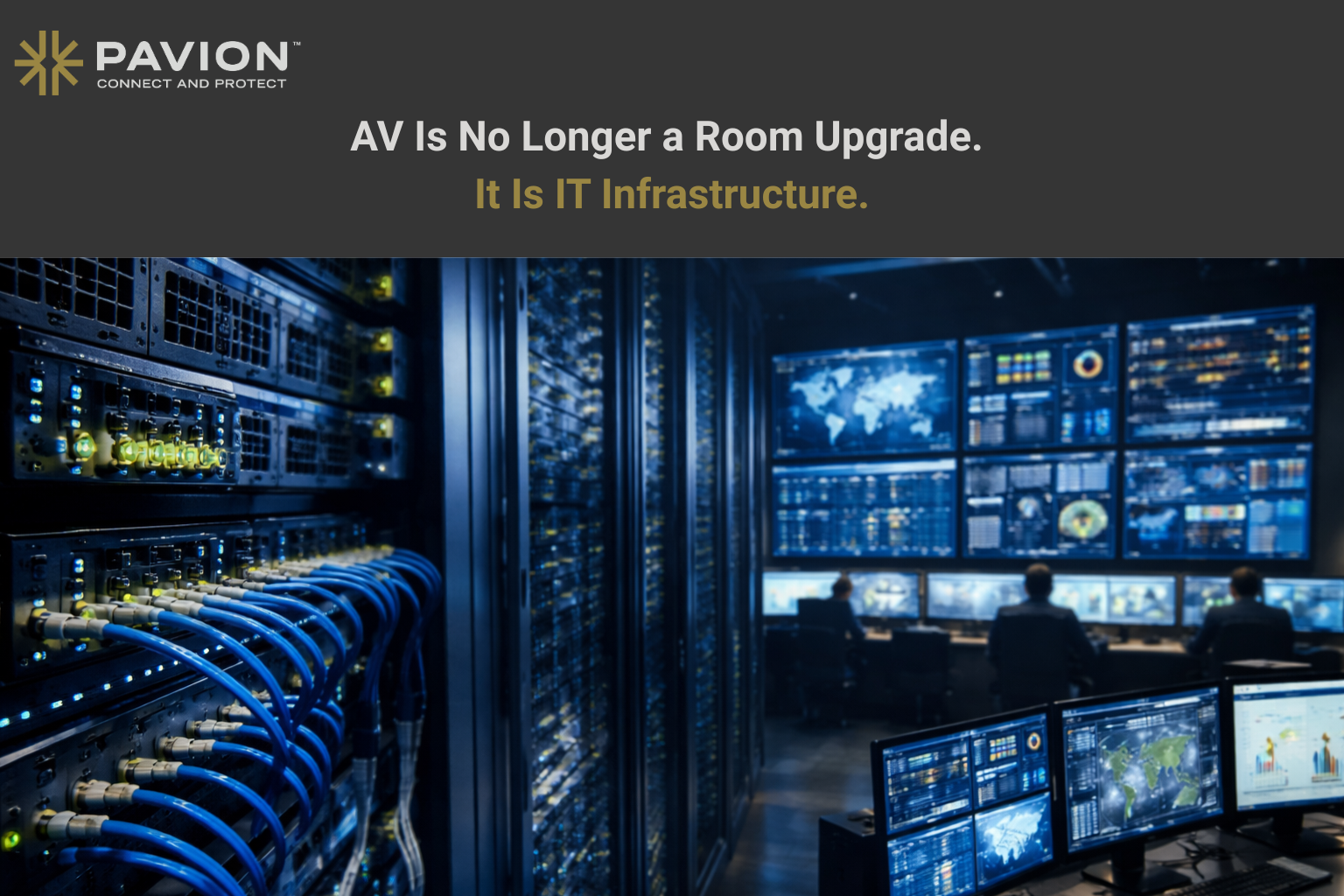
AV Is No Longer a Room Upgrade. It Is IT Infrastructure.

For years, audiovisual systems were viewed as room-based enhancements. Conference rooms. Training centers. Auditoriums. Digital signage.
Today, that mindset is outdated.
Modern AV has evolved into enterprise infrastructure. It runs on the network. It lives in the cloud. It touches cybersecurity. It impacts uptime, compliance, and long-term IT strategy.
Organizations that still treat AV as a facilities purchase risk misalignment, performance gaps, and security exposure.
The industry has shifted. And AV is now firmly part of IT.
The Industry Shift Toward AV Over IP
Traditional AV relied on point to point cabling and hardware based routing. It was isolated, difficult to scale, and expensive to modify.
Today, organizations are deploying AV over IP architectures. Instead of proprietary cabling and fixed signal paths, audio and video now travel over standard IP networks.
This shift enables:
- Scalable room expansion without rewiring entire facilities
- Centralized system monitoring
- Remote diagnostics and troubleshooting
- Integration across campuses and global locations
But it also means AV now shares bandwidth with business critical applications. That changes everything.
When AV rides on the enterprise network, IT must be involved from day one.
Cloud Managed AV Is Becoming the Standard
The next transformation is cloud management.
Modern AV platforms allow organizations to:
- Monitor system health in real time
- Push firmware updates remotely
- Manage configurations across multiple locations
- Track usage analytics
Cloud managed systems increase visibility and reduce onsite service visits. But they also introduce cybersecurity considerations, identity management requirements, and data governance questions.
AV is no longer just about displays and speakers. It is about authentication, encryption, and secure remote access.
This is why AV decisions now require alignment with network security teams.
Software Defined Signal Routing Changes System Design
Legacy AV routing was hardware driven. Physical matrix switchers defined what went where.
Today, signal routing is increasingly software defined.
That means:
- Dynamic reconfiguration without replacing hardware
- Greater flexibility for hybrid work environments
- Faster response to evolving collaboration needs
Software defined AV provides agility. But it also introduces dependency on firmware lifecycle management, compatibility planning, and version control.
Those responsibilities traditionally fall under IT governance, not facilities.
Why AV Decisions Now Involve IT Stakeholders
As AV becomes network based, cloud connected, and software driven, decision making shifts.
AV now intersects with:
Network Security Teams
Firewall rules. VLAN segmentation. Zero trust architecture.
AV endpoints must comply with enterprise security standards.
IT Policy Compliance
Patch management schedules. Device authentication. Access controls.
AV systems must align with company wide governance frameworks.
Lifecycle Management
Hardware refresh cycles. Software updates. Warranty tracking.
AV is now part of the broader IT asset lifecycle strategy.
Facilities and operations remain important stakeholders. But they are no longer the sole decision makers.
The Risk of Treating AV as a Standalone Project
Organizations that purchase AV without IT integration often face:
- Network performance conflicts
- Security vulnerabilities
- Unsupported firmware and outdated devices
- Limited scalability
- Fragmented vendor ecosystems
In contrast, organizations that treat AV as infrastructure benefit from:
- Unified technology standards
- Better cybersecurity posture
- Predictable lifecycle budgeting
- Long term scalability
The difference is strategic alignment.
The Pavion Approach: Infrastructure First, Not Room First
At Pavion, we view AV as part of a connected ecosystem.
Our teams work alongside:
- IT leadership
- Network architects
- Cybersecurity stakeholders
- Facilities and operations teams
We design AV solutions that align with enterprise network architecture, security requirements, and lifecycle strategy.
Because modern collaboration environments are not just about screens and sound.
They are about uptime. Governance. Security. And long term performance.
AV Is Infrastructure. Plan Accordingly.
The evolution toward AV over IP, cloud managed systems, and software defined routing is not a trend. It is the new baseline.
If your AV strategy does not involve IT, network security, and lifecycle planning, it is already outdated.
Forward thinking organizations are aligning AV with their broader digital transformation initiatives.
The question is no longer what display to install.
The question is how your AV infrastructure supports secure, scalable, enterprise wide communication.