Retail Security Is Changing. Is Your Store Keeping Up?

Retail Has Changed
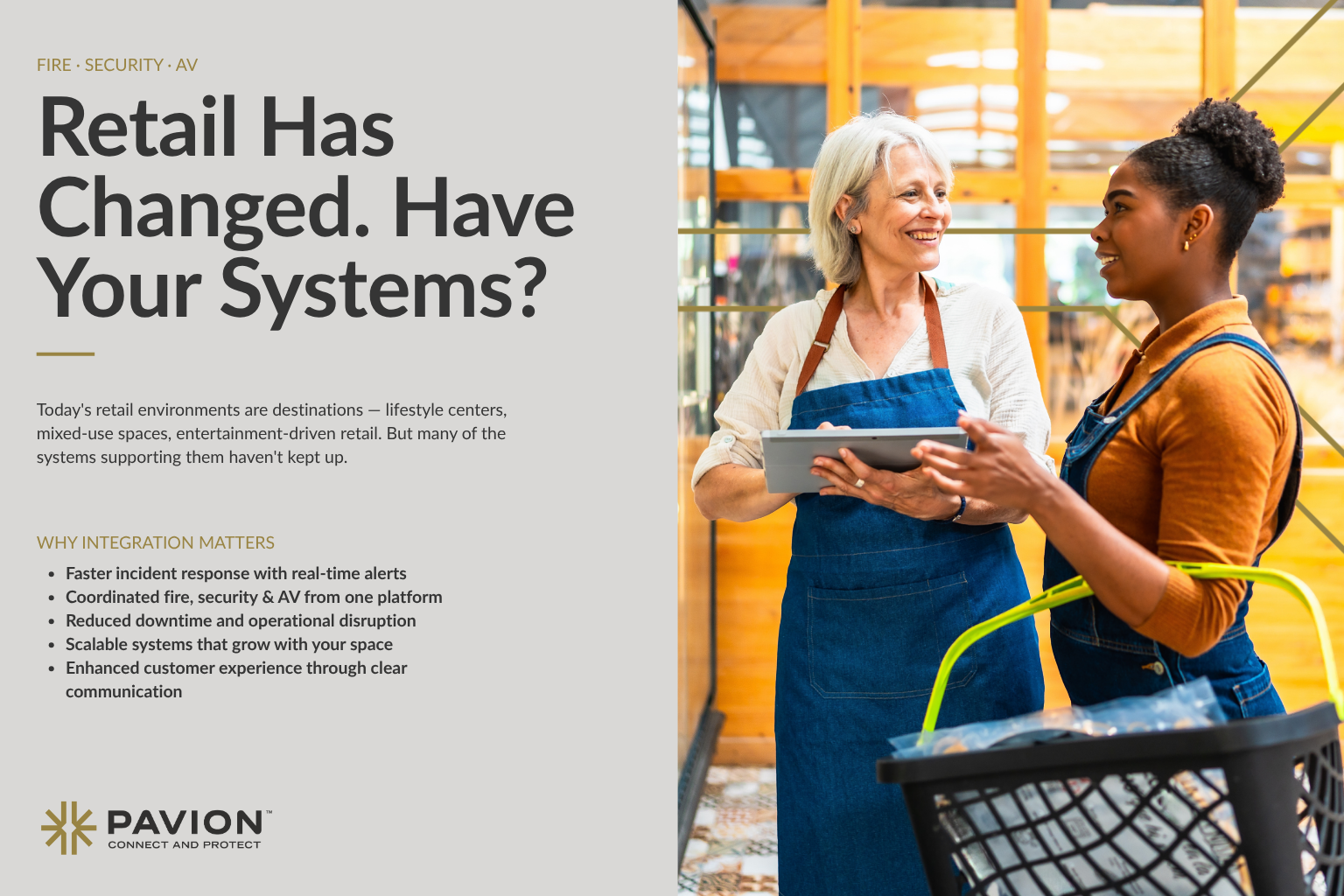
Today’s retail environments are no longer just places to shop. They are destinations. From lifestyle centers and outlet malls to mixed use developments and entertainment driven retail spaces, the goal is no longer just transactions. It is experience.
But while the retail experience has evolved, many of the systems supporting it have not.
Fire protection, security, and audiovisual systems are still often treated as separate pieces rather than a connected strategy. That disconnect creates gaps that impact safety, operations, and ultimately revenue.
The Problem with Disconnected Systems
In many retail environments, fire systems, security platforms, and AV technologies are installed at different times by different vendors with little coordination.
At first, everything appears to work. Over time, the issues begin to surface:
- A security incident occurs, but communication is delayed
- An emergency happens, but systems do not work together as expected
- Teams rely on manual processes instead of real time visibility
These are not failures of individual systems. They are failures of integration.
In high traffic retail environments, seconds matter. Systems need to communicate instantly and operate as one.
Retail Today Requires More Than Basic Protection
Modern retail environments are more complex than ever:
- High foot traffic
- Multiple entry and exit points
- Large, open floor plans
- Events and activations
- Mixed use spaces combining retail, dining, and entertainment
These environments require more than standalone solutions.
- Fire systems must trigger clear communication across large spaces
- Security systems must provide real time visibility into activity
- AV systems must deliver information quickly to both staff and customers
When these systems are connected, they do more than protect. They support operations.
Why Integration Impacts More Than Safety
Integration is not just about responding to emergencies. It directly affects how a retail environment operates every day.
With integrated systems, retail operators can:
- Respond faster to incidents with real time alerts and visibility
- Improve coordination between teams across large properties
- Reduce downtime and disruption during system issues
- Enhance the customer experience through clear, consistent communication
In destination retail, where experience drives foot traffic and revenue, these advantages matter.
A delayed response or poor communication does not just impact safety. It impacts how customers perceive the entire environment.
Protecting Inventory, Employees, and the Experience
Retail security is often viewed through the lens of loss prevention. While protecting inventory is critical, it is only one part of the equation.
- Employees need to feel safe and supported
- Customers expect a secure and well managed environment
- Operators need systems they can rely on without constant troubleshooting
Integrated fire, security, and AV systems help deliver on all three.
They create environments where risks are identified faster, communication is immediate, and operations continue without interruption.
The Shift Toward Connected Retail Environments
Retail environments are becoming more connected. Systems are no longer isolated. They are part of a larger infrastructure that supports safety, communication, and operations in real time.
This shift allows retail operators to:
- Monitor environments across multiple locations
- Communicate instantly during both routine operations and emergencies
- Adapt systems as layouts, tenants, and needs change
Scalability is critical. Retail spaces evolve frequently, and systems must be able to grow with them.
A Smarter Approach to Retail Integration
The most effective retail environments are not built around separate systems. They are built around integration.
When fire, security, and AV are designed to work together from the start, organizations reduce complexity, improve performance, and create more resilient environments.
This approach supports long term success, not just short term functionality.
Final Thoughts
Retail is no longer just about products. It is about experience.
Behind every successful retail environment are systems that must perform consistently, communicate clearly, and adapt over time.
When fire, security, and AV are treated as a connected strategy, retail spaces become safer, more efficient, and better equipped to meet the expectations of modern consumers.
FAQs
What is retail security integration?
Retail security integration connects fire alarms, surveillance, access control, and AV systems into one unified platform to improve safety and operations.
Why is integration important for retail environments?
Integration allows systems to communicate in real time, improving response times, coordination, and efficiency in high traffic retail spaces.
How does AV support retail environments?
AV systems support communication through digital signage, announcements, and real time messaging that enhances both safety and customer experience.
What types of retail spaces benefit most from integration?
Shopping malls, lifestyle centers, outlet malls, mixed use developments, and entertainment focused retail destinations benefit most from integrated systems.
Can integrated systems scale as retail spaces grow?
Yes. Integrated systems are designed to scale and adapt as retail environments expand or change over time.