The Automation Paradox: Why Security’s Future Isn’t Posthuman—It’s Partnership

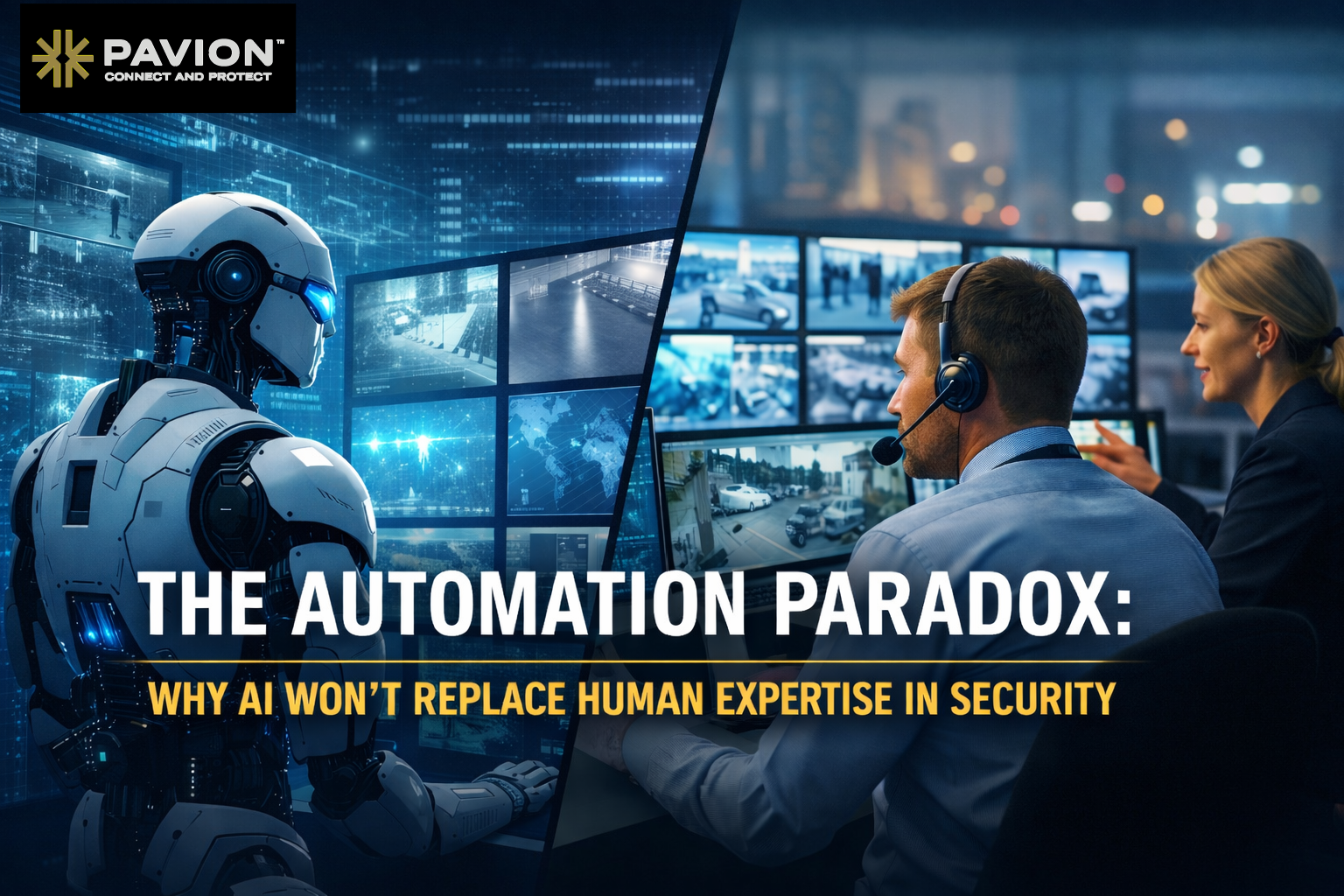
The security industry loves a provocative headline, and “posthuman automation” certainly delivers. But strip away the drama and what remains is a more pragmatic reality: artificial intelligence is fundamentally changing how security systems operate, not by replacing human judgment, but by redefining what humans spend their time doing.
The real question isn’t whether AI will eliminate security professionals. It’s whether organizations will use AI strategically to amplify human expertise—or reactively, once the competitive gap becomes too wide to close.
From Detection to Prevention: What Actually Changed
For decades, security technology operated on a reactive model. Cameras recorded. Alarms triggered. Humans responded. The most sophisticated systems improved detection accuracy and reduced false positives, but the underlying logic remained the same: something happens, technology flags it, people investigate.
Agentic AI breaks that pattern. Unlike traditional automation that follows rigid if-then rules, agentic systems interpret context, prioritize decisions, and execute actions autonomously. They don’t just detect anomalies—they assess threat probability, correlate data across systems, and initiate responses before human review.
This shift is already operational. AI-driven platforms now handle video analytics that once required dedicated monitoring staff. They rank alarms by risk severity. They manage routine access control decisions—temporary visitor badges, time-based permissions, automated lockdowns during detected incidents—without human initiation.
The aspiration isn’t new. Security practitioners have always wanted prevention over response. What’s new is the capability to deliver it at scale.
The Displacement Myth and the Augmentation Reality
Every technological leap triggers workforce anxiety, and AI is no exception. Reports of AI-related layoffs fuel concerns that automation will hollow out security departments, leaving skeleton crews managing black-box systems they don’t fully understand.
The reality is more complex. AI isn’t eliminating security roles wholesale—it’s forcing a reckoning about where human expertise adds value and where it’s wasted on repetitive tasks that machines handle better.
Monitoring video feeds for hours to catch seconds of relevant activity? That’s not strategic human judgment—it’s labor-intensive pattern recognition that AI executes faster and more consistently. Reviewing access logs manually to identify permission creep or compliance gaps? Same story. Generating incident reports by pulling data from multiple systems and formatting it for leadership review? Automatable.
What AI doesn’t replace: strategic risk assessment, stakeholder communication, crisis decision-making under ambiguous conditions, and the organizational trust that comes from having accountable humans—both within the organization and alongside their security integration partner—collaborating to address today’s risks while planning intelligently for what’s ahead.
The distinction matters because it defines how organizations should approach AI adoption. Leaders who view AI as a headcount reduction tool will cut roles prematurely and discover gaps in judgment, adaptability, and institutional knowledge that automation can’t fill. Those who view it as a capability multiplier will redeploy talent toward higher-value functions—threat intelligence, vendor management, cross-departmental collaboration—and see productivity gains without sacrificing operational resilience.
The Aggregation of Marginal Gains: Where AI Delivers Now
Security leaders don’t need a fully autonomous system to benefit from AI. The opportunity lies in incremental automation that removes friction, accelerates response, and surfaces insights buried in data.
Automated Reporting: Security teams spend significant time compiling incident summaries, compliance documentation, and operational dashboards. AI can pull data from access control, video management, and alarm systems, format it for different audiences, and generate reports on demand—freeing analysts to interpret findings rather than assemble them.
Video Review and Forensic Search: Post-incident investigations often involve hours of manual footage review. AI-driven search allows security teams to query video by object, behavior, or timeline—”show me all instances of someone entering this zone after hours in the last 30 days”—and retrieve results in seconds instead of days.
Access Permission Audits: User access reviews are compliance requirements that rarely happen proactively because they’re tedious. AI can flag dormant accounts, identify permission anomalies, and recommend access adjustments based on role changes or activity patterns, turning a periodic audit into continuous hygiene.
Alarm Triage and Prioritization: Not all alarms require immediate response, but humans still review them all because missing a critical alert has consequences. AI can rank alarms by threat probability, correlate them with other system events, and escalate only those that meet defined risk thresholds—reducing alert fatigue without compromising vigilance.
These aren’t theoretical applications. They’re operational today in organizations that invested in integrated platforms and trained staff to leverage them. The value compounds over time as systems learn organizational patterns and refine their accuracy.
Why Perfect Automation Is the Wrong Goal
AI is powerful, but it’s not infallible. Systems trained on historical data inherit the biases and gaps in that data. Algorithms optimized for efficiency can miss edge cases that human judgment would catch. And when AI makes a mistake—granting access to the wrong person, failing to flag a legitimate threat, misinterpreting behavior—the consequences fall on the organization, not the algorithm.
This is why the posthuman framing misses the point. The goal isn’t to remove humans from security—it’s to free them from tasks where their expertise is underutilized so they can focus on decisions where judgment, context, and accountability matter most.
The best security operations will be hybrid by design: AI handling repetitive analysis, real-time monitoring, and data synthesis; humans providing strategic oversight, escalation judgment, and the organizational trust that comes from having someone accountable when systems fail.
That partnership requires investment—not just in technology, but in training, system integration, and cultural adaptation. Security teams need to understand what AI is doing, how to validate its outputs, and when to override its recommendations. Leaders need to structure roles around augmented workflows, not just automate old ones and expect transformation.
Adapt Proactively or React Defensively
The competitive risk isn’t AI replacing your security team—it’s competitors using AI to deliver faster response, deeper insights, and more consistent operations while your team still manually reviews access logs and compiles reports by hand.
Organizations that adopt AI incrementally, train staff to leverage it, and integrate it into existing workflows will see compounding efficiency gains. Those that wait until disruption forces change will spend more, struggle with adoption, and lose institutional knowledge as talent exits rather than adapts.
The choice isn’t whether to embrace automation. It’s whether to shape how automation enhances your security posture, or let external pressure dictate it for you.
AI won’t make security posthuman. But it will make passive approaches to security operations obsolete. The question is whether your organization is ready to partner with automation—or still treating it as a future problem.
Frequently Asked Questions About AI in Security Operations
What is agentic AI in security systems?
Agentic AI refers to artificial intelligence systems that can interpret data, make decisions, and execute actions autonomously without requiring human intervention for every step. Unlike traditional automation that follows pre-programmed rules, agentic AI adapts to context, learns from patterns, and can handle complex scenarios that would typically require human judgment. In security applications, this means systems that can analyze video feeds, correlate alarms across platforms, manage access permissions, and prioritize threats based on risk assessment—all in real time.
Will AI replace security professionals?
No. AI is augmenting security roles, not eliminating them. While AI automates repetitive tasks like video monitoring, alarm triage, and report generation, it doesn’t replace the strategic judgment, crisis decision-making, and accountability that human security professionals provide. The shift is toward redeploying talent from labor-intensive tasks to higher-value functions like threat intelligence, risk assessment, and cross-departmental security strategy. Organizations that view AI as a capability multiplier rather than a headcount reduction tool will see the greatest operational gains.
What security tasks can AI automate today?
AI is already operational in several areas: automated video analysis and forensic search, alarm ranking and prioritization based on threat probability, access control audits and permission reviews, incident report generation and compliance documentation, visitor management and badge issuance, and real-time threat correlation across integrated security systems. These applications reduce manual workload and allow security teams to focus on investigation, strategy, and response rather than data compilation and routine monitoring.
How accurate is AI in security decision-making?
AI accuracy depends on the quality of training data, system integration, and ongoing refinement. While AI excels at pattern recognition and data analysis, it’s not infallible. Systems can miss edge cases, inherit biases from historical data, or misinterpret ambiguous situations. This is why hybrid security operations—where AI handles routine analysis and humans provide strategic oversight—deliver the best results. Organizations should implement AI with validation protocols, human review of high-stakes decisions, and continuous system training to improve accuracy over time.
What’s the first step to implementing AI in security operations?
Start with incremental automation in areas where manual processes create bottlenecks or inefficiency. Common entry points include automated reporting, video search and forensic review, and access permission audits. Evaluate your current security platform’s AI capabilities and integration potential. Invest in staff training so your team understands how AI supports their work rather than viewing it as a threat. Partner with integrators who can design AI-enhanced systems that align with your operational workflow and risk profile. The goal is measurable improvement in efficiency and response time, not wholesale transformation overnight.
How do I prepare my security team for AI integration?
Focus on education, involvement, and role evolution. Help your team understand what AI will handle and where their expertise remains critical. Involve security staff in AI implementation planning so they see it as a tool they control, not a replacement imposed on them. Provide training on interpreting AI outputs, validating system decisions, and overriding recommendations when necessary. Redefine roles to emphasize strategic functions—threat analysis, vendor coordination, crisis management—that AI can’t perform. Organizations that treat AI adoption as a workforce development opportunity, not a cost-cutting exercise, see higher adoption rates and better long-term outcomes.